The US government, citing national security authorities, has issued an export control directive to suspend all access to Fable 5 and Mythos 5 by any foreign national, whether inside or outside the United States, including foreign national Anthropic employees.
The net effect of this order is that we must abruptly disable Fable 5 and Mythos 5 for all our customers to ensure compliance.
Access to all other Claude models is not affected.
We apologize for this disruption to our customers. We believe this is a misunderstanding and are working to restore access as soon as possible.
Read our full statement: https://t.co/bwn0sximKZ
@a_chhoy@rynokinsight The problem with Tenaz is that #Teammarino is too stubborn and do not want to sell their shares. Institution tried to enter, but couldn't generate a liquidity event or get a private placement from Marino. So the daily volumes remain low.
In the era of #ArtificialIntelligence, when human dignity is threatened by new forms of dehumanization, ours is the pressing duty to remain profoundly human. We must lovingly safeguard the grandeur of humanity bestowed upon us and revealed in its fullness in Christ, the splendor of which no machine can ever replace. #MagnificaHumanitas
https://t.co/6i9MWs6LJl
the pope and anthropic's co-founder just stood together at the vatican to release "magnifica humanitas," the first ever catholic teaching on AI
yes, you read that right. the full ceremony was 2 hours.
here's the most interesting things for you to know:
1. this is the biggest religious response to AI in history. popes only put out a handful of these huge official letters in their entire time as pope. the fact that one of them is about AI tells you how seriously the church is taking what's coming.
2. small detail with massive meaning: this pope picked the name "leo XIV" on purpose. the last pope named leo was leo XIII back in 1891, and his most famous act was writing the church's response to the industrial revolution. picking the same name is a deliberate signal. this pope sees AI as the new industrial revolution.
3. the catholic church does this every time a major technology reshapes humanity. they wrote "rerum novarum" in 1891 to respond to the industrial revolution. when nuclear weapons threatened the world in the 1960s, they wrote "pacem in terris." climate change and runaway tech got "laudato si" in 2015. now AI gets "magnifica humanitas." they don't issue these often.
4. the pope's main line: "AI needs to be disarmed." he literally compared AI to nuclear weapons. he said the church spent decades pushing for nuclear disarmament because the technology was too dangerous to leave in the hands of a few. he says AI is now in that same category.
5. anthropic co-founder christopher olah told the pope, on stage at the vatican, that anthropic's own research team keeps finding things inside their AI models that "mirror joy, satisfaction, fear, grief, and unease."
6. olah's reframe of what AI actually is: these things are grown. they're trained on a structure roughly modeled after the human brain and fed everything humans have ever written. in his own words: "they are made from us, from our words." he said even the people building them don't fully understand what's happening inside.
7. olah publicly admitted that every AI lab, including his own, faces pressure that can conflict with doing the right thing. commercial pressure to keep shipping, competitive pressure from other labs, plus the older pressures of pride and ambition. his solution: we desperately need outside critics with no skin in the game who will tell the labs when they're failing.
8. olah says there are 3 giant questions the AI labs cannot answer alone and the world needs religion and philosophy to step in on:
> how do we make sure poor countries actually benefit from AI?
> what does human flourishing even look like in this new world?
> and what are these things we're actually building?
9. one of the sharpest lines in the whole encyclical: "the promise of automatic general prosperity often proves illusory." translation: the idea that AI will just make everyone rich on its own is a fantasy. someone has to actually design the system so the benefits get shared.
10. the pope also pulled out a 100-year-old quote: "contemporary man has not been trained to use power well." said by a theologian back in the 1920s. the whole encyclical is basically a long argument that we need to learn how to use this kind of power before it uses us.
11. the pope kept stressing that he doesn't have the technical answers. but he says the church has thousands of years of wisdom on what it means to be human, and that wisdom is exactly what's missing from how we're building AI right now. his closing line: this technology should serve "human flourishing and human dignity, not control consciences."
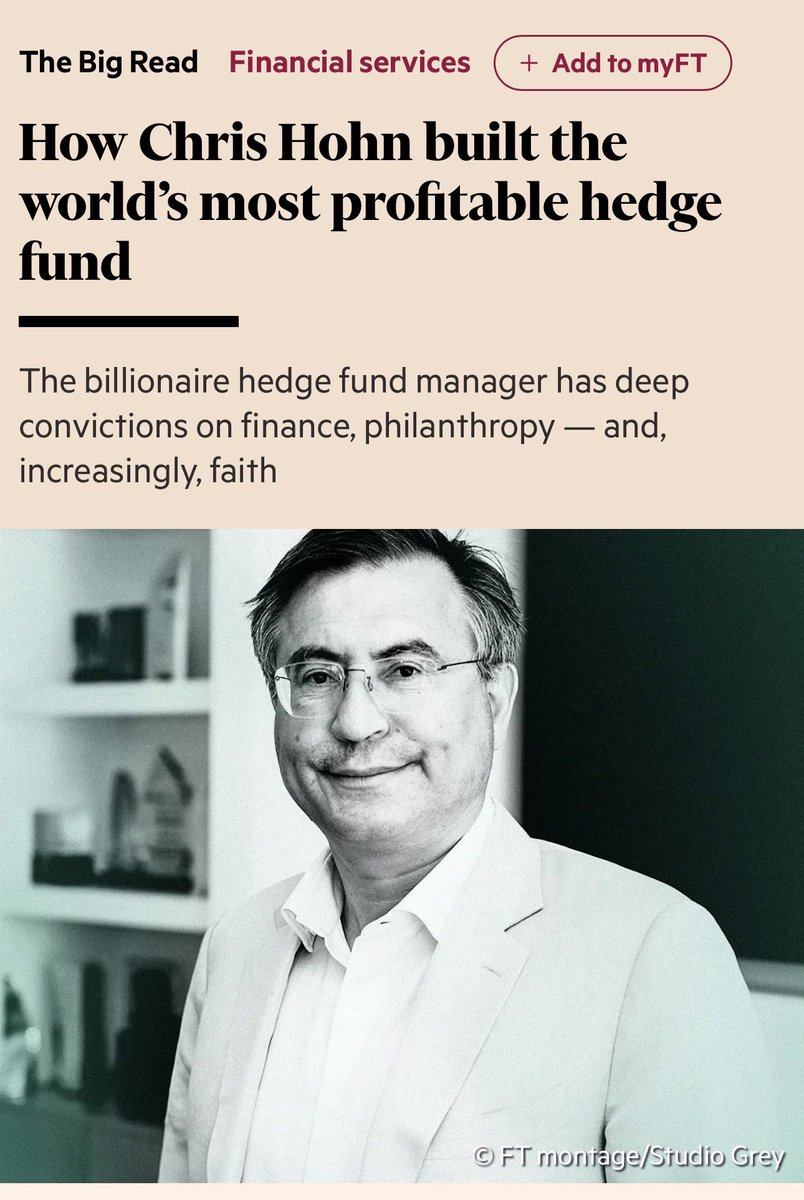
Chris Hohn did a 90-minute sit-down with Nicolai Tangen and then dropped an investor letter the FT got hold of last week.
You’d think the guy who printed a record $18.9B last year would be doing victory laps. Instead he’s quietly rewiring his whole portfolio.
My favorite takes from both:
1.The most important thing in investing isn’t growth. It’s barriers to entry. Growth without a moat is the airline industry: 5% volume growth for 100 years and basically zero cumulative profit.
2.There are only about 200 companies on earth he considers high-quality and investable. His fund holds 15.
3.Average holding period: 8 years. Some positions 13. “You have to hold the company forever, because the stock market may be at very bad prices when you want to sell.”
4.His real test for a moat: can the company price above inflation? A 20% margin business that prices 1% above inflation grows profits 5% faster than revenue. Forever. Almost no companies can do this.
5. Industries he won’t touch: banks, autos, retail, insurance, tobacco, asset managers, fossil fuel utilities, airlines, wireless telecom, media, advertising. On banks: “sooner or later someone without a lot of intelligence comes to run them, and then it can be toxic.”
6.On AI generally: call centers go bankrupt. Indian outsourcing coders are next. But for everyone else, AI lowers costs and raises productivity. Companies with real moats become MORE valuable.
7. Here’s the punchline. The FT got hold of his investor letter. He cut his Microsoft stake from 10% of the fund to 1%. Roughly $8B sold. He’d held it since 2017 through a 400% rally. His reason: AI could disrupt Office and Azure faster than the market thinks.
8.He moved that capital into Alphabet. Doubled it from 3% to 5%. Now his largest tech position. The world’s best quality investor sold Microsoft and bought Google because he thinks Google’s moat is more durable in an AI world. Not the consensus trade.
9.The underlying thesis: “AI eats software.” If AI agents do the work humans used to pay per-seat SaaS licenses for, the whole SaaS model gets re-rated. Oracle, Adobe, Salesforce all ~40% off highs. Microsoft 25% off. Market is starting to agree.
10.When to sell? Not when something gets expensive. When conviction drops. Valuation is one variable, conviction is the other. What kills you isn’t being wrong, it’s permanent loss of capital.
11.He admits hardcore activism doesn’t work anymore. Too much of the shareholder base is passive index funds. And even when activism wins, you usually win in a bad business. “The business always wins.”
12.Counterintuitive take: there are more good companies in public markets than in private equity. The best businesses are too big for PE to buy. And when public companies sell something to PE, they’re selling the assets they want to get rid of.
13.On intuition: “thinking without thinking.” Pattern recognition from 20 years of reps. It’s how he sniffed out Wirecard while the German establishment was defending it. “Most investors trust authority too much.”
14.He basically stopped shorting. “You’re going to be eventually right but not be able to fund the losses.” The first guy to short Wirecard had to cover 19 years before it hit zero. Buffett told him he and Charlie studied shorting and concluded it was too hard.
15.He gives almost everything away. ~$500M a year. $10 prevents an unwanted pregnancy in Africa. $40 saves a child from severe malnutrition. $50 prevents permanent blindness.
16.Tangen asks: advice to young people? Hohn, who runs the world’s most profitable hedge fund: “Go on a spiritual path.” The guy who made $18.9B last year ends the interview saying only purpose and meaning matter.
The headline: the world’s best quality investor just sold his biggest tech compounder because he thinks AI is breaking the moat. Quietly, with conviction, on an 8-year horizon, while everyone else is still buying the AI winners of 2023.
Jane Street's head of technology just explained the full spectrum of how fast their trading decisions are made.
the fastest systems turn around a packet in under 100 nanoseconds. at that speed, if you attached an oscilloscope to the wire going in and the wire going out, you'd see the response start to leave before the incoming packet has finished arriving.
at that speed, you can't use a CPU. you can't use any programming language. you're on an FPGA direct wired to the network. and the decisions you're making are incredibly simple. because you literally can't compute anything complex in that time.
but here's the part most people miss: that's just one end of the spectrum.
Jane Street runs an ensemble of systems operating at every timescale simultaneously. some decisions happen in nanoseconds. some in microseconds. some in milliseconds. some take hours or a full day.
"the right way to build an optimal trading strategy is an ensemble approach. for some decisions you're making very simple decisions very quickly. for others, you're operating at the scale of microseconds, milliseconds. and in some cases, if you can get that decision turned around in an hour, that's totally fine."
the faster you need to respond, the simpler the decision has to be. the slower you can afford to go, the smarter the model can be.
this is why "Jane Street is just a speed game" is wrong. speed is one dimension. intelligence is the other.
@captgouda24 The prostitute comment is quite apt. God made men differ in strength, but Sam Colt made them equal. Likewise, God made men differ in intelligence, but Sam Altman made them equal. We’re now competing on beauty. The concern is not if scaling has hit a wall. It’s if you have.
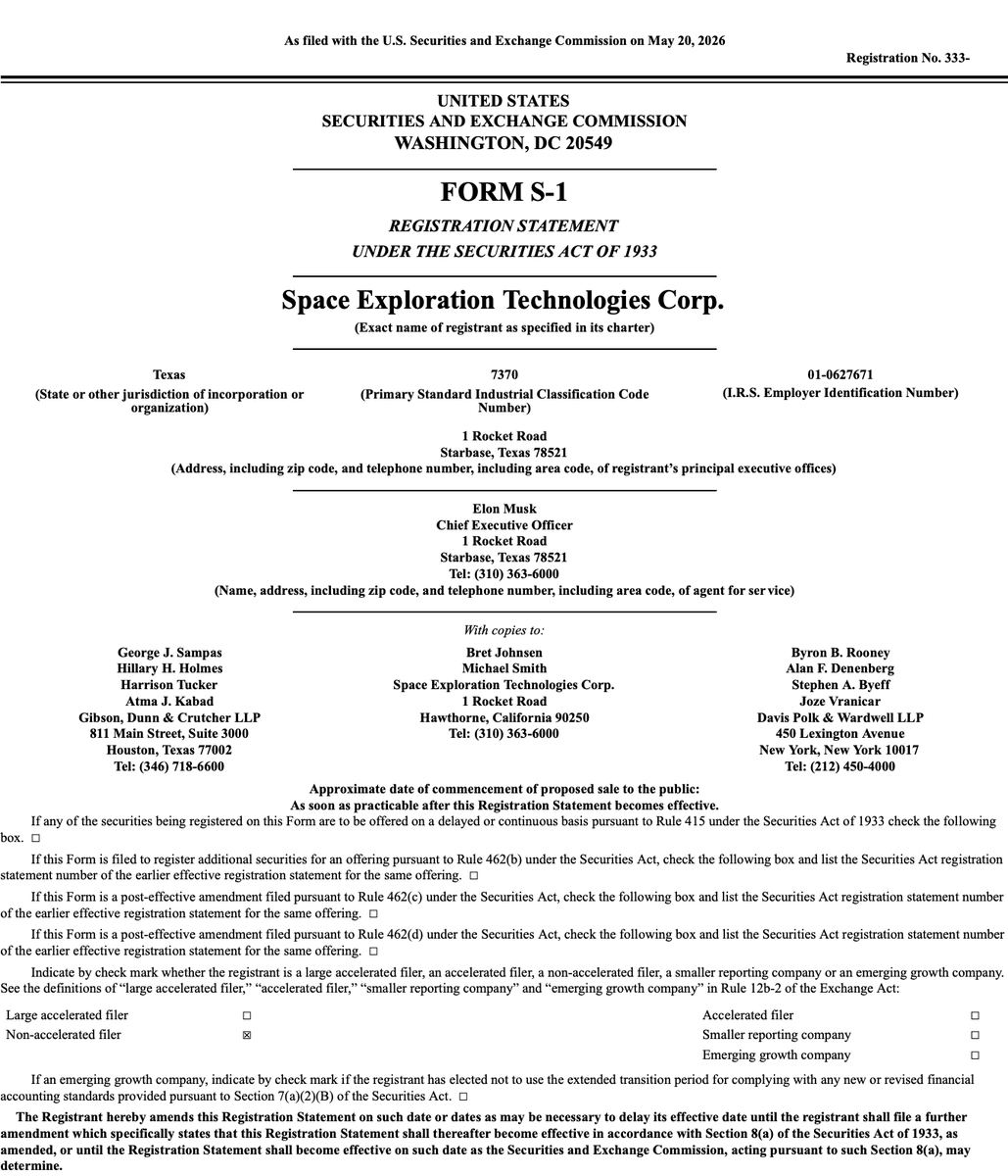
$SPCX Highlights of $1.75 trillion company:
-- 2025 sales $18.7 bn
-- 2025 operating loss $2.6 bn
-- 1Q26 sales $4.7 bn
-- 1Q26 operating loss $1.9 bn
You are cordially invited to take out 2nd mortgage and buy on margin at 93x 2025 sales.
S-1 filing: https://t.co/lczJvzf9oZ
⚡️San Francisco is experiencing the first psychological shockwave of the intelligence gold rush.
This is what happens when a city built around meritocratic striving suddenly realizes the old ladder has been bypassed by a new wealth machine. The old Valley bargain was brutal but legible: be smart, work hard, join the right company, climb, vest, network, maybe found something, maybe win. AI just compressed that timeline into a lottery where a small cohort arrived at generational wealth almost overnight while everyone nearby remained close enough to smell it and far enough to feel excluded.
That creates a very specific kind of torment.
People are not merely jealous. They are disoriented because the map of effort to reward broke. A good engineer making $300K or $500K used to feel elite. Now that person can look across the street and see someone with similar age, similar background, similar intelligence, and similar social circle sitting on $20M to $100M because they joined the right lab at the right moment. That destroys the emotional value of a “good job.”
The corporate ladder starts looking like a trap because the payoff has been visually invalidated. Why climb for twenty years when the new wealth event happened in two? Why optimize performance reviews when the real prize was getting close to the model frontier before the equity repriced? Why tolerate bureaucracy when the people who escaped into the right cap table are now post-economic?
That is the psychological rupture.
AI is not just automating jobs. It is automating the prestige structure that justified those jobs. Software engineers used to sit near the top of the cognitive labor hierarchy. Now they are watching code become cheaper, agents become stronger, junior work get compressed, middle management thin out, and capital flow toward a narrow set of model companies, chip companies, infrastructure platforms, and founders who can ride the wave directly. The skill that made them feel protected is becoming a tool inside the machine.
That is why the malaise is so deep. The fear is not merely “will there be layoffs?” The fear is “was the whole identity trade wrong?” People sacrificed location, lifestyle, relationships, creativity, and youth for the promise that proximity to tech meant proximity to upside. Now the upside has become hyper-concentrated, and proximity alone is not enough.
The middle managers are in the worst psychological position. They are too senior to become young founders easily, too encumbered to gamble recklessly, too nontechnical in the new agentic sense to feel frontier-relevant, and too expensive to feel safe. They know the coordination layer is getting attacked. AI reduces the need for people whose main function was translating, reporting, aligning, and supervising. The middle of the org chart was always vulnerable once the machine could summarize, route, draft, monitor, and coordinate.
The rich being unhappy also fits the structure. Sudden wealth solves financial fear, then exposes metaphysical emptiness. Money removes the old mission. Status becomes the substitute. That is why post-economic founders keep building companies “just cuz.” They do not need the money. They need the field to keep reflecting significance back to them. Selling the company means losing the live arena where everyone wants access. They are not trapped by poverty. They are trapped by relevance addiction.
That line from the founder is the whole Valley in miniature: “If I sell, I will only have money.”
That is devastating because it reveals that money was never the final object. The real object was attention, centrality, momentum, being inside history while it is happening. In San Francisco, wealth without narrative can feel like exile.
The city teaches people to confuse being wanted by the future with being alive.