This is f*cking gold..
A RULE WON 11 OF 15 TRADES AND TURNED $10,000 INTO $10,770. ONE BUY DID SOMETHING ELSE.
it's vn. py, 46k stars, the open-source quant platform out of china.
five years on amd, and the rule does one thing: buy the dip, sell the bounce.
it was right 11 times.
it paid 2.90% in fees to be right.
and its drawdown still hit -57%.
honestly a 73% win rate looks great in a screenshot. the final balance doesn't care.
that one buy is on screen in the clip.
STOP BABYSITTING F*CKING EVERY TURN
Anthropic just dropped the cleanest /goal loop in Claude Code.
Opus 5.5 runs in auto mode and plans + edits completely unattended.
Fable 5.1 sits as the evaluator and only wakes up after each turn to check if the goal is actually met.
Sonnet 5.5 dispatches three subagents in the background:
→ worker reads the test harness and patches
→ explorer maps token call sites and AST
→ verifier runs pytest and lint
JEV sits underneath and resolves 1,700+ micro-forks in under 16ms (which file, which tool, retry or pause) before anything reaches the main session.
Fable never writes code.
It just reads the full transcript after every turn and says “token signature expired” or “CORS header missing Origin.”
Opus applies the guidance on the next turn.
18/18 tests pass.
Lint clean.
Goal achieved.
You launch it like this:
claude --auto-mode "/goal all tests in test/auth pass and lint is clean"
The full tree
> Opus 5.5 auto mode plans + edits unattended
> JEV 16ms fork layer resolves deterministic micro-forks
> Sonnet 5.5 subagent dispatcher runs worker / explorer / verifier
> Fable 5.1 evaluator checks after every turn
> proves the condition in the conversation transcript
> zero tool calls made, Fable never edits code
Paste the tree + this prompt into Claude Code ↓
Rebuild my Claude Code setup around this tree:
Run the main session on Opus 5.5 in auto mode with effort high.
Use /goal to remove per-turn prompts.
Dispatch background work to Sonnet 5.5 subagents (worker, explorer, verifier).
Route deterministic forks (which file, which tool, retry or pause) through JEV at 16ms.
Keep Fable 5.1 as the evaluator. It checks after each turn, reads the session transcript, and gives the reason for the next turn.
Fable never edits code. It only evaluates whether acceptance criteria hold.
Stop when the goal is met or an unachievable goal is caught.
Show me every change as a diff first. No edits until I say go.
save it, it’ll come in handy.
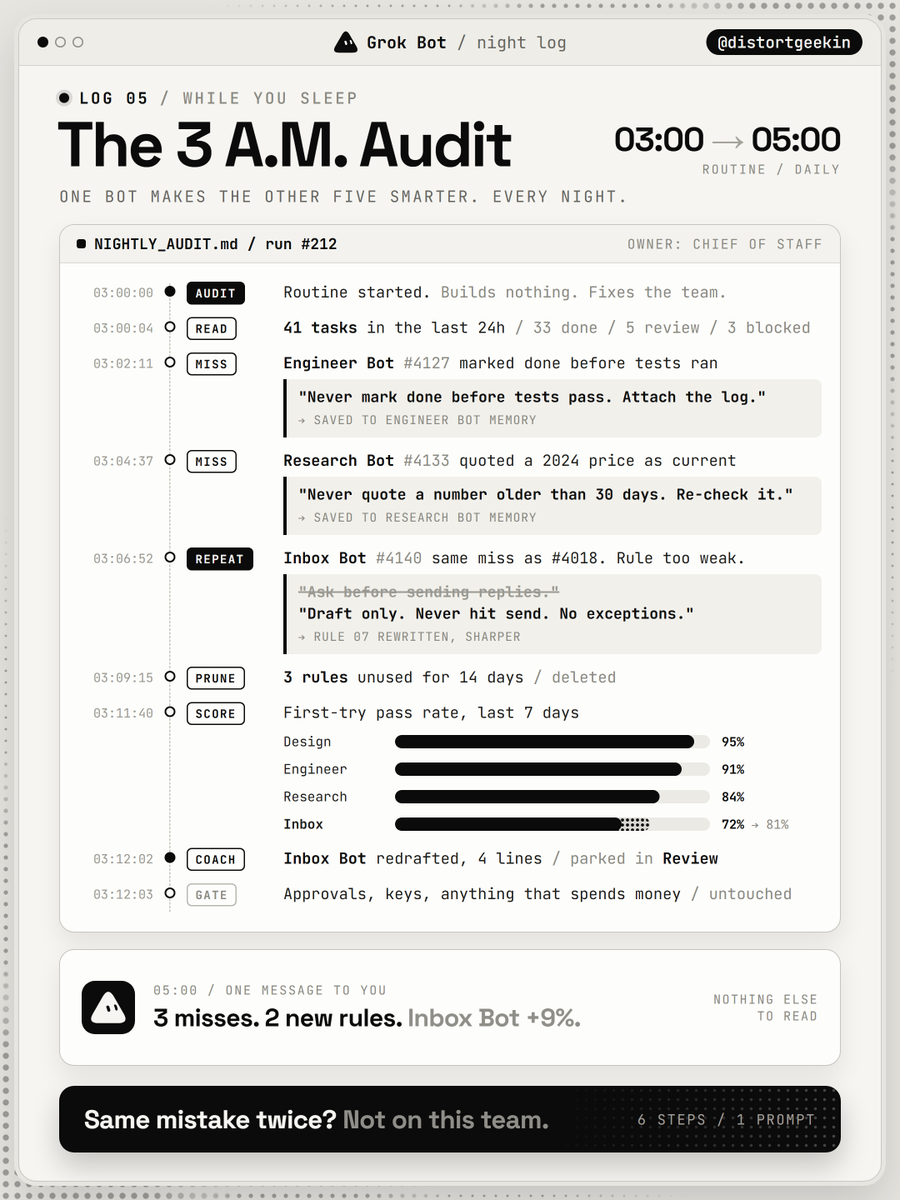
SpaceXAI engineer, Lingxi Li:
"My Grok Bots run 200+ agents. Not one of them has made the same mistake twice.
At 3 a.m. one bot audits the other five. I wake up to a smarter team"
I turned her 3 a.m. audit into one prompt you can paste tonight
Mistake → Rule → Memory → Instructions → Self-Improving Team
Most people re-explain the same fix to their bot every single week
Worth more than most $1,000 agent engineering courses
Bookmark it and set it to run at 3 a.m. tonight
Then read the full guide on building a team of Grok Bots below ↓
i gave Grok Bot 128 documents and told it one thing
don’t summarize them
then 2,774 nodes became 10,199 links, the raw files stayed untouched, and the bot started building a second brain around me while i was doing other work
that’s what this video is showing
sources stay locked
new facts get pulled into separate pages
projects connect to research
decisions connect to context
people connect to conversations
and every useful relationship gets written back into the graph instead of dying inside one chat
the part i care about most is that nothing has to “remember everything”
the system only needs to know where the truth already lives
by the end, 128 documents weren’t 128 documents anymore
they were a knowledge engine i could keep adding to without rebuilding the context from zero
i used to think AI memory meant giving a model a bigger context window
now i think the better version is making sure useful knowledge has somewhere permanent to go