The two hottest topics in AI right now are RAG and Agents.
Every top company in the AI community is laser-focused on making AI Agents a reality.
I'm working on a couple of YouTube videos to teach you how Agents work and how to build one. In the meantime, let me show you this:
@langflow_ai is an open-source visual framework for building RAG applications and agentic workflows.
It's super-popular, with over 15k stars on GitHub:
https://t.co/F91niosr8x
What's cool about LangFlow is that anyone can use it to build langchain-based applications:
• Visual interface
• Drag-and-drop
• Reusable components
You can write all the code you want, but a visual interface with predefined components will save you a ton of time.
Something cool:
@DataStax just acquired LangFlow. They'll be backing the tool financially to speed up innovation.
By the end of the year, developing AI applications will be 100x better than today.
𝐀𝐳𝐮𝐫𝐞 𝐎𝐩𝐞𝐧𝐀𝐈 𝐋𝐞𝐚𝐫𝐧𝐢𝐧𝐠 𝐑𝐞𝐬𝐨𝐮𝐫𝐜𝐞𝐬
#AzureTips#OpenAI 👋 Hey everyone, I wanted to share some exciting resources related to Azure OpenAI that I came across recently. If you're interested in learning about Azure OpenAI Service and Azure OpenAI Studio, then this post is a great place to start.
🔷 Azure OpenAI in a Day Workshop
In this technical workshop, you will get a comprehensive introduction to Azure OpenAI Service and Azure OpenAI Studio.
https://t.co/MbUzlKC9oP
🔷 Azure OpenAI Service Deep-Dive Workshop.pdf
https://t.co/LR5MRX6YLx
🔷 Azure OpenAI Workshop
Using Azure OpenAI like a Pro to build powerful AI applications
https://t.co/ldKR4AnHnR
🔷 Azure OpenAI Samples
This repository contains resources to help you understand how to use GPT offered by Azure OpenAI at the fundamental level, explore sample end-to-end solutions, and learn about various use cases.
https://t.co/KYQferkGsO
🔷 Customer Service Conversational Insights with Azure OpenAI
The Customer Service Conversational Insights is a solution accelerator built on top of Azure Cognitive Search, Bot Framework, Azure Speech Services, and Azure OpenAI.
https://t.co/njqbLotBuO
🔷 Knowledge Mining with Azure OpenAI
The purpose of this repo is to accelerate the deployment of a Python-based Knowledge Mining solution with OpenAI.
https://t.co/zryA9fNQ5g
🔷 Visual ChatGPT
TaskMatrix connects ChatGPT and a series of Visual Foundation Models to enable sending and receiving images during chatting.
https://t.co/OdNmEnR0bo
🔷 Azure OpenAI Embeddings QnA
This repo uses Azure OpenAI Service for creating embedding vectors from documents.
https://t.co/6FDpG1ZZWl
🔷 Azure OpenAI Accelerators and Demo Assets
https://t.co/SW3YIQREIs
🔷 Business Process Automation Accelerator
This accelerator provides a no-code Studio for users to quickly build complex, multi-stage AI pipelines across multiple Azure AI and ML Services.
https://t.co/OliS7VIHVO
🔷 ChatGPT + Enterprise data with Azure OpenAI and Cognitive Search
This sample demonstrates a few approaches for creating ChatGPT-like experiences over your own data using the Retrieval Augmented Generation pattern. It uses Azure OpenAI Service to access the ChatGPT model (gpt-35-turbo), and Azure Cognitive Search for data indexing and retrieval.
https://t.co/IfGiiWosW0
🔷 Accelerator powered by Azure Cognitive Search + Azure OpenAI
Your organization needs a search engine that can make sense of all kinds of types of data, stored in different locations, and that can return the links of similar documents, but more importantly, provide the answer to the question!
https://t.co/wIV5qKpVur
🔷 What's new in Azure OpenAI Service
https://t.co/nsr7XprieR
I hope you find these resources helpful, and they inspire you to explore the possibilities of Azure OpenAI further. Happy learning! 🚀
🎯 Follow me: @chen_jd
#azure #ai #business #automation #ml
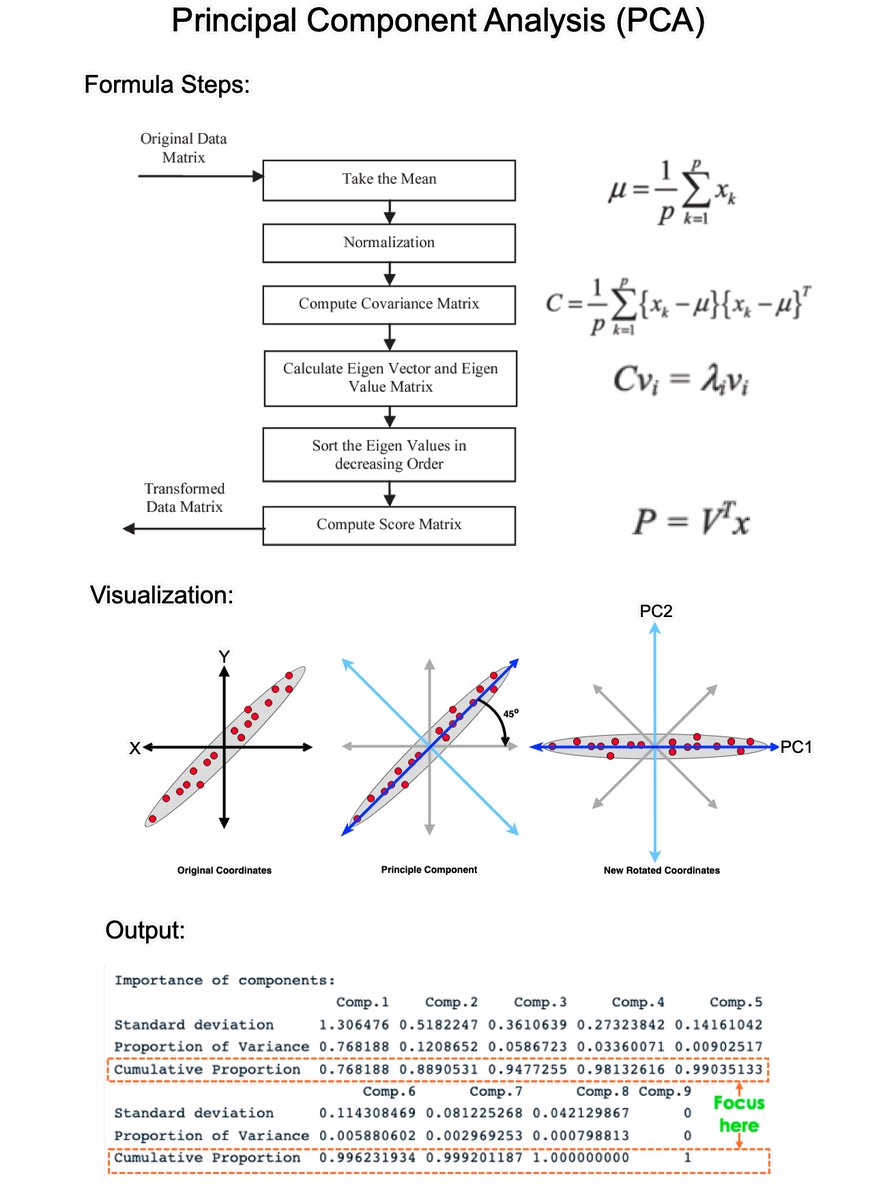
Principal Component Analysis (PCA) is the gold standard in dimensionality reduction with uses in business. In 5 minutes, I'll teach you what took me 5 weeks. Let's go!
1. What is PCA?: PCA is a statistical technique used in data analysis, mainly for dimensionality reduction. It's beneficial when dealing with large datasets with many variables, and it helps simplify the data's complexity while retaining as much variability as possible.
2. How PCA Works: PCA has 5 steps; Standardization, Covariance Matrix Computation, Eigen Vector Calculation, Choosing Principal Components, and Transforming the data.
3. Standardization: The first step in PCA is to standardize the data. Since the scale of the data influences PCA, standardizing the data (giving it mean of 0 and variance of 1) ensures that the analysis is not biased towards variables with greater magnitude.
4. Covariance Matrix Computation: PCA looks at the variance and the covariance of the data. Variance is a measure of the variability of a single feature, and covariance is a measure of how much two features change together. The covariance matrix is a table where each element represents the covariance between two features.
5. Eigenvalue and Eigenvector Calculation: From the covariance matrix, eigenvalues and eigenvectors are calculated. Eigenvectors are the directions of the axes where there is the most variance (i.e., the principal components), and eigenvalues are coefficients attached to eigenvectors that give the amount of variance carried in each Principal Component.
6. Choosing Principal Components: The eigenvectors are sorted by their eigenvalues in descending order. This gives the components in order of significance. Here, you decide how many principal components to keep. This is often based on the cumulative explained variance ratio, which is the amount of variance explained by each of the selected components.
7. Transforming Data: Finally, the original data is projected onto the principal components (eigenvectors) to transform the data into a new space. This results in a new dataset where the variables are uncorrelated and where the first few variables retain most of the variability of the original data.
8. Evaluation: Each PCA component accounts for a certain amount of the total variance in a dataset. The cumulative proportion of variance explained is just the cumulative sum of each
===
PCA is a powerful tool. But, there’s a lot more to learning Data Science for Business.
I’d like to help.
I put together a free on-demand workshop that covers the 10 skills that helped me make the transition to Data Scientist: https://t.co/LR39RJ5XKB
And if you'd like to speed it up, I have a live workshop where I'll share how to use ChatGPT for Data Science: https://t.co/EaMpKrJiqX
If you like this post, please reshare ♻️ it so others can get value.
LoRA is a genius idea.
To understand the fine-tuning of Large Language Models, you must understand how LoRA works.
By the end of this post, you'll know everything important about how it works.
Large Language Models are good generalists, but they have little specialization. We train them in many different tasks, so they know a bit about everything but not enough about anything.
Think of a kid who can play three different sports at a high level. While he can be proficient across the board, he won't get a scholarship unless he specializes. That's how the kid can reach his full potential.
We can do the same with these large models. We can train them to solve a particular task and nothing else.
We call this process "fine-tuning." We start with everything the model knows and adjust its knowledge to help it improve on the task we care about.
Fine-tuning is revolutionary, but it's not free.
Fine-tuning a large model takes time, care, and lots of money. Many companies can't afford the process. Some can't pay for the hardware. Some can't hire people who know how to do it. Most companies can't do either.
That's where LoRA comes in.
We realized we could approximate a large matrix of parameters using the product of two smaller matrices. There was a lot of wasted space within these large models. What would happen if we find a new, more optimal representation?
Did you ever buy a map at a gas station? Giant pages showing every small road, path, and lake around you. They were exhaustive but hard to navigate. These are like parameters in a large model.
LoRA turns a gas station map into a cartoon treasure map. Every useless parameter is gone. Only two roads, a palm tree, and a cross pointing at the treasure. We don't need to fine-tune the entire model anymore. We can only focus on the small treasure map that LoRA gives us.
It's a mind-blowing trick.
We can train the small approximation matrices from LoRA instead of fine-tuning the entire model. LoRA is cheaper, faster, and uses less memory and storage space.
You can also merge the approximation matrices with the model during deployment time. They work like simple adapters. You load up the one you need to solve a problem and use a different one for the next task.
Then, we have QLoRA, which makes the process much more efficient by adding 4-bit quantization. QLoRA deserves its own separate post.
The team at @monsterapis has created an efficient no-code LoRA/QLoRA-powered LLM fine-tuner.
What they do is pretty smart:
They automatically configure your GPU environment and fine-tuning pipeline for your specific model. For example, if you want to fine-tune Mixtral 8x7B on a smaller GPU, they will automatically use QLoRA to keep your costs down and prevent memory issues.
The @monsterapis platform specializes in no-code LoRA-powered fine-tuning. It's the fastest and most affordable offering for fine-tuning models in the market. They sponsored me and gave me 10,000 free credits for anyone who uses the code "SANTIAGO" in their dashboard:
https://t.co/DBsB9EXgYR
If you want to read their latest updates, get free credits and special offers, join their Discord server: https://t.co/oecoxEec14
TL;DR:
• Traditional fine-tuning trains the entire model. It requires a complex setup, higher memory, and expensive hardware.
• LoRA: Trains a small portion of the model. It's faster, requires much less memory, and affordable hardware.
• QLoRA: Much more efficient than LoRA, but it requires a more complex setup.
• No-code fine-tuning with LoRA/QLoRA: The best of both worlds. Low cost and easy setup.
It's only been 1 day of CES 2024, and the tech developments have been incredible.
The 10 most impressive reveals of CES 2024 so far:
1. The world's first transparent MICROLED screen by Samsung