This statue is at the Stalag Luft III Prisoner Camp Museum in Zagan. The prisoner camp was the inspiration for the movie 'The Great Escape'.
#NeverForget
Dear Shareholders.
If the Executives and/or Directors of a company, in which you have invested, are "investing" in AI-driven management solutions.
Sell you shares. Get out now. These are people who don't want to work .
That company will very soon be over.
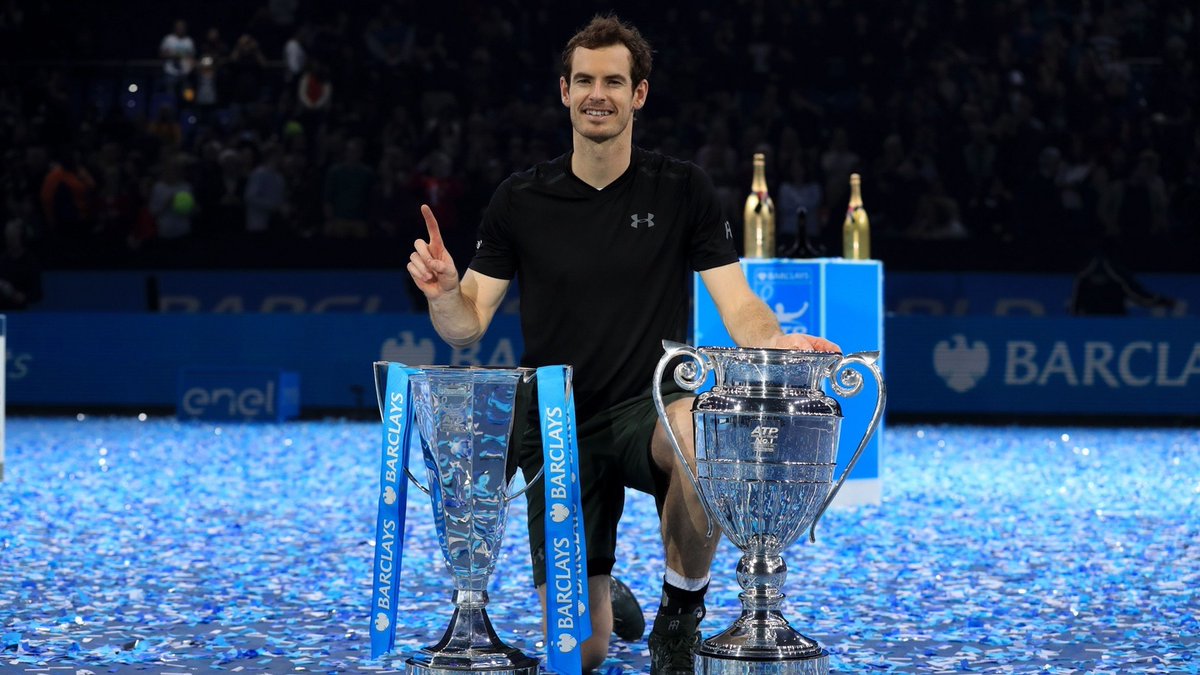
Should Murray's 2016 be spoken about more? I think so.
2016 was the only season within the 2010s in which a player outside the Big 3 finished the year as World Number 1.
But the way Murray achieved the Number 1 ranking was remarkable. He lost the Roland Garros final to Djokovic, which meant that Djokovic was now holding all 4 Slams at once. The Serbian had accumulated the highest ranking points total ever - 16,950.
Even then, Murray would have to do something crazy to eclipse him. And that's exactly what he did
He won Wimbledon, his first Slam title in 3 seasons. And then, his 2nd Olympics, a feat that has still not been replicated in the men's tour.
The true craziness started after the US Open though... he won 10 straight matches to win the Beijing and Shanghai titles, reducing the difference between him and Djokovic from 4,695 to 2,415 points.
The next tournaments? Vienna and Paris. He won both, taking his win streak to 19. Djokovic lost in the quarters in Paris, so Murray making it to the final instantly made him the new World No1. A gigantic gap overtaken in just a few months.
But in the final tournament of the season, the Tour Finals, Djokovic had the chance to take it back. They faced each other in the final, in a match to decide who would end the year as No1.
He won in straight sets. 6-3, 6-4. His win streak up to 24. And with it, the Year End No1 Title.
One of the most remarkable ends to a season in recent times... Sir Andy Murray 👑
@MichaelT1992_@alexmassie He is using this to go after Farage and Reform, as he knows they are the party to fight at them next election. I think this is the wrong battlefield for him to choose. A party is rarely elected on a foreign affairs policy. This is hubris and arrogance, IMO, kinda like Cameron
@MichaelT1992_@alexmassie Whatever mate. Lots of revisionism in that statement. I ask you this question. Do you think Burnham is onto a winner seeking to re-open this topic in the national discourse?
To the "anti-imperialists" in the back.
1. russia doesn't want peace
2. It was always about conquest and expansion
3. NATO did not "provoke" russia
4. You are all idiots
The Russians have completely lost their f**king minds
Medinsky had barely left the negotiating room when he declared that every inch of Russian land would be reclaimed — “one way or another”.
The masks are off. The occupiers didn't even bother to put on a vaguely respectable face. They turned up in Abu Dhabi with their hatred, their vile behaviour and their fear of the Kremlin maniac.
@malcolm_reavell@GarethDavies_MP To be fair, Burnham should wait until they go bankrupt, and buy them for £1. The govenment should not be enriching those who failed.
We don't even need to look far to challenge the NATO security narrative. We just need Vladimir Putin's own words.
In 2000, Putin said he found it hard to see NATO as an enemy. In 2001, he explicitly stated that Russia did not consider NATO a threatening organization.
In 2002, he acknowledged that Ukraine's relationship with NATO was a matter for Ukraine and NATO to decide.
And in 2005, after the Baltic states had already joined NATO in 2004, bringing the alliance directly to Russia's borders, Putin said that former Soviet republics had the sovereign right to determine their own defense policies and that Russia would respect their choices.
So Putin himself acknowledged NATO wasn't inherently a threat and that neighboring countries had the right to choose their alliances. He did not treat it as justification for invading sovereign states.
Robert Burns died in July 1796, aged 37, three days after coming home from the cure his doctor had recommended for a failing heart: standing up to his armpits in the cold sea of the Solway Firth every day, and riding a horse.
Scotland's national poet had been ill on and off for years, with fevers, aching joints and a pounding heart. In the spring of 1796 it got worse. His doctor and friend William Maxwell, who was said to have dipped his handkerchief in the blood of Louis XVI at the guillotine, diagnosed what Burns called flying gout and prescribed what medicine prescribed for it: country air, horse riding, port wine and sea bathing.
So at the start of July Burns rode the ten miles from Dumfries to Brow, a hamlet on the Solway with a mineral spring. Every day he drank the iron-tasting water from a cup chained to the well, then waded out into the firth up to his armpits and stood there. He wrote to his wife that the bathing had eased his pains. A friend who visited him there wrote that the stamp of death was already on his face.
He came back to Dumfries on 18 July too weak to stand. Maxwell told a friend he had no hope left. Burns died on the morning of 21 July. On the day of his funeral his wife Jean gave birth to their last son. They named him Maxwell, after the doctor.
The physicians who have since gone through his symptoms think he had rheumatic heart disease, a damaged valve left by rheumatic fever in a childhood of hard labour on poor farms, possibly with a fatal infection of the heart lining on top. A heart in that condition is the last thing on earth to put into the Irish Sea every morning.
For nearly two hundred years he was remembered instead as a man who drank himself to death. His first biographer, James Currie, a physician and a temperance man, told it that way and it stuck. A doctor who had been a boy in Dumfries when Burns died put it better a lifetime later. Burns, he said, died the doctor's martyr.
Scotland raises a glass to him every January, with the whisky and the haggis.
It should raise one to the cure as well. It did more to finish him than the drink ever did.
1
£711 A MONTH TO KEEP MY GRANDDAUGHTER SAFE AND THEY CALL THIS AN ENERGY RICH COUNTRY?
By Allan Petrie
Scotland has the energy, Scotland has the resources, so why are Scottish families being forced to pay such an extortionate price just to live?
I've been involved in politics long enough to know when something is wrong, I've seen poverty, I've seen injustice and I've seen governments of every political colour make promises that somehow never quite reach the people who need them most but there are times when something comes along that makes even me stop and stare in disbelief.
My latest monthly energy bill was £711.
Seven hundred and eleven pounds, for one month, not for the quarter, not a year for one months and before somebody sitting comfortably behind a desk starts lecturing me about turning down the thermostat, switching off lights or buying a more efficient kettle, let me explain something, I am not running a bloody factory, I am keeping my granddaughter safe.
My granddaughter Megan has FOXG1 syndrome, a rare and profoundly disabling neurological condition, she cannot walk, she cannot talk, she depends entirely on other people for her care and that care depends on electricity.
In our home we have:
• Two electric hoists.
• Two feeding pumps.
• A suction machine to help keep her airway clear.
• An electrically operated shower plinth.
• An electric hospital bed.
• An oxygen saturation monitoring machine used throughout the night.
All this equipment needs to be kept charged, powered or ready for use, day and night, alongside the normal electricity and gas needed to run a family home, this isn't luxury living or extravagance, this isn't somebody leaving the television on in an empty room, IT IS THE COST OF KEEPING A VULNERABLE CHILD SAFE IN HER OWN HOME.
Apparently, in modern Scotland, that's a financial burden families like mine are simply expected to shoulder, well, I'm not prepared to accept that, not for Megan and not for the thousands of disabled people and unpaid carers facing similar pressures and certainly not in a country blessed with the natural energy resources Scotland possesses.
THE GREAT SCOTTISH ENERGY CONTRADICTION
Scotland a country with enormous renewable energy potential, wind sweeping across our hills and coastlines, hydro schemes generating electricity from our rivers and lochs, oil and gas resources that have contributed enormously to the British economy for decades.
We have the natural resources, the engineering talent and the expertise, yet families are opening their energy bills with a sense of dread, pensioners worry about heating their homes, parents worry about feeding their children, disabled people worry about the cost of operating essential equipment and unpaid carers, already saving the public purse enormous sums through the care they provide, find themselves paying extortionate amounts for the privilege of doing so.
What kind of society allows the people providing some of its most essential care to be financially punished for it?
Now, I know perfectly well that producing electricity and delivering it to people's homes are not the same thing, there are generation costs, transmission costs, distribution networks, market arrangements and investment requirements but that is precisely why we should be asking who controls those arrangements, who benefits from them and whose interests come first because having abundant energy resources means very little to ordinary Scots if they have no meaningful control over how those resources are managed.
The fundamental issue is one of power.
Not simply electrical power but also Political Power.
The Scottish Parliament has important responsibilities but the main regulation of Great Britain's electricity and gas markets remains reserved to Westminster.