$CNX | @crynuxio might be one of the more overlooked projects in the decentralized AI sector.
55 million tasks completed during testnet.
1,785 participating nodes.
A working AI chat and image-generation application.
And 71% of $CNX supply allocated to task mining tied to network usage.
Here’s why I’ve been paying attention 🔽
1️⃣ Turning idle GPUs into productive infrastructure
There are millions of GPUs sitting inside gaming PCs and other computers around the world.
Many of them remain underutilized for significant portions of the day.
Crynux is building a decentralized network that allows GPU owners to contribute their computing resources to AI workloads.
Instead of relying entirely on centralized infrastructure providers, developers can access computational power supplied by independent operators.
The arrangement is straightforward:
→ GPU owners contribute computing power.
→ Developers use that power to run AI applications.
→ Operators earn $CNX for completing tasks.
The interesting part is that a computer in one part of the world can process an AI request originating from an application thousands of kilometres away.
And the network handles the coordination.
2️⃣ But does decentralized AI actually work?
This was the question I wanted answered.
A decentralized computing network sounds promising in theory, but the real test is whether it can deliver something people can actually use.
That’s where Crynux Chat comes in.
It’s a working AI application powered by the Crynux network, with a free demo that anyone can explore.
You can interact with AI models, ask questions, generate content, and even create images.
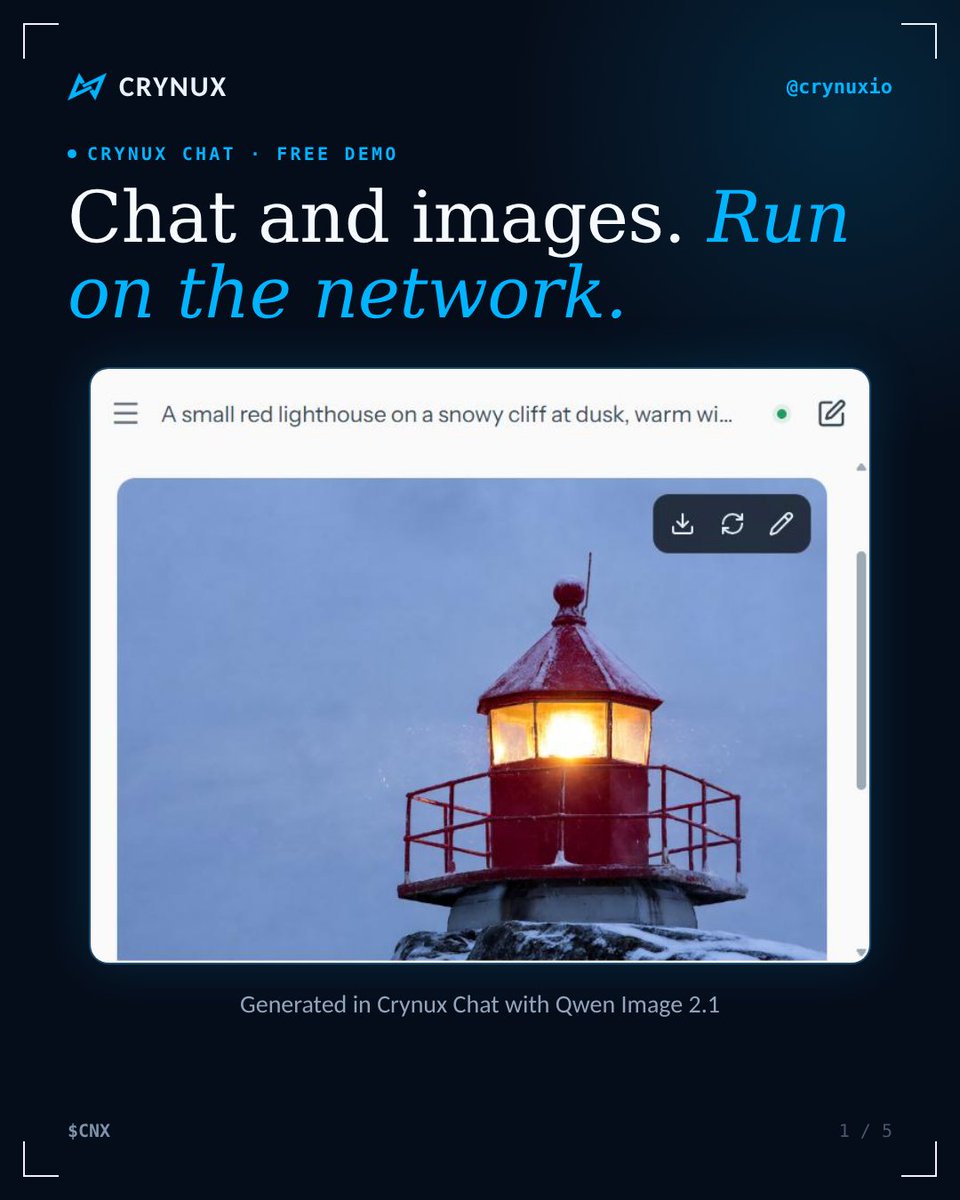
For example, one of the demonstrations involves generating an image of a small red lighthouse on a snowy cliff at dusk.
Here’s what happens behind the scenes.
When you submit the prompt:
→ Crynux-AS submits the task to the network.
→ The blockchain assigns an available GPU node.
→ The node receives the task through a relay and runs the AI model.
→ The network performs the required validation.
→ The generated image returns to your chat.
And you can actually follow the progress.
The interface shows the different stages: In Queue, Generating, Verifying, Uploading, and Finishing.
The example uses Qwen Image 2.1, with the actual computation performed by a GPU node participating in the network.
It’s a simple demonstration, but it makes the underlying technology much easier to understand.
3️⃣ Solving the trust problem
Now comes one of the more interesting technical challenges.
If anyone can contribute hardware, how does the network know that operators are completing tasks correctly?
After all, decentralized infrastructure can’t simply assume every participant is honest.
Crynux addresses this through its verification system, vssML.
Rather than duplicating every computation, the network uses unpredictable checks.
Approximately 10% of tasks are selected for independent verification, with results compared across three nodes.
Operators don’t know beforehand which tasks will be checked.
And because they have $CNX at stake, submitting dishonest results carries financial consequences.
The objective is to make dishonest behaviour economically unattractive while avoiding the enormous cost of independently repeating every computation.
4️⃣ More than just AI chatbots
Crynux Chat is one application built on the network, but the potential use cases extend considerably further.
The infrastructure supports workloads involving:
→ AI chatbots and virtual assistants
→ Text generation, translation, and summarization
→ Code generation and debugging
→ AI image generation and editing
→ Model fine-tuning
→ LoRA training and customization
For developers, another important feature is compatibility with familiar AI development tools and request formats.
That means existing applications can potentially integrate Crynux without rebuilding their entire AI infrastructure.
And this is important because the easier it becomes for developers to access decentralized computing, the easier it becomes for the network to attract real workloads.
5️⃣ The $CNX economics are particularly interesting
This is one aspect I think deserves more attention.
71% of the maximum $CNX supply is allocated to task mining.
But unlike conventional token emission schedules, these allocations are linked to network demand and completed work.
In other words, the task-mining allocation isn’t simply released because another month has passed.
Actual network activity drives its distribution.
Why does this matter?
Because many crypto projects experience supply expansion regardless of whether their products attract meaningful adoption.
Crynux takes a different approach with its task-mining allocation.
Of course, this doesn’t eliminate dilution altogether. Other token allocations and circulating supply dynamics still matter.
But linking a substantial portion of token distribution to actual computational work creates an interesting relationship between network usage and token issuance.
It’s a model worth watching as adoption develops.
6️⃣ Where does Crynux stand today?
Crynux launched its mainnet in June 2026.
Before that, its testnet recorded:
→ 1,785 participating nodes
→ 55 million completed tasks
Those figures provide some early evidence of network activity, although sustained mainnet usage will ultimately be the more important measure.
There’s also a fairly accessible way for newcomers to explore the ecosystem.
Crynux Chat offers a free demo with a limited daily allowance.
Users can try AI conversations and image generation without immediately needing to purchase tokens.
Wallet connectivity is optional for users who want to access their own Crynux credits.
One important detail: conversations are stored locally in the browser, and GPU node operators may have access to the information necessary to process requests. Sensitive information should therefore never be submitted.
✦ My perspective
I’ve always been more interested in crypto projects that build technology people have a practical reason to use.
And decentralized AI computing is an area I believe deserves serious attention.
The demand for AI computation is real. The hardware needed to supply it already exists.
The opportunity lies in connecting those resources efficiently, making the computation reliable, and building an ecosystem that developers actually want to use.
That’s the opportunity Crynux is pursuing.
The next questions are whether the network can attract sustained developer demand, remain cost-competitive, and scale reliably.
Those are the metrics I’ll be paying attention to.
For now, @crynuxio is firmly on my radar.
And $CNX is one I’ll be watching closely.
ZEPHYR gives you a dollar nobody can freeze or trace.
▦ Private by default, built upon Monero foundations.
Better yet, those dollars work for you — with sustainable, competitive yield.
▦ +99% return in 24 months.
▦ Purely powered by PoW block rewards.
❯❯ It pays to be private_
zephyr-protocol:native
🛡 Security Incident Update: Recovery of Funds
We have an important update on the recovery of funds affected by the recent weak wallet seed incident.
This TXID (https://t.co/JAEGlCRguv) related to the drained funds that left Qubic Network during the incident are being returned on-chain to their originating address.