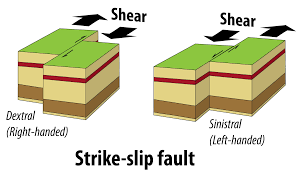
5) Oblique Fault - a fault that has a dip-slip component and a strike-slip movement component.
6) How did faults form?
Faults generally occur due to the brittle deformation in response to stress in the Earth's crust. This stress is driven by tectonic plate activity.
Faults:
1) Normal Faults - a fault in which the block above the fault has moved downward relative to the block below.
2) Reverse Faults - a fault in which the block above the fault moves up relative to the block below the fault.
3) Left lateral strike-slip fault - a fault on which the displacement of the far block is to the left when viewed from either side.
4) Right lateral strike-slip fault - a fault on which the displacement of the far block is to the right when viewed from the other side.
Register now by clicking the link below
Date: 4th June & 5th June 2022
Venue : Dewan Kuliah Geologi
Registration Link:
https://t.co/ynw2Koa0PR
Book your date now📌!! and The e-certificate will only be given to the participants who have registered and joined the event .
of time required for the annihilation of whole continents by so insensible a process.” The “ideas of sublimity” awakened by this “plan of such infinite extent,” as Lyell referred to it, inspired not only Hutton’s contemporaries, but generations of geologists to come.
English geologist Sir Charles Lyell, who was born the year Hutton died and whose influential book Principles of Geology won wide acceptance for the Theory of Uniformitarianism, wrote, “The imagination was first fatigued and overpowered by endeavouring to conceive the immensity-