Berthold Beitz watched SS soldiers throw Jewish babies out of orphanage windows.
August 7, 1942. Boryslaw, Poland. The SS was clearing out the Jewish orphanage.
Beitz was 28 years old. A young German oil executive. He had been warned by the local police. He went to see what was happening.
The SS were dragging children out of beds. Throwing infants out of upstairs windows. Loading them into trucks for the death camps.
Beitz stood there and watched. He had a small daughter at home. About the same age.
He went home that night and told his wife. He said: we have to do something.
By the end of the war, Berthold and Else Beitz had saved 800 lives.
Here's how he got there.
Born September 26, 1913. Zemmin, Pomerania. A small German village. Son of a banker.
Bert grew up in a normal middle-class German family. Some of his relatives liked the Nazis. He joined the Hitler Youth as a boy. Most German boys did.
He trained as a banker. Then in 1939, at age 25, he joined Royal Dutch Shell. The big oil company. Worked in their Hamburg office.
When the war started, Bert was in a special category. Oil experts were essential. He didn't get sent to the front.
In 1941, the Germans needed someone to run the oil fields in occupied Poland. Boryslaw. A small town in eastern Galicia. Today it's in Ukraine.
The oil fields there were important. Hitler needed oil to fuel his tanks. The German army needed every drop.
Bert was sent to Boryslaw in April 1941. Made business manager of the Beskidian Oil Company. Later renamed Carpathian Oil.
He brought his wife Else. Their baby daughter. They moved into a nice house in town.
Then he saw what was happening to the Jews of Boryslaw.
Boryslaw had been home to thousands of Jews for centuries. Many of them worked in the oil industry. Engineers. Chemists. Lab assistants. Office workers.
When the Germans arrived, the killings started. SS units. Ukrainian collaborators. Death squads.
Jews were rounded up. Shot in mass graves outside town. Or sent to camps.
Belzec death camp was nearby. Auschwitz was a few hours away.
Bert watched it happen.
Years later he tried to explain why he did what he did. He said it wasn't politics. He said it wasn't anti-Fascism.
He said: "When you see a woman with her child in her arms being shot, and you yourself have a child, then your response is bound to be completely different."
He started small.
The Carpathian Oil Company employed Jewish workers. They wore badges with the letter "R" on them. Standing for Rüstungsarbeiter. Armaments worker. Essential to the war.
These workers were officially protected. The SS couldn't take them. They were too valuable.
Bert started expanding the definition.
A Jew came to him. Said his brother was being deported tomorrow. Said his brother was a tailor.
Bert wrote out a paper. Said the brother was a "petroleum technician." Essential to the oil fields. Couldn't be touched.
Then a hairdresser. A "petroleum technician."
Then a Talmudic scholar. A "petroleum technician."
Years later, Bert remembered it: "I chose tailors, hairdressers, and Talmudic scholars and gave them all cards as 'petroleum technicians.'"
He didn't know any of them. Didn't ask. Just signed.
Then he started doing something more dangerous.
When the SS organized deportations, trains would arrive at the Boryslaw station. Jews would be loaded into cattle cars. Sent east to the camps.
Bert started showing up at the trains.
He would push past the SS guards. Walk into the cars. Shout that this man, that woman, that child, was an essential worker for his oil fields.
He needed them back. The German war effort needed them back.
The SS didn't always argue. Bert was a German civilian executive. He had powerful friends in Berlin. The oil mattered.
He pulled people off the trains. Sometimes one at a time. Sometimes in groups.
In 1945 alone, he and his team pulled about 220 Jews off deportation trains.
Else was doing more.
His wife was 22 when they moved to Boryslaw. Pregnant with their second daughter.
She turned their family home into a hiding place. The cellar. The attic. The spare rooms.
When Jewish parents knew they were going to be killed, they brought their children to Else. She hid them. Fed them. Kept them quiet when the SS came to visit.
Sometimes there were dozens of children in the house. Jewish children. The Beitz daughters grew up playing with them.
The SS visited often. Bert and Else would entertain officers in the dining room while Jewish children sat silent in the cellar below.
If the SS had checked the cellar, the whole family would have been killed. The children. Bert. Else. Their daughters.
The penalty for hiding Jews in occupied Poland was death.
They did it anyway.
In early 1943, the Gestapo finally came for him.
Two Jewish girls had been caught on a train to Hungary. They had forged work permits. The forged permits had Bert's signature on them.
Bert was called in for questioning. Faced the Gestapo.
He didn't crack. He said the permits were forgeries. Said he had no idea who had signed his name.
He had a story prepared. He had powerful supporters. The oil company needed him.
The Gestapo let him go. They warned him to be more careful.
Word spread among the Jews of Boryslaw. They knew what had happened. They knew what was at stake.
In March 1944, the war turned worse for Germany. Bert's protected status ended. He was drafted into the army at age 30.
He fought on the Eastern Front for the last year of the war.
His protection of the Jews of Boryslaw ended.
Most of the Jews he hadn't been able to save were killed.
But the 800 he had saved were still alive.
When the war ended, the survivors found him.
Letters poured in from Israel. From America. From across Europe. Jews who had been pulled off the trains. Children who had hidden in his cellar. Workers whose forged papers had said "petroleum technician."
They came to thank him.
Many of them sent testimonies to Yad Vashem. Israel's Holocaust memorial. They wanted Bert and Else honored.
In 1973, Yad Vashem named them Righteous Among the Nations. Israel's highest honor for non-Jews who saved Jewish lives.
Bert was 60 years old. He had spent 30 years rebuilding his career. He hadn't talked about Boryslaw much. He didn't think it deserved special attention.
He went to Jerusalem to receive the medal. He cried during the ceremony.
Here's what makes his story remarkable.
Bert Beitz didn't stay a small oil executive.
After the war, he came home to Germany. Found work in insurance. Then ran an insurance company in Hamburg.
In 1953, he met Alfried Krupp. The head of the Krupp steel empire. The most famous family business in Germany. They had armed the Nazi war machine.
Krupp had just been released from prison. Convicted of war crimes. Of using slave labor.
Krupp needed someone clean to rebuild his company. Someone with no Nazi past. Someone respected.
He hired Bert Beitz.
Bert spent the next 60 years running Krupp. Turning it into one of Germany's biggest companies. Building Krupp Steel into ThyssenKrupp.
He became one of the most powerful businessmen in Germany. Met with chancellors. Met with presidents. Met with Soviet leaders during the Cold War.
He once spent 21 hours straight in a meeting with Khrushchev. The Soviet premier. Talking about trade between East and West.
He helped Germany rebuild itself after Hitler.
He helped end the Cold War quietly. Behind the scenes.
He was a member of the International Olympic Committee. Vice-President from 1984 to 1988.
He never bragged about saving 800 Jews.
His grandson said it once. "He never spoke about it. We had to read about it in the papers."
When asked, late in life, why he had done it, Bert always said the same thing. "It wasn't heroism. It wasn't resistance. I was just a human being who saw what was happening."
Else Beitz survived him by a year. Died in 2014, age 94.
Their three daughters grew up. Had children. Have grandchildren.
The descendants of the 800 they saved number in the thousands today. Spread across Israel. America. Europe.
Many of them light a candle for the Beitz family every year.
In Germany, Bert is remembered as the last great industrialist. The man who rebuilt Krupp. The Cold War diplomat. The Olympic leader.
The 800 Jews he saved are barely mentioned in his German biographies.
In Israel, he's remembered the other way. The German who saved 800 lives.
Both versions are him. Same man. Same story.
He died on July 30, 2013. Two months before his 100th birthday.
He had gone to work every day until the end.
Berthold Beitz. German industrialist. Hitler Youth boy. Royal Dutch Shell executive.
Saw SS soldiers throw babies out of windows. Decided to fight back.
Forged papers for tailors and rabbis. Hid children in his cellar. Pulled Jews off deportation trains.
Saved 800 lives.
His crime? Refusing to look away.
His legacy? 800 families that lived. A medal in Jerusalem. A German empire he rebuilt. A grandson who only learned what he had done by reading the newspaper.
Some heroes shout about what they did.
Some never stop talking about it.
Bert Beitz lived 71 years after the war and barely mentioned it.
He thought saving 800 lives was just being human.
That's all it was.
That's everything./
@Dr_TheHistories No. The story of scorbut is much older and a good example that knowledge is beaten by examples.
First written evidence of fruits against scorbut in the British marine dates back to the 17th century, i. e. about 100 years earlier.
Don't distribute half knowledge.
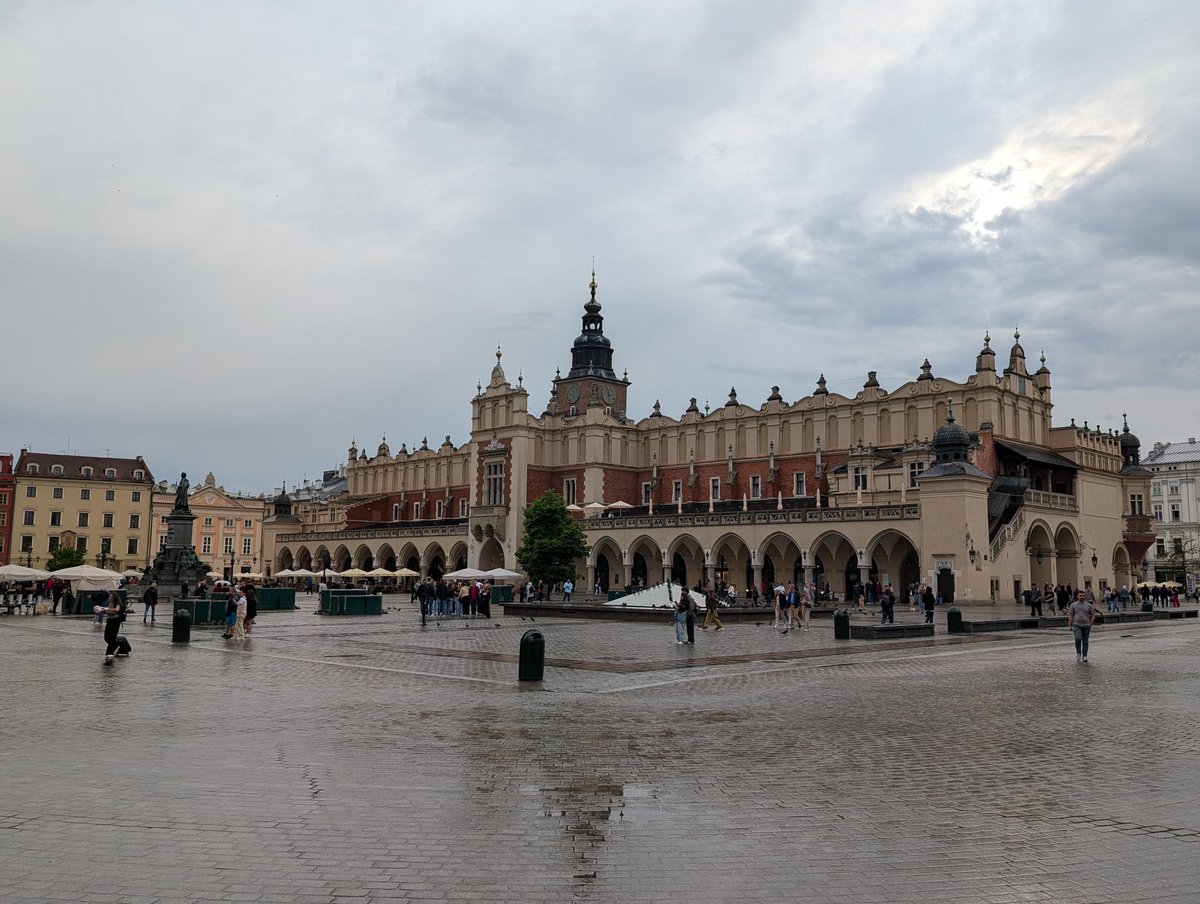
Alle Jahre wieder: Der absolzTop Kongress zur Inneren Medizin, mit den großen Ärzten der McMaster University, der Heimat der evidenzbasierten Medizin.
Und in einer der schönsten Städte Europas ❤️ #Krakow#medbubble
205 years ago today, Napoleon Bonaparte died on a tiny British prison island in the middle of the South Atlantic. He was 51. He had ruled most of Europe. And he changed the world so thoroughly that you are still living inside the systems he built.
Start with the obvious one. The Napoleonic Code. He commissioned it in 1800, sat in on the drafting sessions personally, argued with the lawyers, and pushed it through in four years. Equality before the law. Property rights. Religious freedom. The end of feudal privilege. It is still the basis of civil law in France, Belgium, the Netherlands, Italy, Spain, Portugal, most of Latin America, Quebec, Louisiana, and chunks of the Middle East and Africa. About a third of the planet writes contracts using rules a Corsican artillery officer wrote between battles.
He sold Louisiana to Thomas Jefferson in 1803 for 15 million dollars. Roughly four cents an acre. It doubled the size of the United States overnight. Without that deal there is no St. Louis, no New Orleans as an American city, no Lewis and Clark, no Manifest Destiny. The American century starts with Napoleon needing cash for a war.
He invaded Egypt in 1798 with an army and, weirdly, 167 scientists, mathematicians, and artists. They found the Rosetta Stone. That single slab is the reason we can read hieroglyphs at all. Egyptology as a field exists because Napoleon brought scholars to a war.
He built the Bank of France, which still runs French monetary policy. He created the lycée system that still educates French teenagers. He shoved the metric system across Europe at sword-point until it stuck. He emancipated the Jews of every territory he conquered, tearing down ghetto walls in Rome, Venice, Frankfurt. He abolished serfdom in Poland. He standardized road networks, civil registries, and tax codes that European governments still operate from.
And then there's the soldiering. He fought around 60 major battles and won most of them. Austerlitz, in 1805, against the combined Russian and Austrian empires, is still taught at West Point as one of the closest things to a tactically perfect battle ever fought. He was outnumbered, baited the enemy onto ground he had pre-selected, and broke them in a single afternoon. Three emperors took the field that morning. Only one walked off it on his own terms.
He slept four hours a night. He read constantly, dictated letters to four secretaries at the same time, and personally signed off on everything from cavalry boot specs to the seating chart at the Comédie-Française. Wellington, the man who finally beat him at Waterloo, was asked decades later who the greatest general in history was. He answered without hesitating. "In this age, in past ages, in any age, Napoleon."
He lost, in the end, because he could not stop. Russia in 1812 swallowed his army whole. Six hundred thousand men marched in. Maybe a tenth came back. He abdicated in 1814, escaped from Elba, ruled France again for 100 days, and lost it all for good in a wheat field in Belgium in June 1815.
The British shipped him to St. Helena, a volcanic dot 1,200 miles off the African coast, and waited. He spent six years there dictating his memoirs, gardening, complaining about the dampness, and quietly rewriting his own legend so effectively that Europe spent the next century arguing about him.
He died on May 5, 1821, during a storm so violent it ripped up the willow tree he liked to read under. His last words trailed off into fever. France. The army. Joséphine.
Nineteen years later France brought him home. Two million people stood in the snow to watch the coffin go by.
He was a tyrant. He was a reformer. He started wars that killed somewhere between three and six million people. He also wrote the rulebook that a third of humanity still lives under.
Most people who try to conquer the world are forgotten inside a generation. Napoleon has been dead for 205 years and we are still arguing about him because we are still using his furniture.