Phishing attacks have evolved beyond obvious scam emails into sophisticated campaigns delivered through email, SMS, messaging apps, social media, and QR codes.
#GKavach#StaySecure#OnlineSecurity
A good SIEM doesn't just tell you that something happened.
It helps you understand how the events connect.
And sometimes, the most important security signal isn't an individual event.
It's the story created by several ordinary events happening in the wrong order.
#SIEM#SOC
An incident rarely happens in a single event.
The suspicious login isn't the attack.
Neither is the unusual PowerShell command.
Neither is the new administrator account.
The problem is what happened between them.
#DetectionEngineering#NextGenSIEM#Greentick
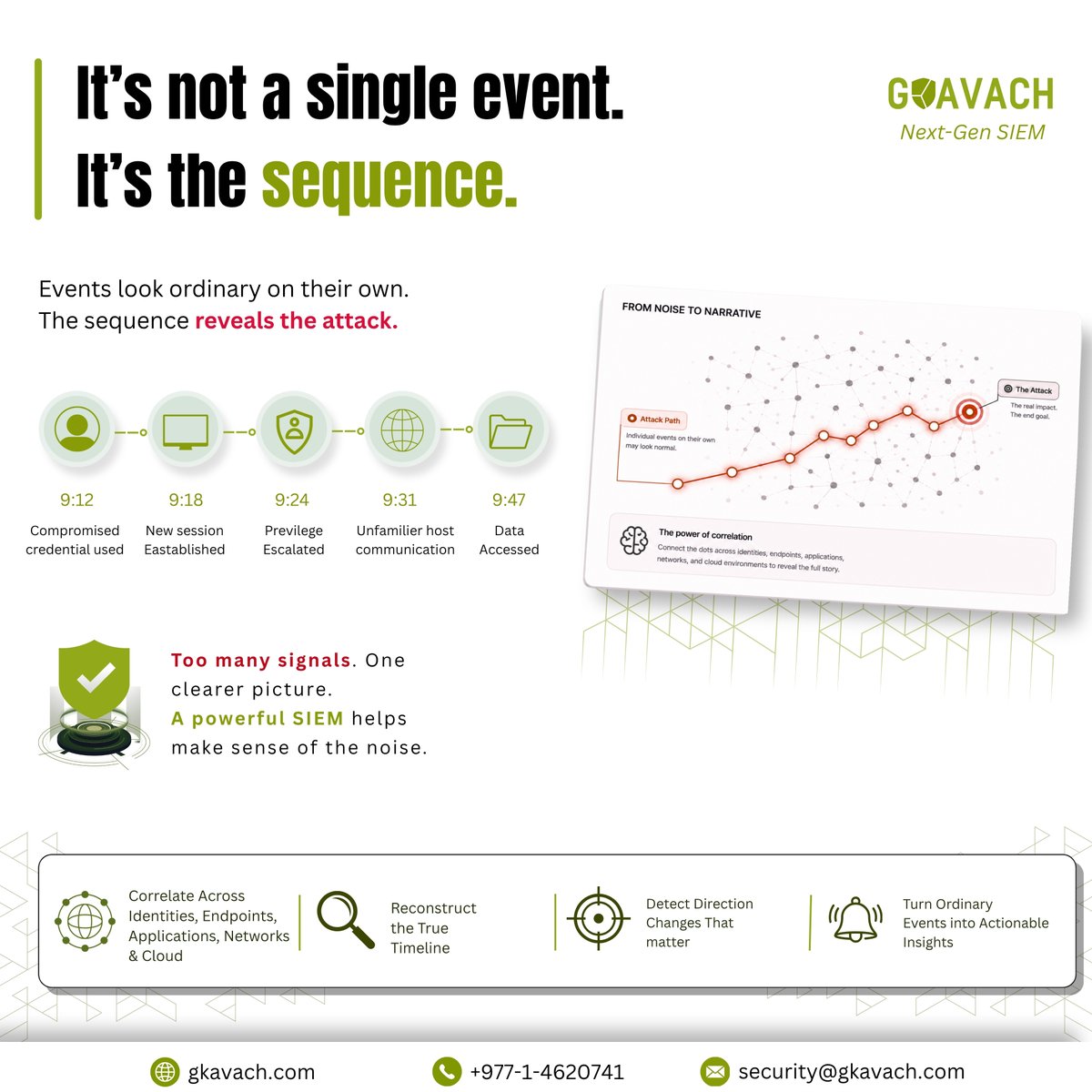
A compromised credential is used at 9:12.
A new session appears at 9:18.
A privilege changes at 9:24.
An endpoint starts communicating with an unfamiliar host at 9:31.
Data is accessed at 9:47.
Individually, each event can look explainable.
#ThreatHunting#SecurityAnalytics
Because during an investigation, the question isn't simply:
"What happened?"
It's:
"What happened first, what happened next, and where did the attack actually change direction?"
That timeline can reveal the difference between an isolated anomaly and a genuine intrusion.
#SOC
Together, they tell a very different story.
This is where a SIEM has to do more than store logs.
It needs to connect events across identities, endpoints, applications, networks, and cloud environments so analysts can reconstruct the sequence.
#SecurityOperations#IncidentResponse
One QR code.
One login page.
One moment of trust.
And suddenly, your credentials aren't yours anymore.
Not every QR code leads where it claims.
Always verify before you scan.
#GKavach#StaySecure#OnlineSecurity
Download GKavach~DWM today and strengthen your defense against new threats.
GKavach~DWM is available globally:
Web: https://t.co/69pDzqhTCH
Android (Google Play): https://t.co/wgxxivXFIX
iOS (App Store): https://t.co/YxtoWBFj2B
#QRCodeScam#Quishing#DigitalSafety
Most organizations monitor public conversations to protect their brand, but the biggest threats often emerge long before they become visible. Learn how dark web monitoring helps detect leaked credentials, stolen data, and hidden risks before they turn into public incidents.
Know how brand protection works
Read the full blog here: https://t.co/eC9PQh1Gm8
Download GKavach~DWM today and strengthen your defense against new threats.
GKavach~DWM is available globally:
Web: https://t.co/69pDzqhTCH
#GKavachDWM#Brandprotection
The differentiator was never which SIEM you buy. It's whether you have the headcount to actually run the one you have.
What's actually worked for lean teams better tuning discipline, SOAR, ripping out the SIEM entirely?
#SIEM#SOC
SOC teams do not complain about SIEM because it's "hard to use." They complain because the economics are backwards.
A few things worth sitting with:
→ The license is often the cheapest part. #ThreatDetection
Industry surveys put it at roughly a quarter of total cost the rest is tuning, onboarding data sources, and staffing to keep rules from rotting. Some orgs spend seven figures a year on outside consultants just to keep their SIEM usable.
#CyberSecurity
→ Where the real ROI shows up now isn't "more log sources." It's AI-assisted correlation and auto-suppression of known-noise patterns cutting the queue before a human ever sees it, not just visualizing it better.
it's a signal that on-prem, license-heavy SIEM economics stopped scaling. Consumption-based, cloud-native pricing is winning because teams are done paying to store logs they'll never query.
Analysts don't ignore alerts because they're lazy; they ignore them because the signal-to-noise math forces triage decisions all day, every day.
→ The recent M&A wave (LogRhythm-Exabeam, QRadar changing hands) isn't random consolidation
→ Alert fatigue isn't a bug, it's the default state. Somewhere around half of SIEM alerts are false positives higher for MSSPs juggling multiple clients.