**50yrs of China - longterm strategy**
CHINA
“The year is 1975.”
> You have 924 million people.
> Your entire economy is worth $164 billion.
> Barely $180 of GDP per person.
> More than 80% of your people live in villages.
> Life expectancy is just 61 years.
> Millions struggle to afford basic necessities.
> Much of the countryside lacks reliable electricity.
> You don't even have a modern expressway network.
> You have a problem.
> Nearly a billion people need a better life.
“1978 arrives.”
> Start reforming agriculture.
> Let farming families keep more of what they produce.
> Productivity improves.
> Open your doors to foreign investment.
> Turn a small border town called Shenzhen into an economic experiment.
> Start making clothes, shoes, toys and cheap household goods.
> Foreign companies bring orders, machinery and expertise.
> Millions begin leaving farms for factory jobs.
> Your economy crosses $300 billion in 1985.
> Growth reaches 15% in a single year.
“Strength, Weakness & Opportunities; followed by serious Execution”
There's another problem.
> Factories need electricity.
> Build coal mines and power stations.
> They need steel, cement and machinery.
> Start producing those too.
> Goods need to reach the rest of the world.
> Build ports, roads and container terminals.
> In 1988, you have just 147 km of expressways.
> By 2000, you have over 11,000 km.
> Join the World Trade Organization in 2001.
> Export orders pour in.
> Your economy crosses $2 trillion in 2005.
But assembling cheap products can only take you so far.
> Start manufacturing more components yourself.
> Move into electronics, automobiles and industrial machinery.
> Learn to make the equipment that makes other equipment.
> Keep the clothing factories running anyway.
> Keep the toy factories too.
> Why abandon industries you already know how to run?
> Your economy crosses $6 trillion in 2010.
> Become the world's largest manufacturing economy.
> Open your first modern dedicated high-speed railway in 2008.
> Then build another line.
> And another.
> Your cities keep growing.
> So do your electricity needs.
> Expand steelworks, power grids, highways and entire industrial districts.
> Move into batteries, solar panels, electric vehicles and advanced materials.
> Your industrial system now stretches from raw-material refining to finished products.
“The year is 2025.”
> Your population is 1.4 billion.
> Your economy is worth roughly $19.5 trillion.
> GDP per person has climbed to nearly $13,900.
> Life expectancy has reached around 78 years.
> Nearly 68% of your people now live in cities.
> You have almost 200,000 km of expressways.
> More than 50,000 km of high-speed railway.
> Your railways carry roughly 12.6 million passenger journeys a day.
> You produce more than half the world's steel.
> Build more than half its commercial ships.
> Manufacture nearly three-quarters of its electric cars.
> And remain a major producer of the clothes and toys you started exporting decades ago.
————————————————————
Remember 1975?
> Your entire economy was worth $164 billion.
> In 2024 alone, you invested $7.4 trillion in new fixed assets.
> Around 45 times your entire economy of fifty years earlier.
> Nothing about this happened by accident.
This is China, a civilizational nation that locked the F in for fifty years.
And the results speak for themselves.
#BorrowedWisdom
#Courtesy
3 MANDATORY eligibility tests before electing a politician or nominating a cabinet secretary:
They shall:
• Sing the NATIONAL ANTHEM in both English & Kiswahili
• Recite Chapter 1 of the Constitution
• Show their tax returns
We want PATRIOTS, not puppets.
#NaneNane
The leadership at @ntsa_kenya is thick. The data is right there. Most deaths are pedestrian and boda boda related.
But what does ntsa do to respond? Target motorists doing over 80 kph on the expressway where there are no pedestrians or boda bodas. In fact, last I checked there have been zero fatalities on the expressway.
How about you address pedestrian and bodaboda safety first?
And when you look at driver and passenger deaths, those numbers show that those accidents are mostly PSV related. How about you address PSV safety as well?
You want to focus on motorists because that is where there is a Return on Investment. That is where you make money.
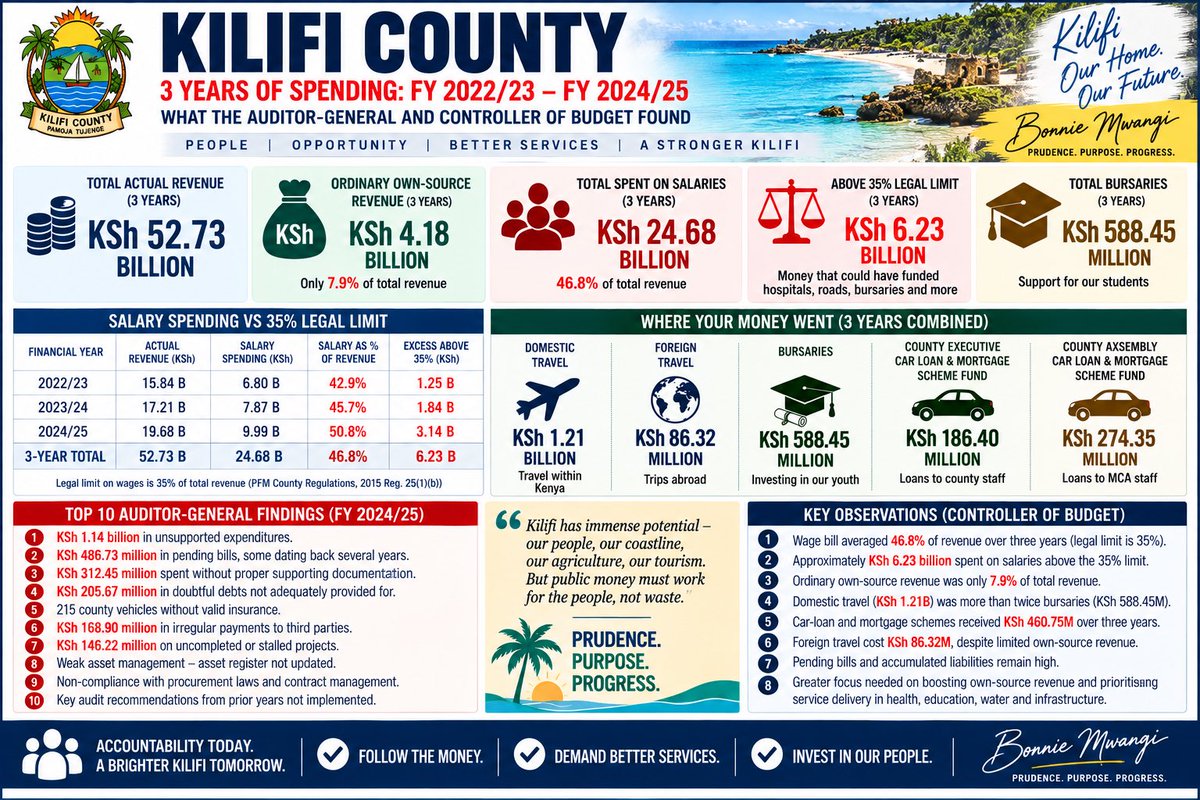
If you are from @KilifiCountyGov and are wondering where the KSH 52 billion went in your county in the last three years, here is the score card.
Please read, re-read, download, and share.
Let’s bring change.
Did you know that our KDE 181Q MAN bus has done more than 1.6M Kilometers since it was launched. Its is the first MAN HB4 we ever had.
Wishing it many more kilometers on road.
Mr Ruto has turned Kenya into Haiti! The main reason Alex Kiprotich was released a few hours after his abduction is that the dash cam captured the violent, armed police officers who grabbed him and were likely going to torture and kill him, like many other victims. Kenyan police have killed three people every day since Ruto became president.
This Kikuyu bogeyman narrative has now come full circle with a UDA MP now threatening his fellow community members with eviction. Started with the Chair, then CS and now Wainaina Kabaiku. This was also the language in 2007. There is a plan to cause violence in 2027. That’s all
I still have serious questions about Ndindi Nyoro, and I do not understand why Kenyans are suddenly being asked to accept his new opposition politics without asking hard questions about the years he spent building William Ruto.
This is a man who was chanda na pete with Ruto for years, defended the Ruto project when many people were warning against it, mobilised for him across Mt Kenya, and once openly argued that Kenya needed a “benevolent dictator.”
During those same years, Ndindi built a very interesting investment portfolio, with public filings previously showing him holding tens of millions of Kenya Power shares and at one point ranking as the company’s biggest individual shareholder.
Before anyone sells Ndindi as the new face of resistance, Kenyans are entitled to ask where the money behind those investments came from, whether every investment belongs to him alone, who his business partners are, and whether he has ever held assets for other politically exposed people.
I am not saying William Ruto owns Ndindi’s Kenya Power shares, since I have seen no evidence proving that, but that does not mean Kenyans should stop asking questions about money, business relationships and political links.
Politics has proxies, business has proxies, shares can sit under nominees, and companies can hold assets on behalf of other people, so the name appearing on a document does not always tell you the full story.
Ndindi spent too many years politically attached to Ruto for everyone to suddenly switch off their curiosity simply because his speeches have changed and he now wants to sound like somebody who was never part of that project.
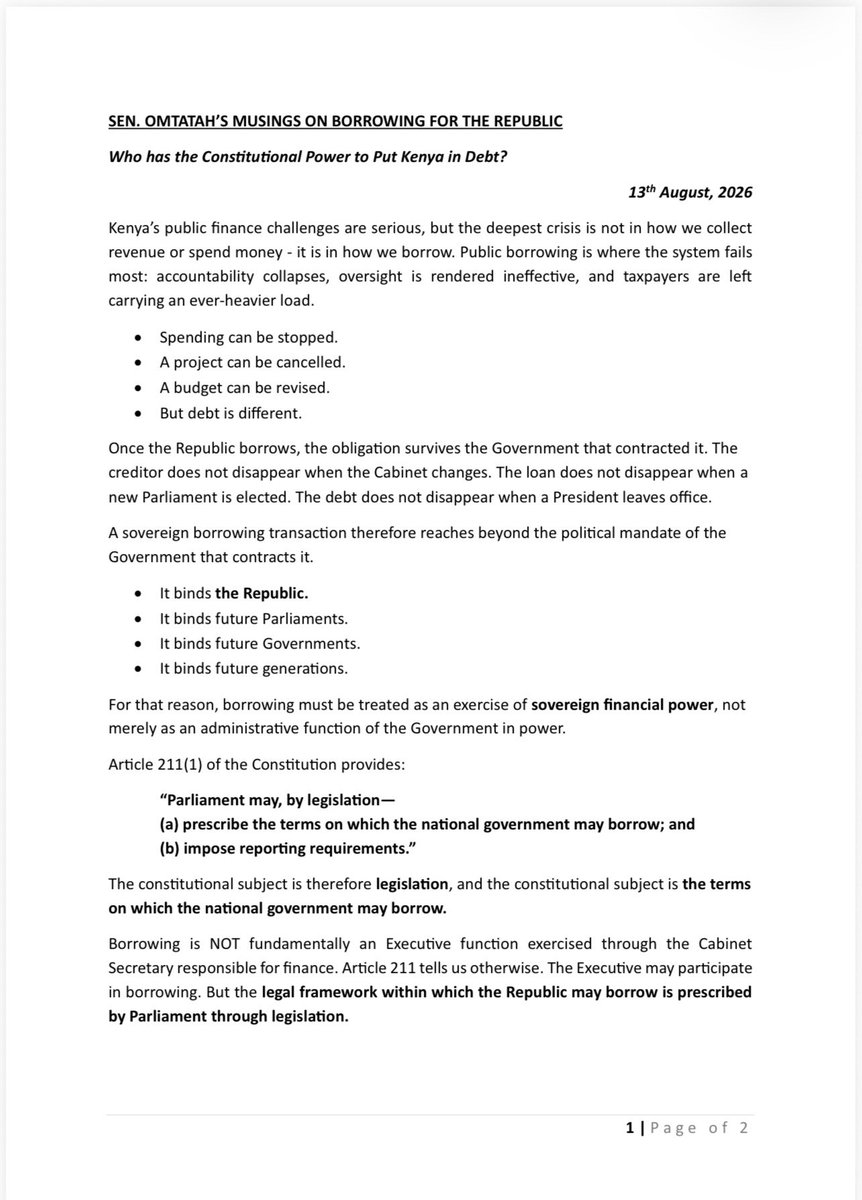
SEN. OMTATAH’S MUSINGS ON BORROWING FOR THE REPUBLIC.
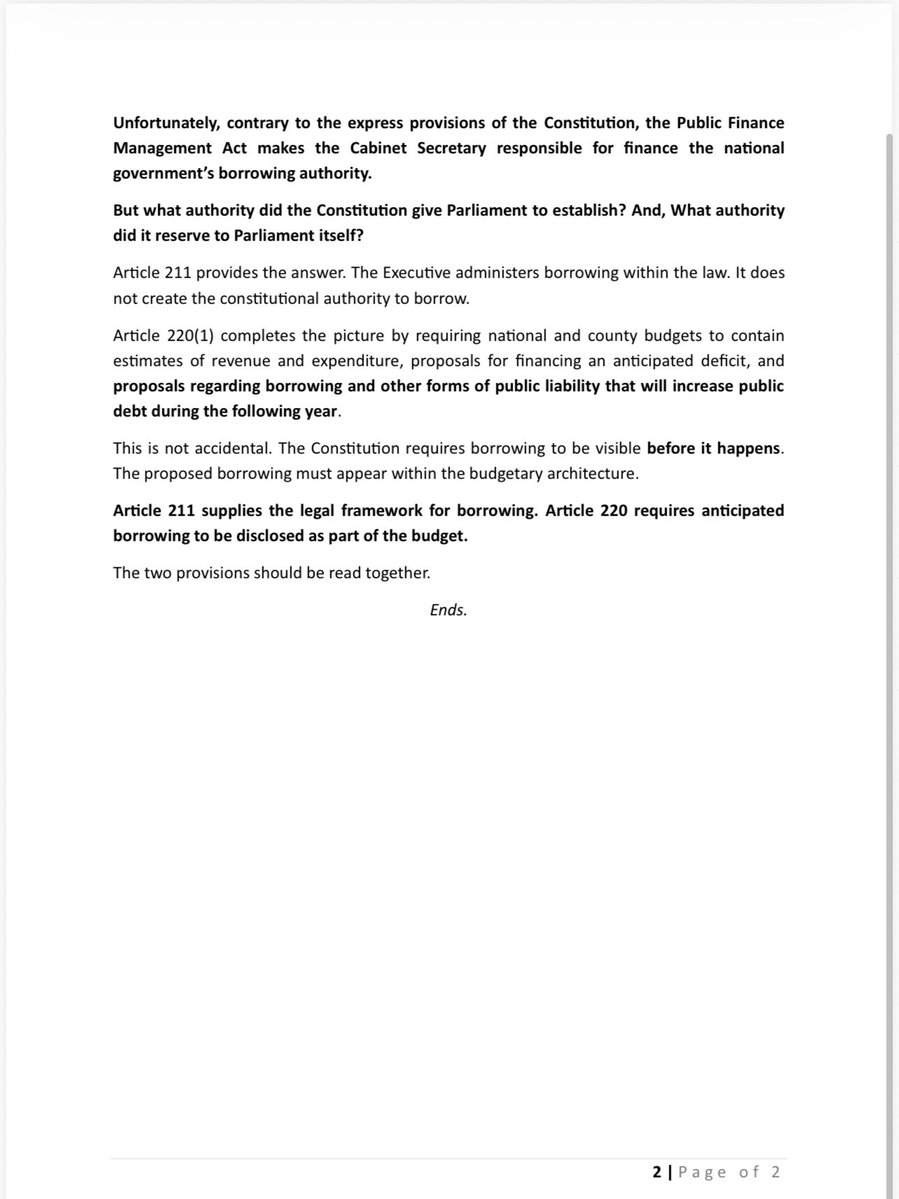
The REAL DANGER of public debt is not simply how much Kenya borrows, but WHO has the constitutional power to BIND THE REPUBLIC to that debt.
Does the Executive borrow, or does Parliament? Under Article 211, it sets the constitutional framework within which Kenya may borrow.
Debt outlives governments. It binds future Parliaments and generations. This deserves serious constitutional scrutiny.
Forcing Kenyans to repay odious debt; money borrowed without their consent, without transparency, and without delivering any clear benefit to the people is more than economic injustice. It is economic oppression.
Kenyans should not be condemned to generations of taxation and austerity to repay debts whose purpose, beneficiaries, and terms were never transparently disclosed.
You cannot privatise the benefits of borrowing and socialise the burden of repayment.
Nation are conditioning the masses to ignore that his term is over, that if we press harder we can have an election and not allow him another year courtesy of a technicality
I think the most painful part about fighting for change is watching people you genuinely believed were part of the movement slowly water it down, shake hands with murderers, laugh with them, sit comfortably around the very oppressors they once condemned, then come back with all sorts of explanations and excuses for why they were there, why it was necessary and why we shouldn’t read too much into it. And you’re left wondering, was any of this ever real, or were some of these people simply well calculated psyops from the very beginning?
And then you find yourself asking an even harder question, are the lives we lost not personal to you? Because for some of us, they are. We remember the young people who lost their lives fighting for a better country, the families that had to bury their children, the blood that was spilled, and maybe that’s why it’s so difficult to understand how someone who stood beside you through all of that can suddenly sit comfortably, laugh and shake hands with the very people we were fighting against 🥹
And somewhere along the way, you begin to understand why people like Patrice Lumumba, Dedan Kimathi, Thomas Sankara and so many other African heroes were killed so brutally. It wasn’t always because they didn’t have people around them. Many did. The problem was that some of the very people they believed they were fighting alongside had already sold out long before the fight was over.
Perhaps that is one of the hardest truths about fighting for change, eventually you realise that people really do have a price. Politics is indeed a dirty game, and I have a feeling 2027 will expose even more about people’s character.
But I really hope the few who genuinely believe in change don’t give up. Is it easy? Absolutely not. But I believe there is something deeply fulfilling about knowing that even if you died today, you never sold out, never shook hands with murderers and never became comfortable with people who have blood on their hands simply because they offered you money, access or power. Does that make you a hero? Absolutely not. It simply means you remained honest about what you stood for.
And eventually, when money no longer matters, when power no longer matters and when all the noise has died down, I think being able to live with yourself knowing you never betrayed what you believed in is what will matter most.
WANTAM!
The Constitution is unequivocal. It DOES NOT not permit ANY verification, re tallying or confirmation of presidential election results after they have been declared by the Constituency Returning Officer.
Articles 86(b) and (c), together with Article 138(2) and 138(3)(c), establish the polling station and the constituency as the only constitutional venues for counting, tallying, verification and declaration of presidential results.
Article 138(10) assigns the @IEBCKenya Chairperson a purely ministerial function. The Chairperson must aggregate the 290 constituency results exactly as received, without altering a single vote, and only confirm whether a candidate has attained the constitutional threshold under Article 138(4).
Section 39 of the Elections Act, particularly Section 39(1C)(b), and Regulation 83(2) purport to create a National Tallying Centre with powers to tally and verify presidential results. Those provisions introduce an extra constitutional process that the Constitution neither creates nor permits.
This unlawful expansion of power has been at the heart of the presidential election disputes of 2013, 2017 and 2022.
The Constitution provides a complete code. Verification ends at the constituency. The National Tallying Centre has no constitutional mandate to re tally, re verify or confirm results. Its role is limited to the mathematical aggregation of constituency results and confirmation of the Article 138(4) threshold.
A Presidential Candidate Should Be Ready To:
1. Reject the KES 12 trillion odious debt and tell the creditors to deal directly with the thieves.
2. Recover all stolen public money and assets dating back to 1960.
3. Cut ties with the IMF and the World Bank.
4. Expropriate and redistribute land.
5. Arrest and administer revolutionary justice to all thieves and politicians who have held public office since 1960.
6. Nationalize the country's natural resources.
7. Provide free, quality healthcare and education to all Kenyans.
8. Industrialize the country.
If your presidential candidate is not ready to do the above, you should abandon that path and join the revolutionary movement.