AI requests shouldn’t have to travel to a giant data centre.
The compute could live right on telecom towers.
Close to users and devices, close enough that “real-time” actually means real-time.
So why isn’t this everywhere already?
Because you can install hardware on towers, that part is doable.
What breaks the model is funding it early.
Investors ask one question: how do we know the tower is actually being used?
If you can’t prove usage, nobody funds it. If you prove it by dumping raw tower data, you’ve created a different problem.
That’s what Nillion, @web3pairpoint (by Vodafone) & Chainlink is fixing.
- Pairpoint measures tower compute usage and signs it at the source
- Nillion verifies and aggregates it privately, so tower data stays protected
- Chainlink publishes the verified usage onchain, so repayments can settle on real activity.
Private health is scaling with @HealthBlocks
From walking challenges with Capgemini to campaigns with Nosu, brands are bringing their wellness programs to HealthBlocks.
Powered by Nillion.
🧵 👇
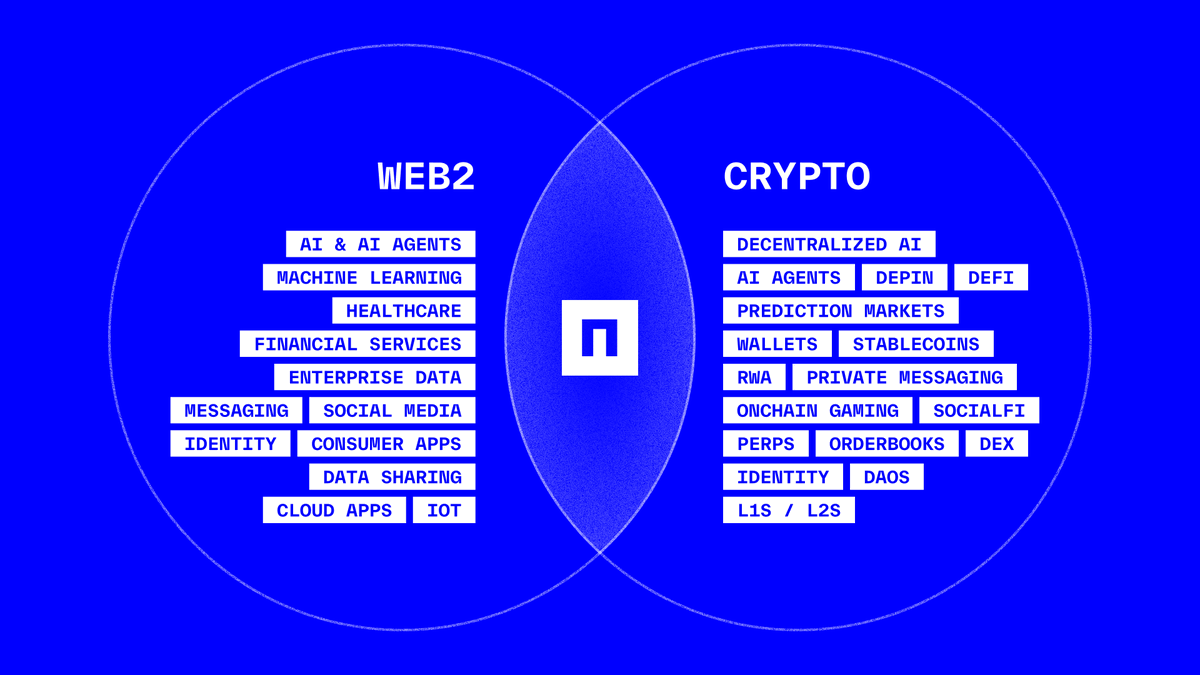
The Blind Computer enables computation and coordination without exposing strategies or raw data while still operating inside public systems.
On Ethereum, that capability becomes native infrastructure within the coordination layer where value is issued and protocols interoperate.
This move also redefines $NIL.
On Ethereum, NIL becomes the coordination asset for privacy-preserving systems, aligning participation, verification and value exchange around the Blind Computer.
That alignment is enforced by Nillion Blacklight.
Blacklight proves the Blind Computer is operating exactly as specified, without revealing inputs. It rewards the nodes that secure this verification, binding privacy to economic incentives.
That’s what makes private computation compatible with open coordination.
Ethereum provides the coordination surface.
The Blind Computer provides the privacy layer.
Together, they make privacy a composable primitive of the open internet.
If you like privacy, you’ll love Nillion.
For years, Nillion has been building around one idea:
Apps should be able to use sensitive data without exposing it.
That is what each part of the stack is built to do.
- nilDB allows developers to store private data without revealing it
- nilCC allows apps to compute on sensitive inputs without exposing them
- nilAI allows AI to use private context without absorbing it
And Nillion Blacklight continuously checks that private workloads are running as promised, so users don't have to rely on 'trust me bro'
For Nillion, privacy was never a narrative, it was the premise.
And it is good to see the world starting to remember why.
The blindfold stays on. Much more to build.
Something big is happening over at Nillion! You’ll regret it for the rest of your life if you don’t get on this train before it turns into a rocket ship 🚀🚀
@nillion