❄️Just published❄️
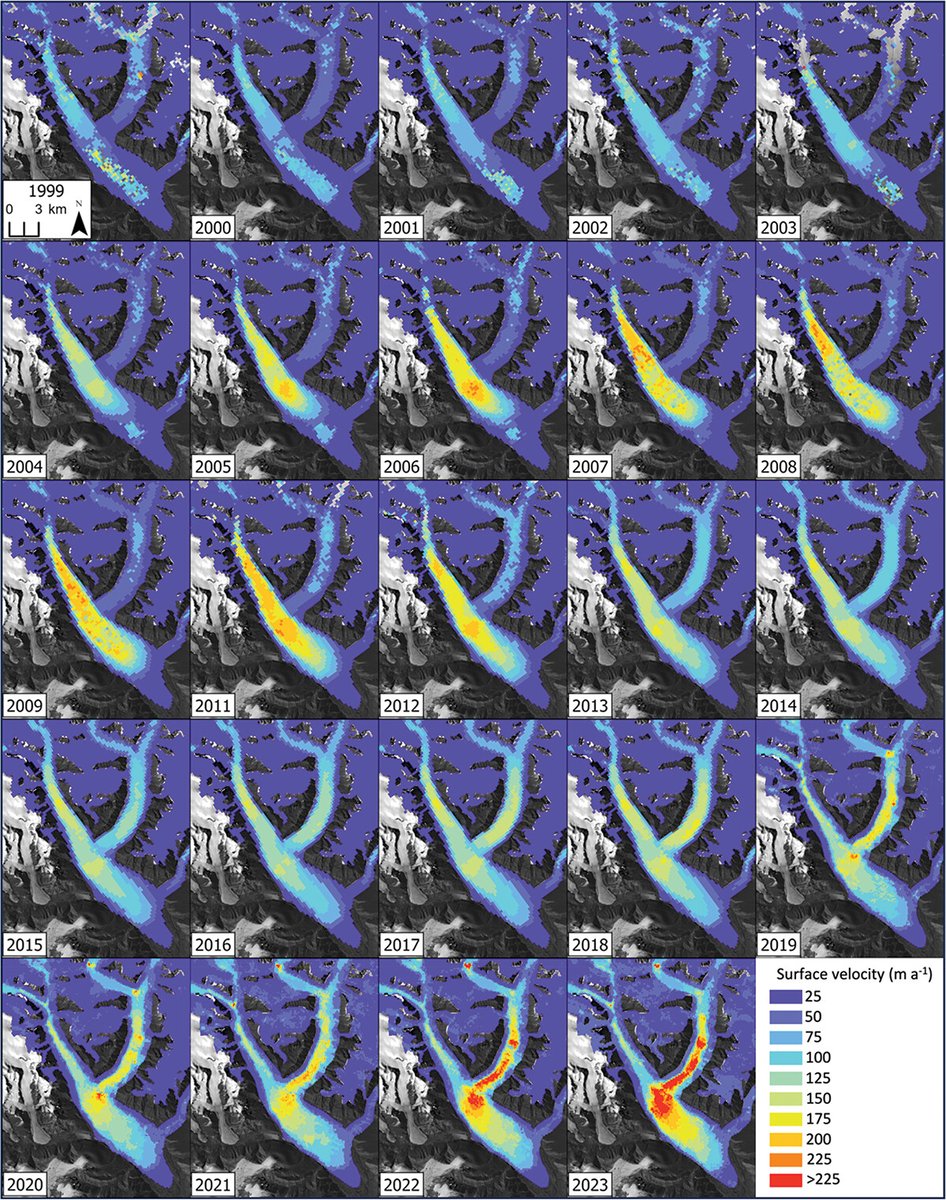
Van Wychen W, H Jiskoot, K Shannon & C Gorwill (2025) "The long multiphase trunk–tributary surge history of the high-Arctic Chapman Glacier, 1959–2023." Arctic, Antarctic, and Alpine Research 57(1).
➡️https://t.co/Cof7jVYeNr
#science@UWGlacier @Ulethgeo
❄️Journal of Glaciology 69(278)❄️
Out now with 48 papers and a cover depicting JOG covers since 1947.
➡ https://t.co/RskiK57pYv
This is the final paper-copy JOG issue. From 2024 onwards we will go online-only. Read the PREFACE; abbr. in the Alt text below.
@egg_igs#Science
❄️Finally out!❄️
Annals of Glaciology 64(92) “Ice, Snow and Water in a Warming World” with 25 papers. Also the final paper-copy AOG issue.
➡https://t.co/TXMajFP8rn
The cover image was painted by artist Klara Maisch inside an ice cave.
@cryosphere2022#OpenAccess#science
@helenafricker @X The question is, how can we remain in solidarity - and in constructive conversation - on social media despite this divide and rule mentality of and within the platforms.
Just published! Young EM, Flowers GE, Jiskoot H & Gibson HD (2024) Reconstructing glacier surge kinematics using a numerical ice‐flow model applied to the Dusty Glacier, St. Elias Mountains, Canada. Geophysical Research Letters 51. ➡ https://t.co/6LW6TzafdR #sliding#massbalance
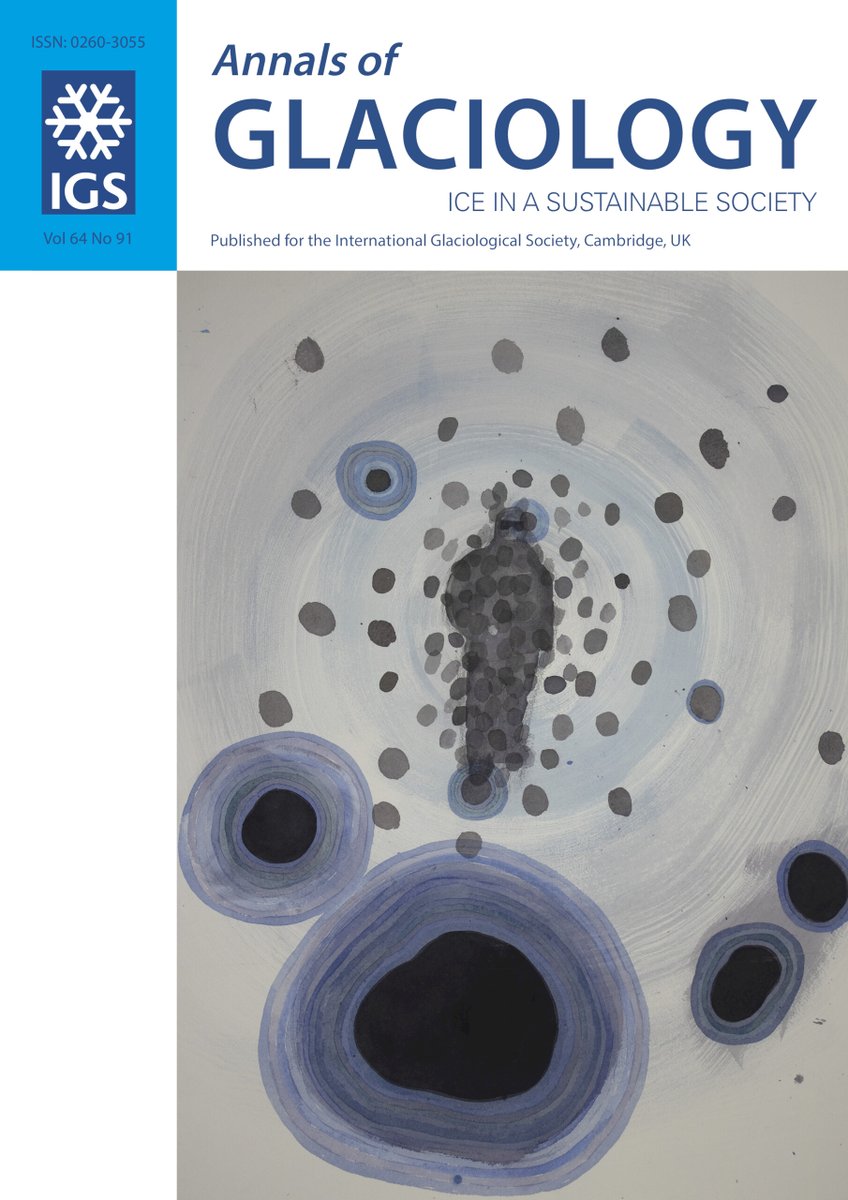
Annals of Glaciology 64(91) “Ice in a Sustainable Society” is out now with 10 papers. The issue was led by ACE Sérgio Faria.
--> https://t.co/Hc22BZAeod
Cover: Watercolour of scientist contemplating the connectivity between black carbon & cryoconite holes. Credit: @PayenSally
Today is π-day and NASA's Image of the Day features some information that @HazLovell and I provided (independently). An alternative title that I suggested was "An Ice Pi with Swiss Cheese". https://t.co/irCL7CiiBH
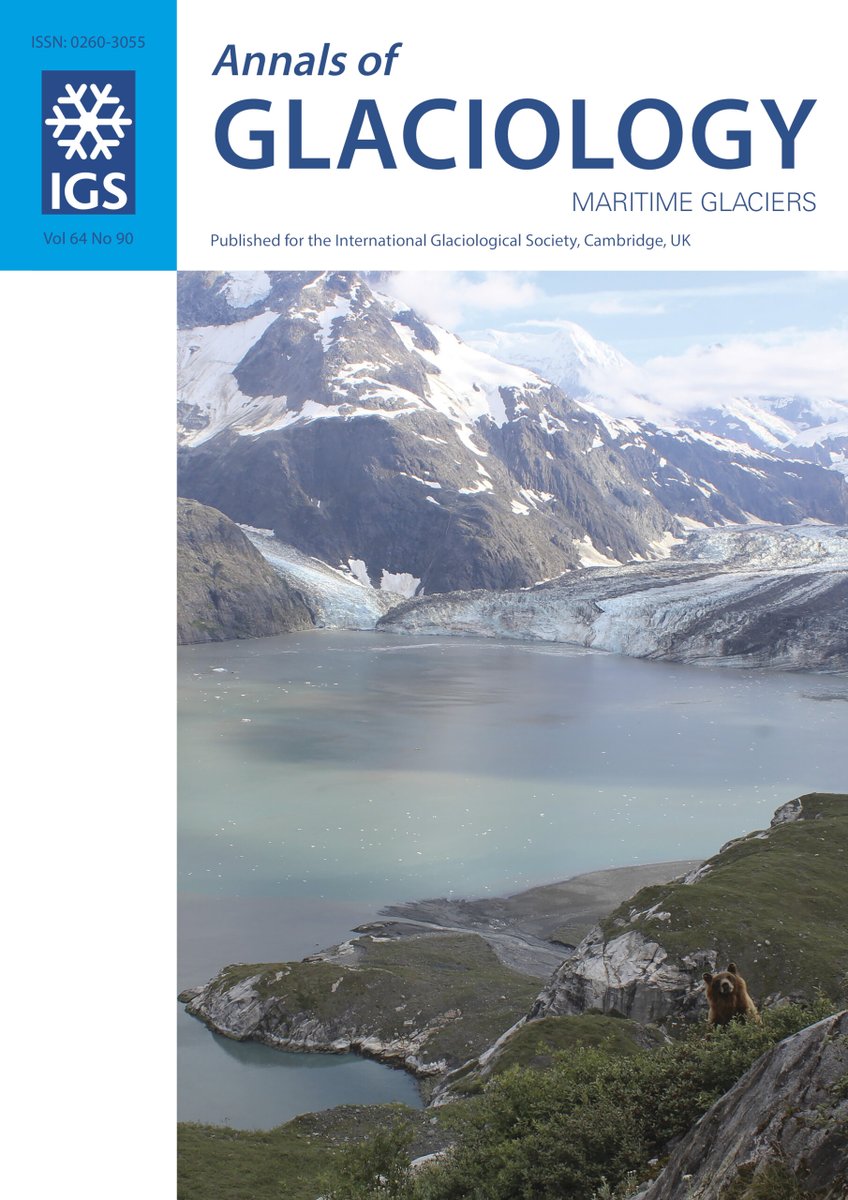
Annals of Glaciology 64 (90) “Maritime Glaciers” is out now! The issue was lead by ACE Shin Sugiyama. https://t.co/TXMajFP8rn
Cover: time-lapse photo of Johns Hopkins Glacier (Tsalxaan Niyaadé Sít’), AK, from 9 Aug 2022: it bears a little surprise too. Credit: Jason Amundson.
@RobbieMallett @igsoc Please email the AnnGlaciol sea ice issue’s Associate Chief Editor (Christian Haas) directly with this complaint, and cc me (IGS Chief Editor). I am trying my best to chase all editors and we often send reminder emails for them to take action. Let’s find a solution for your case.
Just published! Gilson GF, Jiskoot H, Gueye S & van Boxel JH (2023) A climatology of Arctic fog along the coast of East Greenland. Quarterly Journal of the Royal Meteorological Society, 1–21. https://t.co/XGNjamjar7 #arctic#weather#climate#fog#clouds
Journal of Glaciology 69(277) is out now with 30 (!) new papers.
➡https://t.co/RXdorc0CON
Cover: Aerial view of a proglacial lake of the Mittivakkat glacier (Greenland) taken with a drone in July 2019. Credit: Jakob Abermann & Iris Hansche. Related to: https://t.co/RipOMlsZnx
Just published! “IGS Global Seminar Series: New research Directions”, the 2022 Annals of Glaciology 63 (87-89). https://t.co/TXMajFP8rn
In this special AOG, 31 papers offer current perspectives on and future priorities of a diverse range of subfields within glaciology. @egg_igs
I'm back on this hellish platform to share something important: the Randolph Glacier Inventory (RGI) version 7.0 is released!
Find out more on our new user guide https://t.co/Rz0d5mT1et
and in the thread below 🧵
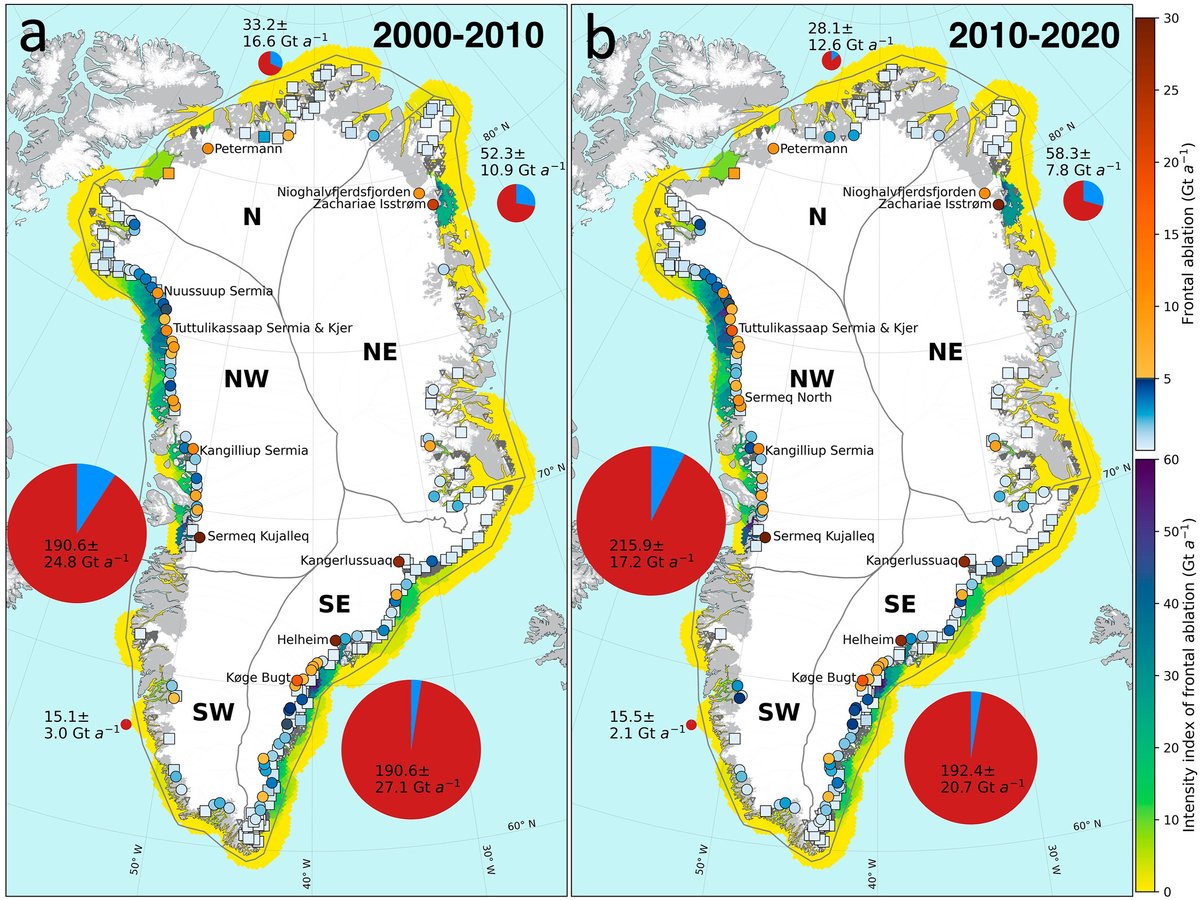
Calculating frontal ablation is complicated and incl. measurements of ice flow (ITS_LIVE & MEaSUREs), margin changes (from Landsat, ASTER, RadarSat), ice thickness (from Operation Icebridge & BedMachine), volume change (geodetic mass balance) & surface mass balance models (RACMO)
Just out!
Kochtitzky W, Copland L, King M, Hugonnet, M, Jiskoot H, Morlighem M, Millan M, Khan SA, Noël B (2023). "Closing Greenland's mass balance: Frontal ablation of every Greenlandic glacier from 2000 to 2020." Geophysical Research Letters 50. https://t.co/R3D8vTEoLw
Total glacier mass balance consists of two components: climatic-basal mass balance and frontal ablation. Our paper is the first to calculate frontal ablation for entire Greenland and we find that frontal ablation is the dominant mass loss component.