@steven_segal88 Steven, I can get 3 lots in Naples west of 41 (near your 699 binnacle but a bit smaller lots) for under $1m each…
I’m looking for commission, some co-GP carry, and the listings at dispo.
I can also get land in Collier for self storage, or multifamily/mixed-use under $20k/unit
GOV: We have a housing crisis. Prices are too high.
ME: I agree. Supply is too low.
GOV: So we have a plan. We’re going to subsidize demand.
ME: …What does that mean?
GOV: We’re going to give people money to buy houses.
ME: But there aren't enough houses.
GOV: Right. So we’ll help them bid harder.
ME: If you have 10 people fighting for 1 house, and you give them all cash... the price just goes up.
GOV: Then we’ll give them more cash.
ME: That’s not a solution. That’s inflation.
GOV: It’s "First Time Homebuyer Assistance."
ME: Okay, let’s back up. Why are houses so expensive in the first place?
GOV: Because we made them the perfect investment vehicle.
ME: How?
GOV: First, the 30-year fixed mortgage.
ME: That’s standard, right?
GOV: Only in America. In other countries, rates float. Here, you can lock in a low rate for three decades.
ME: Why would a bank take that risk? If inflation goes up, they lose money.
GOV: Banks don’t take the risk. They sell the loan to us.
ME: To the government?
GOV: To Fannie Mae and Freddie Mac. We guarantee the liquidity.
ME: So the taxpayer subsidizes the risk so I can have cheap leverage?
GOV: Correct.
ME: And then I get to deduct the interest?
GOV: Only on the first $750,000 of debt.
ME: That seems... high.
GOV: It used to be a million. We trimmed it.
ME: But wait. If I rent, can I deduct my rent?
GOV: No.
ME: If I buy a small business, can I deduct the interest on the loan?
GOV: It’s complicated.
ME: But if I buy a giant house, I definitely can?
GOV: Absolutely. We wrote it into the tax code.
ME: So you’re paying me to borrow money to buy a bigger house than I need.
GOV: We’re "incentivizing ownership."
ME: What happens when I sell?
GOV: The Capital Gains Exclusion!
ME: How does that work?
GOV: If you sell a stock for a $500,000 profit, you pay taxes.
ME: Roughly 20%.
GOV: If you sell your house for a $500,000 profit?
ME: What do I pay?
GOV: Zero.
ME: Zero tax?
GOV: As long as you lived there for two years.
ME: So housing is the only asset class where I get subsidized 30-year leverage and tax-free profits?
GOV: Pretty sweet deal, right?
ME: So you turned shelter into a speculative financial asset.
GOV: We call it "Generational Wealth."
ME: Okay, so demand is juiced to the moon. Can we at least build more supply to bring prices down?
GOV: Oh, absolutely not.
ME: Why?
GOV: Zoning.
ME: I own land. Can I build a duplex?
GOV: Illegal. Single-family only.
ME: Can I build a granny flat?
GOV: Only if you provide two parking spots and pass a shadow study.
ME: So you made it illegal to build cheaper housing?
GOV: We protect "Neighborhood Character."
ME: But you spend billions on roads and utilities for the suburbs.
GOV: Infrastructure investment.
ME: So you subsidize the expensive sprawl, but ban the cheap density?
GOV: Now you’re getting it.
ME: This system seems designed to keep prices high.
GOV: It is.
ME: But you started this conversation by saying we have an "Affordability Crisis."
GOV: We do. Prices are too high!
ME: So we should lower them?
GOV: No! We can’t lower prices.
ME: Why not?
GOV: Because then the voters lose their "Generational Wealth."
ME: So we need high prices for the voters... and low prices for the buyers?
GOV: Exactly.
ME: That’s a paradox.
GOV: It’s politics.
ME: So what is your actual plan?
GOV: We’re going to give first-time buyers $25,000.
ME: Okay. I’m a seller. I list my house for $400,000.
GOV: Uh huh.
ME: I know every buyer just got a free $25,000 from the government.
GOV: Right.
ME: What do I do?
GOV: You... keep the price the same?
ME: I raise the price to $425,000.
GOV: You wouldn't.
ME: I absolutely would. The buyer can afford it now.
GOV: But that just transfers the subsidy from the poor buyer to the rich seller!
ME: Econ 101.
GOV: We don’t think that will happen.
ME: Just like you didn’t think $7,500 EV credits would make Ford raise the price of the F-150 Lightning by exactly $7,500?
GOV: That was a coincidence.
ME: You are trapping us in a box.
GOV: It’s not a box.
ME: What is it?
GOV: It’s a Single Family Home with a 2.5% mortgage rate that you can never afford to sell.
ME: ...
GOV: Welcome to the American Dream.
An uncomfortable truth that boomers dont want to accept is that solving society's biggest problems requires them to take a massive hit on their paper wealth
Just a few examples:
> Solving housing affordability = need to add a lot more supply, which means existing home equity values go down
> Solving healthcare costs = much lower profit margins for many hospitals, pharma companies, and insurance providers, which rerates multiples on a trillion dollar industry
> Solving youth employment = companies must be okay with hiring unproductive employees and training them for a couple of years, instead of just using automation. Margins take a hit and stock multiples rerate
Boomers predominantly own most of the housing and stocks in our country. For many decades, policies favored preserving equity value for themselves instead of paving the path for the new generation
After all, most of our politicians themselves fall within the boomer generation, and they have very little incentive to tackle these issues.
The biggest political challenge of the next few decades will be creating opportunities for younger people to participate in wealth creation while also keeping boomers happy as their net worth declines. It is an incredibly tough balancing act
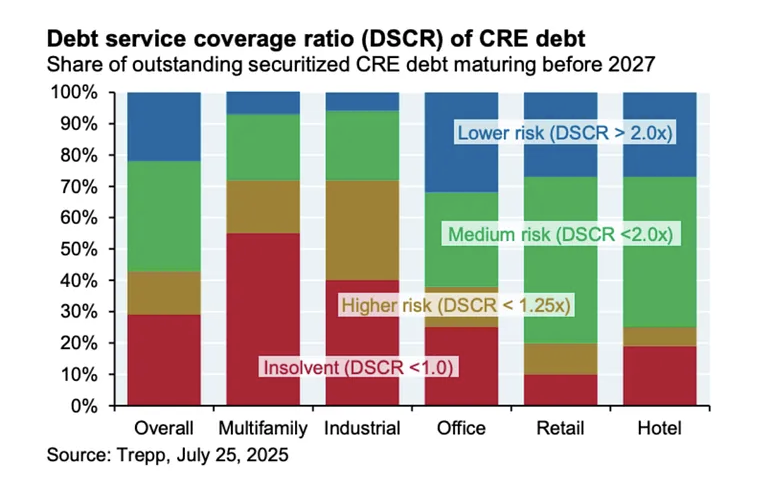
More than half of securitized multifamily debt has DSCR < 1.0
This means the underlying properties are not generating enough cash flow to service the debt.
This isn't breaking news, by any stretch, but the 50%+ figure is not nothing.
Link below
“Giving Up”: The Impact of Decreasing Housing Affordability on Consumption, Work Effort, and Investment
"Conclusion
Housing has become increasingly out of reach for younger generations, and many households are now abandoning the goal of homeownership altogether. This paper shows that giving up on homeownership is more than just a housing-market outcome - it reshapes how people consume, work, and invest, with long-lasting consequences for inequality and the broader economy.
Our empirical evidence demonstrates that renters who no longer expect to become homeowners behave very differently from those still trying to buy a home. They spend more of their income today, put in less effort at work, and are more likely to take on risky financial investments."
"Overall, our findings highlight an important message: when housing becomes unattainable, people do not simply stay renters - they often change how they live, work, and plan for the future. These changes compound over time and can reshape the economy. Policies that preserve or restore households’ ability to aspire to homeownership can therefore have meaningful long-run effects not only on housing outcomes, but also on aggregate labor supply, savings, investment behavior, and wealth inequality."
https://t.co/gW2Bio4A62
This is it.
This is what we’re fighting for:
- Homeownership
- Marriage
- Kids playing in the yard
- White picket fences
- Rocking chairs on the porch
- The American flag flying proudly
- Family dinners
- Safe neighborhoods
- A future for your children
This is the American Dream, and it’s being taken away.
The average first-time homebuyer is now 40. This is a crisis. When people can’t buy a home, everything else collapses: family, stability, legacy, the next generation.
A nation that locks its own citizens out of homeownership is a nation in decline.
We’re fighting to reverse that.
This is the battle.
Americans should own the homes.
Americans should work the jobs.
Americans should live the dream.
Most Federal housing programs grind to a halt in a shutdown.
Opportunity Zones don’t.
They’re like by-right zoning: written into the tax code, not dependent on bureaucrats.
OZ deals keep moving while others wait for D.C. to reopen.
@teshtish_ @matt_vanswol Is it only for black people who were denied housing, or can a person who immigrated it here use it too? What about women who couldn’t get a mortgage without a co-signer back in the day? Does that injustice not matter?