I don't track every expense. It's a waste of time. I focus on 4 key numbers:
- Fixed costs (50-60% of take-home pay)
- Savings (5-10%, higher is better)
- Investments (5-10%, higher is better -- this is where the real wealth is created)
- Guilt-free spending (20-35%)
The only expenses I track are LARGE + VARIABLE expenses. For most people, these are eating out, travel, and kids' expenses
This is how you can radically simplify your finances and spend less than 1 hour/month taking control of your money
If you want a template to do this...
“I’ll deal with my debt when I make more money.”
It’s one of the invisible scripts that keeps people in debt for years.
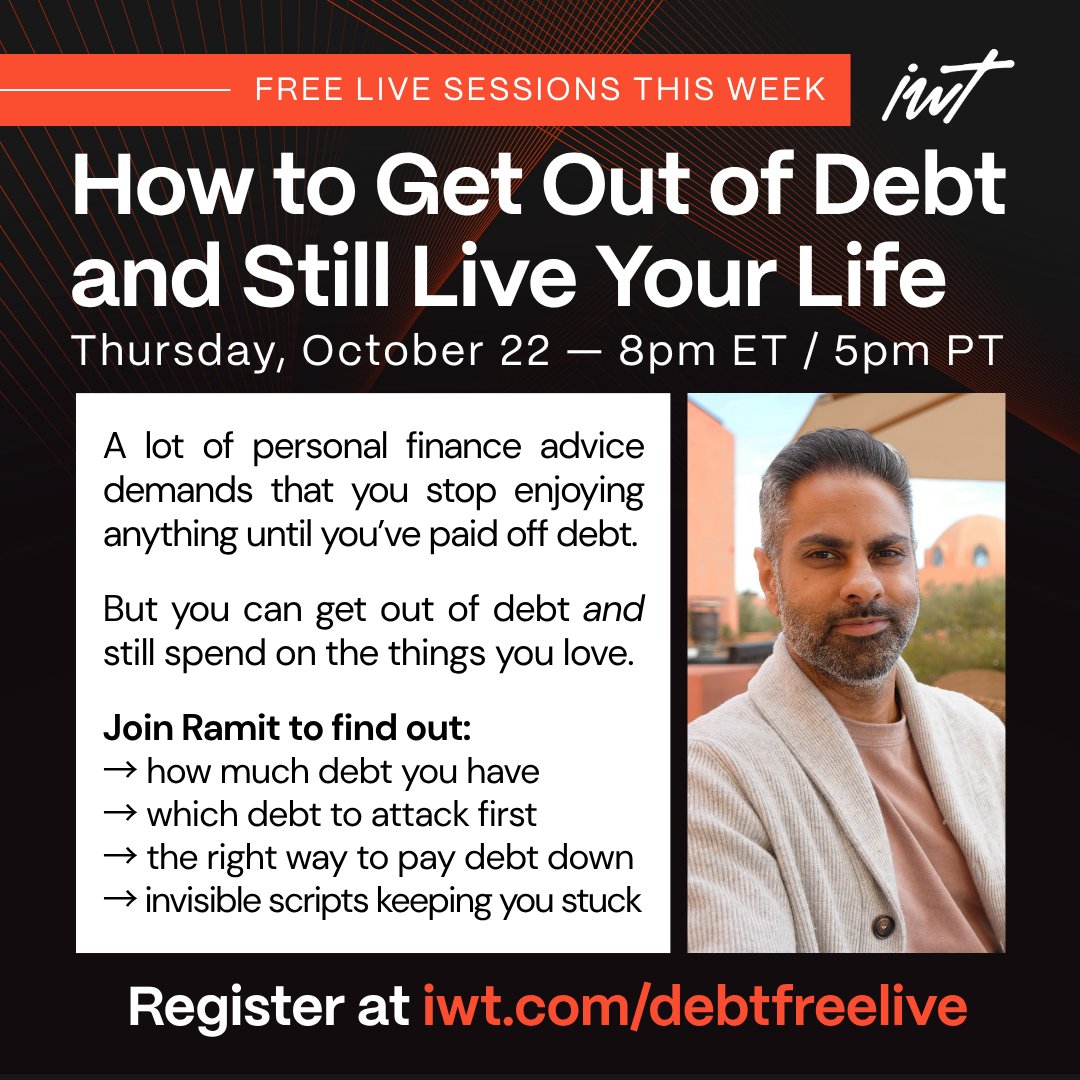
Tonight at 8pm ET / 5pm PT, I’m going live to show you how to break it, and how to get out of debt without giving up everything you love. (link below)
Surprising finding: When people talk about money early on while dating, it almost never changes the trajectory of the relationship
- [Just discovered the guy you're dating has $43,000 of CC debt]: "We'll figure it out"
- [She has $325,000 of student loans]: "We'll figure it out"
- [They haven't ever made more than $37,500/year]: "We'll figure it out"
Here's why I think this happens:
1. Most of us don't understand money ourselves so we never develop a strong POV on it. Compare this to the list of physical traits that almost everyone in America develops
2. Money is so abstract that we don't connect the dots to how our partner's finances will affect our lifestyle. For example, if our partner has to pay $2,250/month in CC debt payments, how will that affect both of us? Almost nobody asks questions like this
3. Money, like flossing, is one of those things we defer until "some day"
Let me know what you think. I see this pattern often on my podcast
2 kinds of people in personal finance:
#1: I don't need much. I prefer to live a simple life & spend less than I earn:
- “I just don’t want much. Is that weird?”
- “I’ve found the less I want the more content I am.”
- “I’m pretty content with what I have. I’m not someone that has a ton of drive and needs, is constantly reaching for the next big thing.”
- “I have what I need. And not aiming for the big-spending high life because I didn’t grow up with much and don’t need much more than I have.”
#2: I want to experience X, Y, and Z. I'm willing to work really hard to make a lot of money and get the things I want:
- “I’m front loading my suffering in order to enjoy the fruits later on.”
- “One of my goals is to fly delta one with no guilt.”
- “Being able to fly first class across the globe, and also being able to pay for our parents to fly first class with us.”
I've always been #2. Which one are you?
Here's the scenario from today's Money For Couples episode:
- 45 years old, married for 20 years, 3 kids
- Income: $178K
- Savings: $571 (would last them 2 days)
- Car: $1K/month ($76K Nissan Pathfinder)
- Eating out: $9,275 this year
- 8 pets: $300
- Fixed costs: 87%
They've looked into bankruptcy. What would you do?
"How do you justify spending money on --"
Reframe:
Why do I need to justify spending money? As long as I'm hitting my investment number, saving number, and Fixed Costs, I can spend my money extravagantly on the things I love -- totally guilt free
What's your Rich Life? Here are a few examples of mine:
Live in a walkable neighborhood with no car
Eat mostly the same thing, mostly at home, every day. When I eat out, price doesn't matter
Took my nephews on a college tour at Stanford
Rent instead of owning
Iron my own clothes
Fruit & almond butter from the farmer's market
Simple dates with my wife: coffee walk, Central Park, out w/friends. But also, a 3-month sabbatical to Barcelona, Paris, Marrakech, and Tokyo together with private tours and beautiful hotels
Weekly haircut
Unlimited spending on health
Yes, you can get out of debt and keep spending on the things you love.
Start tonight: write down every debt you have, with the balance and interest rate.
Then on Thursday, I’ll help you:
→ decide which debt to attack first
→ build a plan that pays it down automatically
→ identify the invisible scripts keeping you in debt
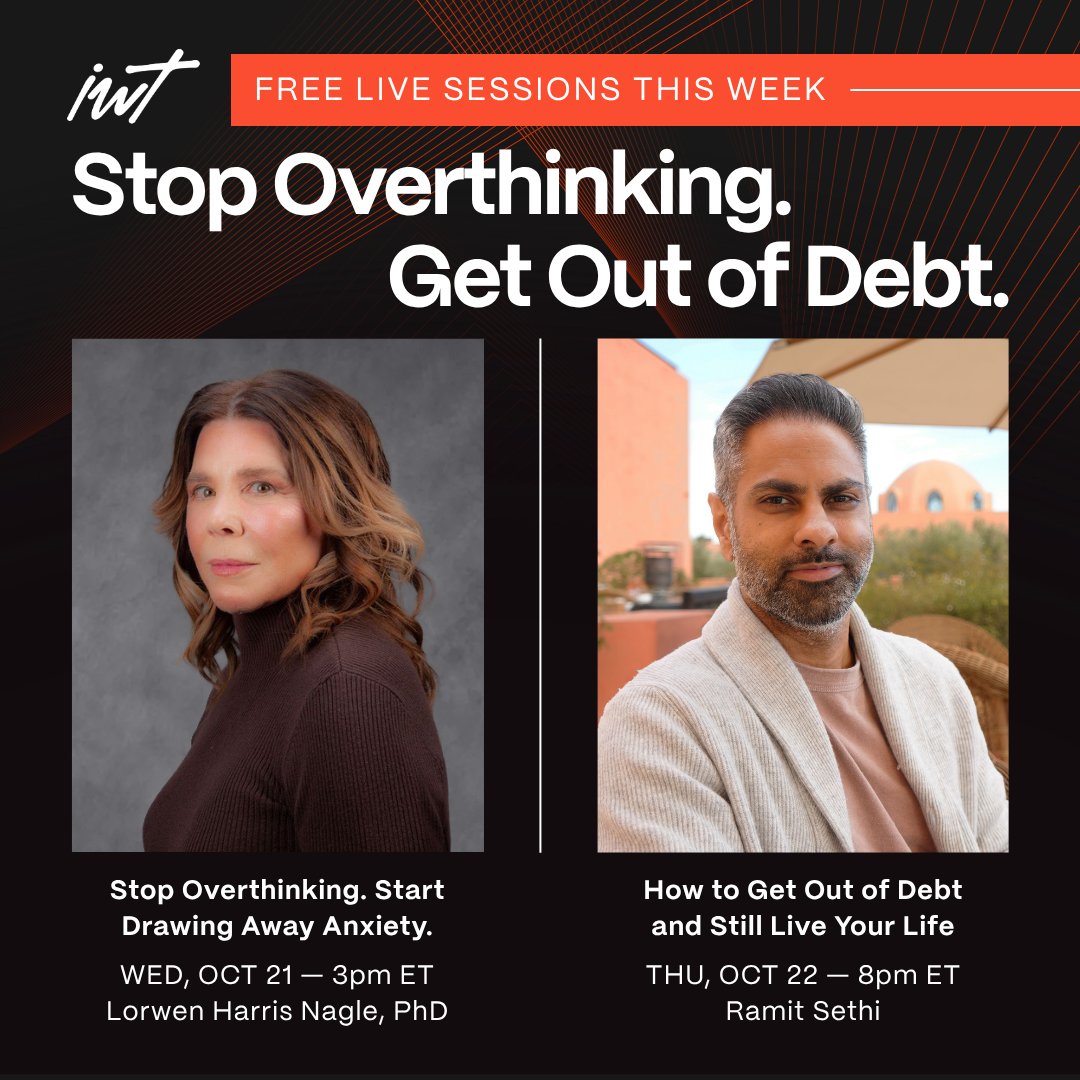
🔗 Register for Thursday: https://t.co/RyMuCGPGcP
Understanding your anxiety isn’t the same as stopping it. Sometimes the next step isn’t more analysis.
→ try a 90-second drawing exercise live (no artistic skill required)
→ learn why drawing works differently from going for a walk
→ leave with one thing to try the next time your brain won’t let something go
🔗 Register for Wednesday: https://t.co/AQPPulVrA3
I think that is great
For the biggest purchase of our lives, we should run the numbers first, then factor in the non-financial considerations second
Some people want to buy a house because they love renovating. Others for school reasons. Some just because. GREAT!
But very, very few people actually run the numbers. (It's currently cheaper to rent than to buy in 100% of the top 50 metro cities in the country.) They don't understand amortization, or opportunity cost, or that renting can sometimes (often) be a superior financial decision. Merely suggesting running the numbers makes people claim I "think owning a house is financially irresponsible"
I'm glad your house has worked out for you. I also think that for the biggest purchase of our lives, we should run the numbers, then decide
@climatepaige@cynthiamcgillis@brickywhat I do not say that buying is financially irresponsible, Paige
Nor do I say that you should live in an apartment your whole life (though if you want to and it makes financial sense, that's great)
Please read what I actually say