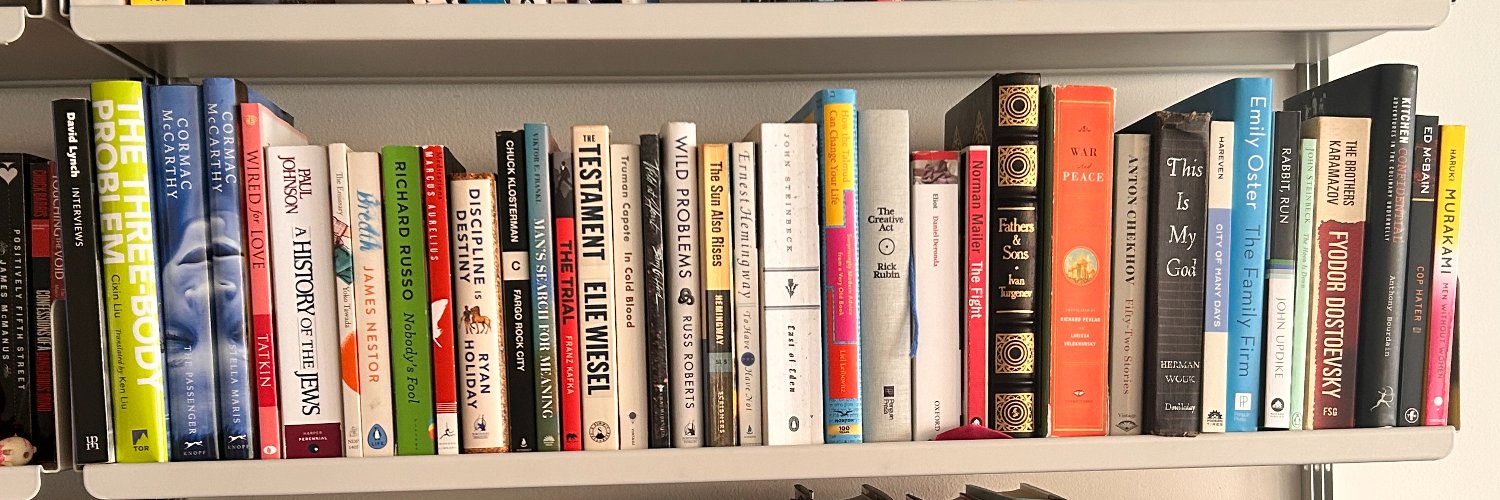
@SethAMandel I dunno, he will harp on his lived experience as a brown person and how he now understands the apartheid and will be part of the chorus of democratic candidates pitching this stuff and nobody will challenge him. So overall, still a net negative, I fear. Not for him.
USA. A Mexican restaurant. We had not yet ordered anything, and the food was already arriving.
Chips. Salsa. Unrequested. Free.
I stopped the waiter. "We have not earned these."
"They just come with the table, man."
They come with the TABLE. In my land, hospitality is a debt. Every gift creates an obligation, weighed carefully, returned in the proper season with interest of feeling. Here, the gift arrives before you have even proven you can pay for dinner.
This is not an appetizer. This is a declaration: we trust you. Eat.
I ate with the gravity the moment deserved. And then — I must report this calmly — the basket emptied, and a new one appeared.
"Did we…?"
"Refill," the waiter said. "It's bottomless."
Bottomless. They have wells of salsa. The supply lines of this nation are beyond anything my ancestors imagined.
My friend warned me. "Don't fill up on chips, dude."
Too late. I had accepted three baskets. Honor demanded each one be finished — an unfinished gift is an insult. By the time my actual food arrived, I was a ruined man.
I was not hungry. I was not comfortable. I had been defeated by a courtesy.
Generosity that arrives before the request cannot be repaid. It can only be survived.
I know the rule now. I have made my peace with the basket. One basket. Two at the most.
Who am I deceiving. There is no number of baskets I would refuse. The trust of a nation is in that salsa, and I intend to honor all of it.
I actually saw the same guy today with my son, same outfit, on UWS, and he asked me if I was a Jew and I said yes and he said whatever nonsense he said. But he was clearly just a ranting unstable person who should be institutionalized but that is different problem than the Mandani Hamas loving Jew haters. Was an unpleasant experience for me and one that NYC should handle. Just not the same.
@RyanHoliday Ryan, I am a huge fan. I have 5 of your books. But you clearly didn’t read past this book’s title. The premise should be familiar to you, mercy without justice harms the innocent. It is not about people being too considerate.
In April 1948, the Arab leadership of Haifa announced they wanted to evacuate the city.
Not that they were being forced out. Not that they had no choice. They announced it as a decision.
The Jewish mayor broke down in tears and begged them not to go. The British commander told them they were making a serious mistake. The Haganah’s chief officer promised full equality and peace to every Arab who stayed. The answer from the Arab Higher Committee in Beirut was evacuation anyway.
This is one of the most documented moments of 1948. It is also one of the least told.
Before any major military offensive in Haifa, between 25,000 and 30,000 Arabs had already left voluntarily. The fighting hadn’t reached most of their neighborhoods. What had happened was simpler and more damaging: the leadership had left first. British High Commissioner Sir Alan Cunningham documented it in an April 26 telegram, describing the abandonment by Arab municipal officials, military leaders, and the chief Arab magistrate as probably the greatest factor in the collapse of Arab morale in the city. When the people who are supposed to lead a community disappear, the community follows.
On April 22, a meeting was held at city hall to discuss a truce. The terms guaranteed full safety and civil rights to any Arab who stayed. Shabtai Levy, the Jewish mayor, broke down and pleaded personally with the Arab delegates, calling evacuation a cruel crime against their own people. The British commander urged them to reconsider. The Haganah promised equality and peace to anyone who remained.
The Arab Higher Committee in Beirut said go.
What Arab leaders said publicly in the months that followed tells the rest of the story.
The Economist reported in October 1948 that the departure was driven primarily by orders from the Higher Arab Executive, and that Arabs who stayed and accepted Jewish protection were being called renegades by their own leadership. Time magazine reported in May 1948 that the evacuation was partly driven by Arab leaders who hoped withdrawing Arab workers would paralyze the city economically. Emile Ghoury, secretary of the Palestinian Arab Higher Committee, told the Beirut Telegraph in September 1948 that the Arab states had agreed unanimously on the policy that created the refugees and must share in solving the problem. The Jordanian newspaper Falastin wrote in February 1949 that Arab states had encouraged Palestinians to leave temporarily to clear the way for the Arab invasion armies and then failed to help them return. Monsignor George Hakim, the Greek Catholic Bishop of Galilee, told the New York Herald Tribune in June 1949 that the Arabs of Haifa had fled despite the fact that Jewish authorities had guaranteed their safety and rights as citizens.
These aren’t Israeli sources. These are Arab leaders and Arab newspapers, in their own words, from 1948 & 1949.
The word Nakba was coined in August 1948 by a Syrian historian named Constantin Zureiq, a professor at the American University of Beirut. He used it to describe the catastrophic failure of seven Arab armies to defeat the newly declared State of Israel. In his own words, he wrote that seven Arab states declared war on Zionism in Palestine, stopped impotent before it, and then turned on their heels. He described Arab leaders whose declarations fell like bombs from their mouths but whose bombs were hollow and empty, causing no damage and killing no one. Zureiq made no mention of Palestinians as victims. He defined the Nakba as a self-inflicted Arab disaster, a failure of Arab leadership, Arab unity & Arab will.
That is what the word originally meant. A Syrian intellectual criticizing Arab governments for launching a war they were unprepared to win.
Somewhere between 1948 and the 1980s, that meaning was inverted entirely. The word that began as Arab self-criticism became the centerpiece of a narrative in which Arabs were passive victims & Israel was the aggressor
Edite. via: Melissa Steinberg Brodsky
Nicholas Winton helped 669 Jewish children escape the Nazis. His efforts went unrecognized for 50 years. Then in 1988, while sitting as a member of a TV audience, he suddenly found himself surrounded by the kids he’d rescued, now adults.
This day (April 16) in 1948, the British withdrew from Safed & 100s of Arabs immediately attacked the city’s ancient Jewish community.
The Arab commander cabled the Arab Liberation Army: “Our morale is very high, the young people are enthusiastic, we’re going to massacre them."
The outnumbered Jews chose to stay and fight rather than flee; and, along with a small garrison of Haganah fighters, they managed to repel the attack.
The Arab assault was part of the “civil war” portion of the 1948 War that was launched the moment the UN voted to partition Mandate Palestine into a Jewish state and an Arab state on November 29, 1947.
From day one, the Arabs rejected any Jewish state on any part of the Land.
In fact, on this same day (April 16, 1948), as Arab armies massed on the borders to invade the day the British Mandate ended, Jamal Husseini - acting chairman of the Arab Higher Committee - told the UN Security Council: “The representative of the Jewish Agency told us yesterday that they were not the attackers, that the Arabs had begun the fighting. We did not deny this. We told the whole world that we were going to fight.”
And “fight” they did. The Arabs answered the UN vote with immediate terror: buses ambushed, passengers shot, the Jewish market in Jerusalem stormed with Arabs armed with knives and axes, entire convoys wiped out on the roads with no prisoners taken and corpses mutilated. Jewish civilians were dying at a rate of more than fifty per week.
By March 1948, the Arabs were winning the “battle for the roads” and had the Jewish population on the verge of strangulation and, in Jewish Jerusalem, starvation.
This is where the wildly misunderstood Plan Dalet came into effect. It was a desperate military counter-offensive to reopen supply lines and prevent total annihilation. It was never a “blueprint for expulsion” as propagandists like to claim. The real ethnic cleansing intent came expressly and proudly from the Arabs whose war cry was literally: Itbah al Yahoud! — “Slaughter the Jews!”
On May 14, 1948, Israel declared independence. The next day, five Arab armies invaded with the explicit goal of wiping the Jewish state off the map before it could even breathe.
They failed.
That failure is what Arabs originally called the "Nakba" — “the catastrophe.” Its original use had exactly nothing to do with “refugees,” but was meant to give a word to the humiliating Arab failure to destroy the wildly outnumbered Jews and prevent Israel from being born.
In reality, the vast majority of local Arabs fled before Israeli forces arrived, urged on by their own leaders who promised a quick victory and return. Those who stayed, by the way, became full citizens of Israel with equal rights; and they make up more than 20% of Israel's population today.
Perhaps most importantly, there would NEVER have been a single refugee had the Arabs accepted the UN partition and/or chosen not to invade with genocidal intent.
Like so many anti-Israel narratives that reverse cause and effect today, the “Nakba” narrative inverts aggressor and victim. It erases the fact that the Jews were fighting for survival against a war of annihilation explicitly declared by the Arabs from day one.
What are some other ways cause and effect is reversed in modern anti-Israel discourse? Let me know your thoughts below.
I am the granddaughter of Holocaust survivors. My grandmother, Rifka, was married with four children when the Nazis murdered her husband. Alone with children to raise, her young son Avrumi, 12 years old, took her shift working so that she could prepare for Passover with her other children, sister and sister’s children.
When shouts of “Yudenrein!” “Jew round up” rang through the streets, Rifka took the children to the empty space below the floor boards to hide. As she was closing the hatch, Avrumi ran into the house. “Come! Come!,” she called frantically. “I can’t,” he said. “The Germans saw me, if I don't come out, they will know there is a hiding place. I just came to say goodbye.”
When the Nazis barged in, Rifka listened through the floorboards as her son told them he had run into the house in a random search for food. She would never see him again. Two more of her children as well as her sister, nieces and nephews were killed in subsequent round ups. Her brother had been killed earlier in the war.
Rifka was left with one son, Shlomo. 14 years old. They worked and hid in farms, in hay stacks and behind false doors. Exposed in the fields one day, they ran together, chased like animals by the Nazi’s. Shlomo told his mother, “If you don't let go of my hand, we will both die.” He let go.
Shlomo went one way, Rifka went the other. The Nazis shot him in the back. With no husband or children to live for, Rifka joined the Partisans in the woods. After the war, she lay sick in bed with no will to live. Shlomo, meanwhile, had survived the gunshot. After the war as he searched for family, he heard a woman singing a familiar song. “Where did you hear that song?” he asked her. She told him a woman who lay dying had been humming it. “Is she still alive? Please, bring me to her.”
And so Shlomo was reunited with his mother. In a displaced persons camp in Germany, Rifka married a man named Zalman whom she had met in the partisans. Zalman had lost his wife and three children to the Nazis but had one surviving son, Al. Together, Rifka and Zalman had two more children. Shep, born in the DP camp and Fayge (my mother) born in Bolivia where they moved after being sponsored by cousins.
Zalman fell ill and the family moved to NY for treatment. Unfortunately he died when my mother was 2.5 years old. Left alone with children to raise, Rifka bought a farm in NJ. Back then, being a single parent meant your children could be taken from you. She needed a husband fast.
A man named Berche, also a survivor, whose wife and two children were murdered, remarried after the war and had a daughter. His second wife, Dubye, died on the boat to America. A widower with a daughter to raise, he needed a wife to keep his daughter from a state run orphanage. Someone introduced Berche to Rifka and they married.
I was raised with their memories. Their tears and their fears. There was no Sabbath when my grandfather didn’t cry, no day my grandmother didn’t stare silently into a past I could not accompany her to. Each spoke 4- 5 languages. Each had rebuilt their lives over and over again...But despite their pain, they were full of love. Their pride in their families, their belief in goodness...I cannot imagine the depth of their loss and how much strength it took to simply continue breathing. Believing. Hoping. And loving.
I grew up with a family of half, whole and step siblings. A grandfather with whom I shared no blood but with whom I shared a heart. Cousins who drove me nuts but drove hours to see me. Aunts who were crazy and who I was crazy about. Uncles who slobbered me with kisses and showered me with love.
I grew up in a family that understood love and loss, the value of sacrifice and the vital importance of loyalty. I love them all for who they are and who they are to me. They are all part of the story and part of who I am.
#YomHashoa