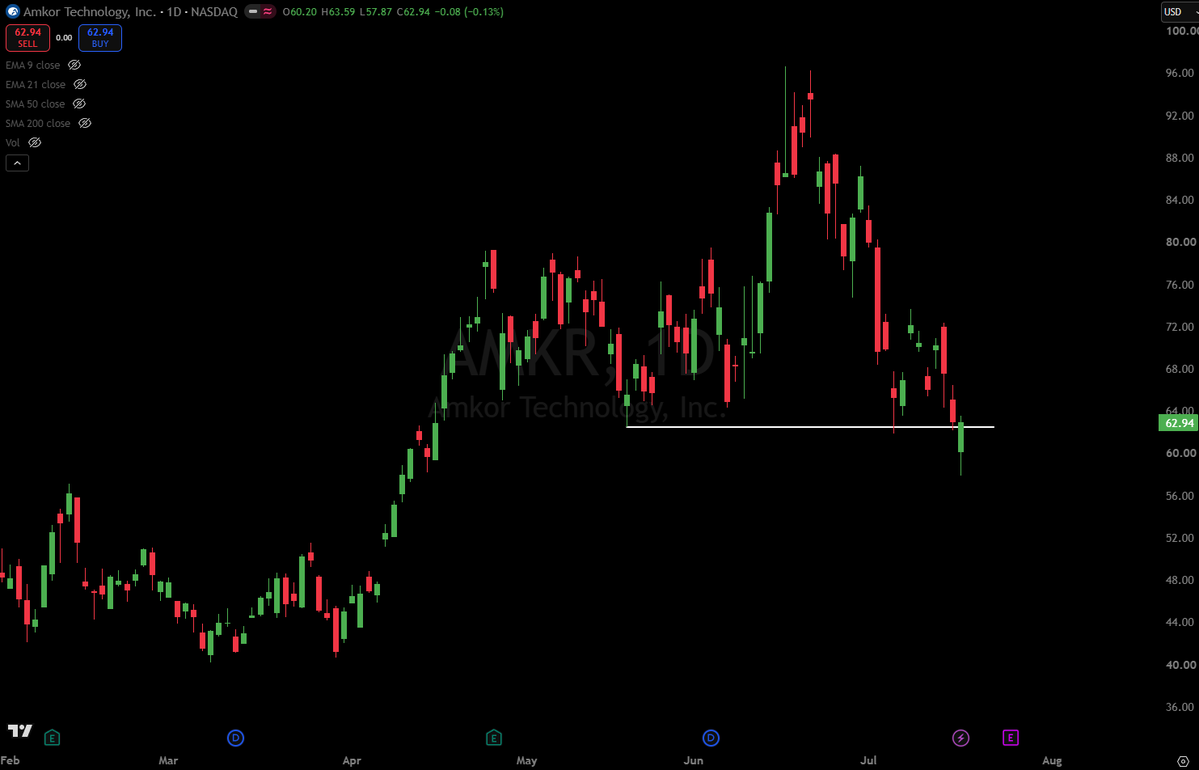
$AMKR just announced LG Chem has entered the semiconductor stripper market and is supplying mass volumes to Amkor. This is a new supply relationship for a key process chemical used in advanced packaging.
For Amkor, this adds a qualified second source for strippers. Reduces single-supplier risk and likely improves cost structure over time. Another sign Amkor’s scale is attracting high-quality chemical suppliers.
Supply chain read: LG Chem (not US-listed) enters a market dominated by $ENTG . Amkor’s diversification creates potential pricing leverage. No immediate threat to $ENTG, but worth watching for share shift. Competitive win for LG Chem in materials.
https://t.co/Q86daAuteO
Not investment advice.
The core thesis on $AMKR is its unique positioning in the supply chain. $AMKR is the only major OSAT in the US. Globally, they rank 2nd behind $ASX. They have a new $7B advanced packaging facility in Arizona and have partnered directly with TSMC.
Check out these posts I wrote for more info:
https://t.co/UmA4dZmKMZ
https://t.co/UHDH7DIacQ
https://t.co/VTNltMuwJR
$GRAB
This will be a long post and dive into many things including Grab's stock performance, some updated thoughts on my Grab thesis after having visited Southeast Asia last month, and new models for valuation.
Let's get into it.
First off, it's obvious that the stock has not performed in the way that most would like since I first initiated coverage, which was at $4.50. The stock is currently at $3.57, so it is down 20% in the 1.5 years since I laid out my thesis.
I think there are many reasons for this but the common theme behind these reasons are less about the fundamentals and more about the macro. It sucks to say that because it would imply that larger forces have played a role outside of the business's execution, but I do think that has happened and unfortunately has made the investment, so far, unsuccessful.
Two major macro disruptions hurt grab: the price of oil skyrocketing and the violent shift to AI stocks. On the price of oil, the company actually has weathered the storm very nicely if you look at their latest earnings, but the sentiment around companies in a region that is prone to oil price risk has been very bad. On AI, this is something that I quite frankly just didn't see coming. $UBER is an exceptional business and in my opinion undervalued, but the overhang of robotaxis has led the stock to not do much. The intensity of the AI buildout that began in early 2025 meant that capital was rotating and Grab wouldn't play a role in that infra cap-ex trade which meant it would be prone to be stuck. I can't even blame the market here, why invest in a company that is growing 25% when you can pick memory names or neoclouds growing 500%?
Having said that, the fundamentals of the business have only gotten better. I know that in this market environment, if you can't get 20% ROI in a week then your stock is failure, but if we are being a bit more realistic...things take time. HOOD took time. PLTR took time. Not every name explodes because of a datacenter contract and I believe that has given some people unrealistic expectations. Regardless, an opportunity cost is an opportunity cost and if the stock price is the basis for judgement, then the investment has not fully played out yet. Thankfully, my time horizon is greater than 1.5 years. I did have calls on GRAB in addition to shares for Jan 2027 and if there is not a meaningful change over the coming months, those calls will be worth nothing. That is the game -- if you take a risk with options, you have to be ready for the downside.
Second, my experience in Southeast Asia. I visited Singapore and basically used GRAB every single day, multiple times a day. My initial thesis was based on a simple idea: compounding earnings growth while consolidating market share within the region. Being able to build the superapp that can grow users would allow upsells and as margins expand, so would operating leverage, which would elevate the company's value. Nothing in my personal experience changed that thesis and if anything, actually witnessing how intense the product was in the region strengthened my conviction.
In order to deal with competition in the region, Grab either has to expand or offer better deals to out compete. With 50M+ MAU, I believe they have still under penetrated the region and have a significant runway of growth to go in order to achieve these goals. Ultimately, many of the competitors in the region are burning cash and can't produce a profit. Eventually, I believe that marketshare continues to consolidate and the one left standing should be able to benefit the most.
Third, valuation. So, I have updated my models and assumptions based on Q1 numbers. I believe the conservative, fair intrinsic value for the name is at $7.50 which is why I continue to own shares.
Q1 2026:
Revenue guidance: $4.04-4.10B (+20-22%)
Adjusted EBITDA guidance: $700-720M (+40%+)
Q1 revenue: $955M (+24% YoY)
Q1 Adjusted EBITDA: $154M (+46% YoY)
Loan book: $1.44B (+130% YoY)
Financial Services approaching EBITDA breakeven
Ongoing $400M accelerated share repurchase
Net cash balance remains one of the strongest in internet/platform companies
For 2027, I would use deliberately conservative assumptions across all three scenarios.
In the bear case, Grab grows revenue by 15% to approximately $4.7 billion and reaches a 19% adjusted EBITDA margin, producing roughly $900 million of adjusted EBITDA. In the base case, revenue grows by 18% to about $4.85 billion, while the adjusted EBITDA margin expands to 22%, resulting in approximately $1.07 billion of adjusted EBITDA. In the bull case, revenue grows by 22% to around $5.0 billion and the adjusted EBITDA margin reaches 25%, generating about $1.25 billion of adjusted EBITDA. These projections assume only moderate operating leverage, even though Grab has recently been expanding profitability faster than revenue.
For valuation, I would apply an 18x adjusted EBITDA multiple in the bear case, a 24x multiple in the base case, and a 28x multiple in the bull case.
Grab should trade at some discount to larger global platforms because of its geographic concentration in Southeast Asia and the risks associated with emerging markets. However, that discount is partly offset by Grab��s leading regional position, improving margins, financial-services growth, strong balance sheet, advertising opportunity, and continued share repurchases.
In the bear case, applying an 18x multiple to $900 million of adjusted EBITDA produces an enterprise value of approximately $16.2 billion. After adding roughly $5 billion of net cash, Grab’s equity value would be about $21.2 billion. Using approximately 4.05 billion diluted shares outstanding, that implies a value of roughly $5.25 per share, with a reasonable bear-case range of approximately $5.25 to $5.75.
In the base case, applying a 24x multiple to approximately $1.07 billion of adjusted EBITDA produces an enterprise value of about $25.7 billion. Adding roughly $5 billion of net cash results in an equity value of approximately $30.7 billion. Based on approximately 4.05 billion diluted shares, the implied value is around $7.55 per share. That supports a base-case valuation range of approximately $7.50 to $8.25 per share.
In the bull case, applying a 28x multiple to $1.25 billion of adjusted EBITDA results in an enterprise value of approximately $35 billion. After adding roughly $5 billion of net cash, Grab’s equity value would reach about $40 billion. Dividing that by approximately 4.05 billion diluted shares produces an implied value of roughly $9.90 per share, supporting a bull-case range of approximately $9.75 to $11.00.
My preferred valuation framework therefore produces a bear case of $5.25 to $5.75 per share, a base case of $7.50 to $8.25 per share, and a bull case of $9.75 to $11.00 per share.
The base case does not require aggressive assumptions. It only assumes that Grab continues growing at a healthy but moderating rate, improves margins as the business scales, and receives a valuation multiple that remains below many higher-growth global technology and marketplace companies.
A valuation of $8.50 per share is also defensible without relying on an extreme bull case. One path would be for Grab to generate roughly $5 billion of revenue and achieve an adjusted EBITDA margin of 23% to 24%, producing approximately $1.15 billion of adjusted EBITDA. At a 24x multiple, that would imply an enterprise value of roughly $27.6 billion. Adding approximately $5 billion of net cash would produce an equity value of around $32.6 billion, or approximately $8.05 per share before factoring in additional share repurchases or stronger cash generation. A slightly higher EBITDA result, a modestly higher multiple, or a lower diluted share count could push the valuation into the $8.50 range.
Another path to $8.50 would be a moderate valuation rerating. If Grab generates approximately $1.1 billion of adjusted EBITDA and trades at 26x adjusted EBITDA rather than 24x, its enterprise value would be approximately $28.6 billion. After adding roughly $5 billion of net cash, the equity value would be about $33.6 billion, which translates to approximately $8.30 per share using 4.05 billion diluted shares. Additional buybacks, higher net cash, or slightly stronger earnings could bring the implied value closer to $8.50 to $9.00 per share.
The market may also be underestimating Grab because it is still often viewed primarily as a ride-hailing and food-delivery company. In reality, Grab is developing several potential profit engines. Mobility can continue generating strong margins and cash flow, delivery benefits from greater scale and operational efficiency, financial services could become a meaningful earnings contributor as the loan book grows, and advertising remains relatively early in its development. At the same time, artificial intelligence and automation may improve driver utilization, merchant performance, customer targeting, and corporate efficiency.
In all of these scenarios, I am also not anticipating revenue growth of 30% or above. This is the wild card, given the company is expanding to Taiwan and has a host of new initiatives that they have been getting into with M&A, if they can reaccelerate to 30%+, it changes all assumptions and could further lead to a rerating.
Overall, I would view approximately $7.50 as a conservative base-case intrinsic value if Grab simply executes on its current trajectory. A value closer to $8.50 is reasonable if the company delivers modest upside to current expectations, continues expanding margins, repurchases shares, and receives even a small valuation rerating from the market.
So, those are my updated thoughts. Some have asked why I don't talk about the name everyday, it's simple: there isn't much to discuss. The name is stuck based on the market's lack of interest which is why I think the discount has become so intense. I continue to hold and until I feel the thesis changes dramatically, if it doesn't, then I will continue to engage in the most boring part of investing: being patient and trusting a thesis can play out.
I think if you’re looking to buy the AI dip
5 names I think are worth looking at:
• $AMKR - Packaging is one of the largest bottlenecks in the chip market right now. Read $TSM earnings.
Amkor is one of the only companies that can do it at scale. And they are US based not Taiwan. This trade just got even stronger with the new china 🇨🇳 us election interference tension
• $NBIS
Kimi k3 will hurt companies like Anthropic/openai but benefit companies like Nebius who own the computer and have the software layer
Cheaper models = more inference = more compute demand
$PENG
• monster earnings + AI infrastructure buildout play.
Went up to $90 now back to $64.
Exactly what will be needed if open source continues to take the lead
$NOK
The next layer of AI is physical AI
This can’t happen without a network for them to operate on as a fleet. This is exactly why NVDA invested in Nokia.
Also their AI/optics biz is up 49% YoY
$MRVL
Down 40% from highs
But if AI shifts towards custom chips / ASICs instead of everyone just buying $NVDA GPUs, Marvell is one of the biggest beneficiaries
Jensen calling for $1T market cap + its being added to S&P
I think if you’re looking to buy the AI dip
5 names I think are worth looking at:
• $AMKR - Packaging is one of the largest bottlenecks in the chip market right now. Read $TSM earnings.
Amkor is one of the only companies that can do it at scale. And they are US based not Taiwan. This trade just got even stronger with the new china 🇨🇳 us election interference tension
• $NBIS
Kimi k3 will hurt companies like Anthropic/openai but benefit companies like Nebius who own the computer and have the software layer
Cheaper models = more inference = more compute demand
$PENG
• monster earnings + AI infrastructure buildout play.
Went up to $90 now back to $64.
Exactly what will be needed if open source continues to take the lead
$NOK
The next layer of AI is physical AI
This can’t happen without a network for them to operate on as a fleet. This is exactly why NVDA invested in Nokia.
Also their AI/optics biz is up 49% YoY
$MRVL
Down 40% from highs
But if AI shifts towards custom chips / ASICs instead of everyone just buying $NVDA GPUs, Marvell is one of the biggest beneficiaries
Jensen calling for $1T market cap + its being added to S&P
This is starting to become one of the best buys in the market, in my opinion.
Need to hold the 100MA here. If not, we could see a test of the 200MA around the low $50s.
$AMKR is the largest U.S.-headquartered OSAT (Outsourced Semiconductor Assembly & Test) company and the #2 global player behind ASE.
They sit at one of the most important parts of the semiconductor supply chain, handling the advanced packaging and testing that connects wafer fabrication to the finished chip.
The AI opportunity is massive.
Advanced packaging is becoming one of the biggest bottlenecks in AI infrastructure, and Amkor is ramping high-density fan-out (HDFO), System-in-Package (SiP), flip-chip, wafer-level packaging, and other advanced solutions for AI accelerators, HPC, premium smartphones, and automotive.
Q1 2026:
• Revenue: $1.685B (+27% YoY)
• Record advanced products revenue: $1.372B
• Gross margin: 14.2%
• EPS: $0.33
Q2 guidance:
• Revenue: $1.75B-$1.85B
• Gross margin: 14.5-15.5%
• EPS: $0.42-$0.52
2025 revenue reached approximately $6.7B, and consensus expects more than $7.6B in 2026 as AI packaging demand accelerates.
Management expects AI-related advanced packaging revenue to roughly triple this year, with the biggest acceleration expected in the second half as new data center compute programs ramp.
They’re investing aggressively as well, with $2.5-3.0B in 2026 CapEx to expand advanced packaging capacity.
Revenue mix is also diversified:
• Communications: 44%
• Computing / AI Data Centers: 21%
• Automotive & Industrial: 21%
• Consumer: 14%
Amkor also benefits from a diversified manufacturing footprint across Asia, the U.S., Europe, and Japan, positioning it well as customers seek resilient semiconductor supply chains and CHIPS Act-related expansion.
Main competitors:
$ASX (ASE Technology) - Global leader
$AMKR - #2 globally and largest U.S.-based OSAT
$JCGIY (JCET) - #3
$PTIYY (Powertech)
Advanced packaging continues to be one of the strongest secular growth areas in semis, and Amkor is positioned directly in the middle of that trend.
If this market gives us the opportunity, I think this one looks significantly undervalued over the long term.
Powertech Teams Up with Broadcom to Advance Panel-Level Packaging with US$400 Million Singapore Joint Venture
Powertech Technology Inc. (PTI), Taiwan’s second-largest semiconductor OSAT (outsourced semiconductor assembly and test) company, announced on July 16 that it will invest US$400 million (approximately NT$12.8 billion) to establish a joint venture with AI ASIC leader Broadcom in Singapore. The partnership aims to accelerate the development and commercialization of panel-level packaging (PLP) technologies, marking a significant strategic move into next-generation advanced packaging for AI semiconductors.
When President Trump said we were bringing semiconductor manufacturing back to America, he meant it.
Today, TSMC announced another $100 billion investment in the United States, bringing its total commitment to $265 billion.
Promises made. Promises kept. 🇺🇸