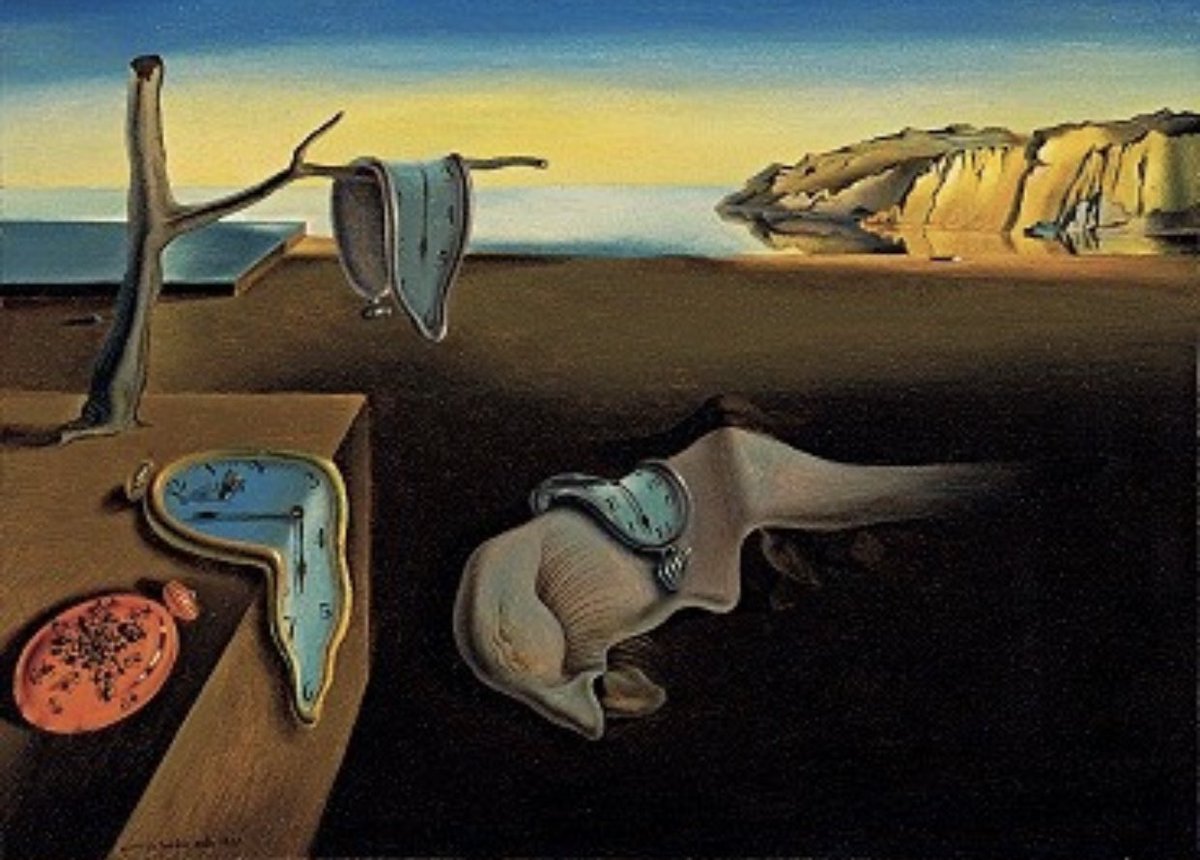
Salvador Dalí painted some of the trippiest art ever.
His surrealist work expressed the unconscious mind (eg. the iconic 1931 “Persistence of Memory”).
To tap this creative space, Dalí frequently used a micro-nap technique called “slumber with a key”
In his words:
1️⃣ “You must seat yourself in a bony armchair, preferably of Spanish style, with your head tilted back and resting on the stretched leather back.”
2️⃣ “Your two hands must hang beyond the arms of the chair, to which your own must be soldered in a supineness of complete relaxation.”
3️⃣ “In this posture, you must hold a heavy key which you will keep suspended, delicately pressed between the extremities of the thumb and forefinger of your left hand.”
4️⃣ “Under the key, you will previously have placed a plate upside down on the floor.”
5️⃣ “The moment the key drops from your fingers, you may be sure that the noise of its fall on the upside down plate will awaken you.”
Dali wanted to achieve a state of “sleeping without sleeping”, which he said was the”most appropriate to the art of painting.”
In scientific terms, Dalí was trying to get to hypnagogia (a transition state between wakefulness and sleep, where individuals can experience unusual sensory perceptions or hallucinations).
While in hypnagogia, the judgy conscious mind takes a back seat. And the semi-conscious mind is able to make new insights and connections that might otherwise *not* have been made.
Back to the “Persistence of Memory” painting: Dali said the inspiration for the melting clocks was the image of melting camembert cheese. But late in life, Dalí also credited Albert Einstein’s theories on space and time as another creative input.
Perhaps unsurprisingly, Einstein was also a practitioner of micro-naps while sitting in a chair. But instead of “slumber with a key”, Einstein did “slumber with a spoon.”