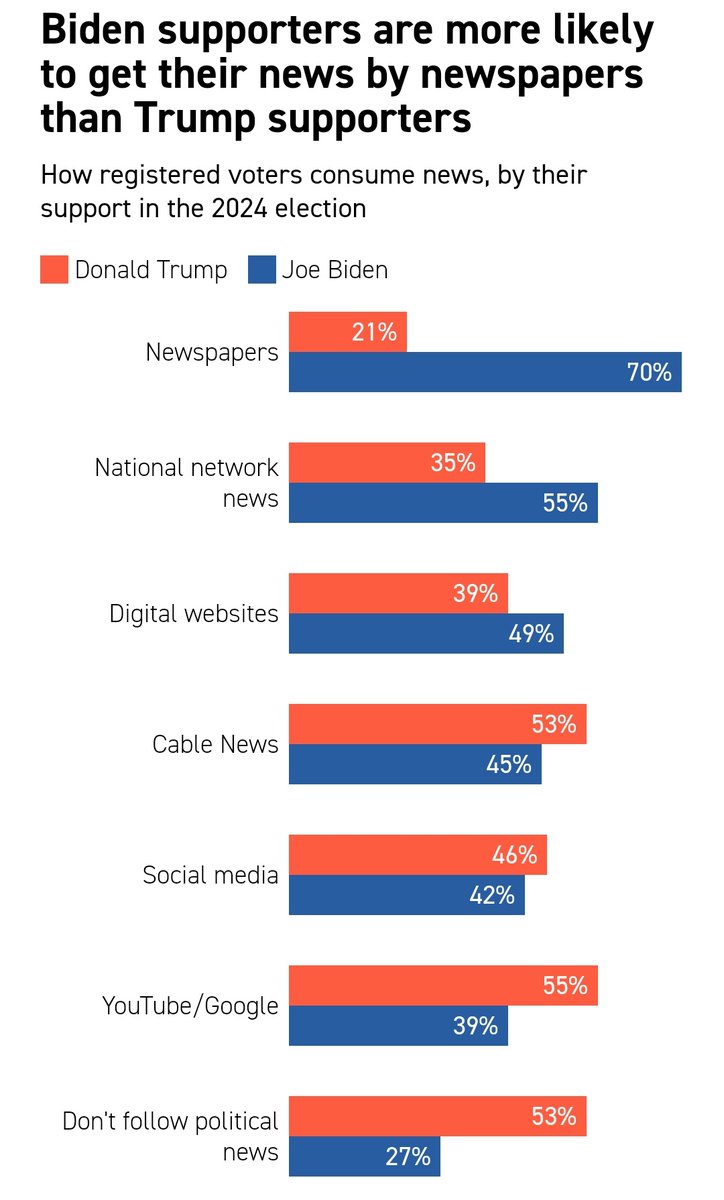
"These studies reveal an interesting fault line. While most women get their news from TikTok, most young men get their news from YouTube, X, and Reddit."
Also, if you read a newspaper, odds are 3-to-1 you voted Harris. If you don't consume news, odds are 2-to-1 you voted Trump.
"My take, worth only that I've thought about this:
Our media environment is currently fucked in ways that defy space and time. And a lot of the reason for that is the ad revenue market of the Internet, and 40 years of the Bork doctrine allowing unfettered media consolidation. (The devil's bargain of the DMCA).
In 1999-2001, there were 39 competing ad exchanges, and they competed on who their clients were and what percentage of revenue they shared. About 65-70% of the ad rev went to websites that hosted the ad exchange's links/modules.
There are 12 ad exchanges now, one of which is Google, and 7 of the others resell Google AdSense. The rev share is about 30-33%, outside of pornography, where it's about 50%.
Oh, and then Facebook mostly successfully made a walled garden of the social internet, and gulped about 30% of the ad revenue available.
It used to be possible to run a web comic or a modestly successful blog, or do a review site on a particular type of good and make a reasonable to even comfortable middle class living. It's not, anymore, because the ad revenue per impression is half of what it used to be, and getting found on search engines means homogenizing what you do to appeal to Google's preferences.
So. Journalism costs money. It used to be that you could put ads next to news, charge local businesses for the ads, charge people per copy to buy the ads, and to get people to look at ads, you had to put news that was relavant to them in between the ads. Your local gentry of car dealerships and restaurants would buy ads based on your circulation numbers...and running a newspaper was a capital intensive purchase. So the owners tended to be in the same social circles as your car dealership owners and restaurant franchise owners, and there was some class solidarity and some quid-pro-quo about keeping failsons and faildaughters escapades with law enforcement or drunken parties buried on page D27. You know, the Brock Turners of the world getting insulated from consequences.
Newspaper owners were part and parcel to that process.
Doing good journalism takes institutional support. There are subscriptions for public records and stock image services and, and, and. Basically, to work as a journalist requires about $1,000 to $1,200 worth of subscriptions per year; fortunately, you can buy multi-seat licenses for these services (for now).
Good journalism takes time, and tracing down sources, and arranging interviews, and writing and editing. And journalists, like cats, need to be fed every now and then, and they really do work best if they've got a place where they can plug in a computer and mostly keep the rain off of them. Oh, and get cups of coffee, because deadlines wait for no-one.
The average entry level journalism position pays about $42k/year. In major metros. And less in smaller cities and towns if there are any jobs open. To get that entry level journalism position, you usually have to do 1-3 years on a half-pay or zero pay internship.
While living in a major metro.
Joohn, what sort of living accommodations can you get where you live working on a half-pay internship for $21K a year? Do you get your own refrigerator carton under an overpass, or do you need to get a roommate to share it with you?
So: Ad revenue evaporated in the late 1990s, as it all went online. Newspapers shifted to online advertising, and it was still less than they'd made in the old days, but, hey, if we efficientize the process through True Performance Management, we can remove 10% of our lowest producers every year and still make this work!
Narrator: It turns out that using TPM to rate effectiveness of journalists who spend time researching their stories doesn't work.
News outlets started to falter, and then they took on outside investors, who promised New! Improved! Efficiencies! Influencers! Crowdsourced Journalism! Writers Working For Exposure!
And we so a decade of journalistic businesses get swallowed hole by new media, and PE vultures, who were convinced they could load a newspaper with more debt, pay themselves handsomely by making it leaner and more efficient by removing deadweight like fact-checkers and copy-editors...aaaaand even that didn't work.
Which led to newspapers being bought as distressed assets.
Meanwhile, it turns out that oil companies and foreign governments *really like* owning majority stakes in right wing news sources.
Notice that you never have to sign in to read Fox News adjacent journalism, but you do to read the NY Times or the Philadellphia Enquirer?
Yeah, they're being subsidized and have the editorial independence of Kim Jong Un's spokesperson, who likely has pictures of his children playing happily with well fed North Korean soldiers before he goes out to repeat the party line.
So, rant about media aside:
The Democratic Party made three mistakes-in-retrospect.
A) They thought that mere competence could overcome misogyny and racism.
B) They thought that the news media would, at some point, treat Trump as harshly as it treated Biden. It didn't, because doing so would'v'e cost them mountains of money, or gotten their billionair owners upset.
C) They though the American public was media literate enough to differentiate between actual policy positions put out by Harris and whatever the fuck Trump was lying about today.
I *hate* being right, because I liked Harris as a candidate, but we now know that when campaigning against a fascist, you have to have a pallid scrotum bearer, who's energetic, glib and combatative as your candidate. Mere competence is not enough.
~14 million Biden voters didn't like admitting a Black woman was smarter than they were, more competent than they were, and stayed home.
(If we elected Presidents based on raw competency rather than 'does the Black woman who's smart and laughs make my penis irrelevant?', we'd've had a debate between Katie Porter and Donald Trump, and she'd have fucking cut him off every time he pivoted to immigration.)"
- Ken Burnside (https://t.co/aUyalNOKBw)
Social media basically brought us to something like an oral culture:
- We're not illiterate in the sense that we can't read, our writing approximates our speaking
- Our writing isn't as complex because it doesn't function like text used to
- We both archive everything and trust our collective memory -- everything is saved, bookmarked, etc. but never revisited (when was the last time you bookmarked a website or even checked your own likes?)
- For information to be remembered it has to be recirculated, repeated, or go viral or we forget because time moves so fast (similar to storytelling?)
- You can't look things up easily because we live in a perpetual now -- if you don't understand the context of the discourse, you need to ask someone to catch you up
- This also makes society very participatory
- This has weird knock-on effects like needing to *always* be online to know what's going on in the world - you can't just hermit away and study, at a minimum you're lurking
- Because of the way the Internet treats time, when we do revisit the past, it's marked by events vs. actual moments in time - do you remember 2017 or what was meme-worthy then?
- There's always a current thing
- Language evolves quickly; things feel dated quickly
- We determine if things are truthfulness through vibes/tribal consensus - there are authorities but they're cults of personality vs. institutions
- You can't "just learn" things, you need to be in the right networks
- Memes, copypastas, etc. are very similar to oral cultures
- I actually don't know if any of this is right so feel free to correct me
"I wish it need not have happened in my time," said Frodo.
"So do I," said Gandalf, "and so do all who live to see such times. But that is not for them to decide. All we have to decide is what to do with the time that is given us.”
The apparent election victory of Donald Trump, has consequences for the world, that I'm sure, very few people, have ever thought of.
The world has just been sent, in an incredibly dangerous direction.
1/🧵
Terwijl alle ogen (terecht) gericht zijn op de verkiezingen in de VS, staat er in Brussel de komende twee weken iets dat misschien wel net zo belangrijk is op de agenda: de hoorzittingen van de kandidaat-Eurocommissarissen.
Waarom dit zo belangrijk is en wat je kunt verwachten:🧵
Does anybody else think it's weird that we can't mobilize to stop climate change but within an incredibly short time span we've gone from having never heard of Chat GPT to building nuclear generators in order to feed its rapacious energy needs?
TikTok admits in their own research:
“compulsive usage correlates with a slew of negative mental health effects like loss of analytical skills, memory formation, contextual thinking, conversational depth, empathy, and increased anxiety.”
https://t.co/tZHMtekExg
Notable to me that every for-profit information hub is injecting AI into every corner of their services while the largest nonprofit information hub is fighting it off like their the Night's Watch
Moet niet gekker worden.
Om tegemoet te komen aan de toenemende vraag naar biomassa wordt nu, bij gebrek aan #bossen in de EU, VK en de VS, gekeken naar Noord-Korea en Afghanistan voor de import van versnipperde bossen.
Het plan van de Britse overheid om biomassa te importeren uit Noord-Korea en Afghanistan, wordt wereldwijd bekritiseerd door #natuurorganisaties en beschreven als "crazy".
In Engeland staat de grootste biomassverbrander van de wereld.
De #overheid geeft aan dat biomassa een "belangrijke rol" speelt bij het koolstofvrij maken van alle sectoren van de #economie in de jaren voorafgaand aan 2050, en heeft de afgelopen twee decennia meer dan £ 20 miljard verstrekt aan bedrijven die biomassa gebruiken in de #energie- en warmtesector.
Ongeveer een derde van de biomassa die in het VK wordt gebruikt, wordt geïmporteerd. In 2021 kwamen 9,1 miljoen ton #houtpellets voor gebruik in energieproductie uit het buitenland - ongeveer 76% uit Noord-Amerika en 18% uit de EU. Maar er zijn niet meer genoeg bossen in deze regio's om de mega grote uitbreiding van biomassa-energie te leveren.
Dit alles tegen de achtergrond van toenemende #stormen, #overstromingen, #bosbranden en #klimaatverandering, terwijl hele regio's te maken krijgen met hongersnood als gevolg van door het weer veroorzaakte mislukte oogsten, is de blijvende en koortsachtige inzet van overheden op biomassa absurd en onacceptabel, volgens @comschonelucht
Fundamenteler nog, de veronderstelling dat biomassa-energie daadwerkelijk de uitstoot van #broeikasgassen kan verminderen, is een politieke afspraak. #Wetenschap heeft al langer het tegendeel aangetoond.
Een recent rapport toonde aan dat #Drax, de grootste biomassacentrale van het Verenigd Koninkrijk, verantwoordelijk was voor vier keer meer #koolstofemissies dan de laatste overgebleven kolencentrale van het land die vorige maand sloot.
De exploitant van Drax is, net als Nederlandse RWE, bezig om biomassa-energie samen met het project koolstofafvang en opslag (#BECCS) te vervolgen om zo, met behulp hiervan, huidige #subsidies te bestendigen en meer overheidssubsidies te genereren voor de toekomst.
Why of why?
Hoe simpel kan het zijn. Waarom niet
inzetten op meer #bosherstel en planten van bos in combinatie met een slimmer van ‘minder’ energie? In plaats van meer en meer subsidies, voor meer en meer boskap, voor meer #energie?