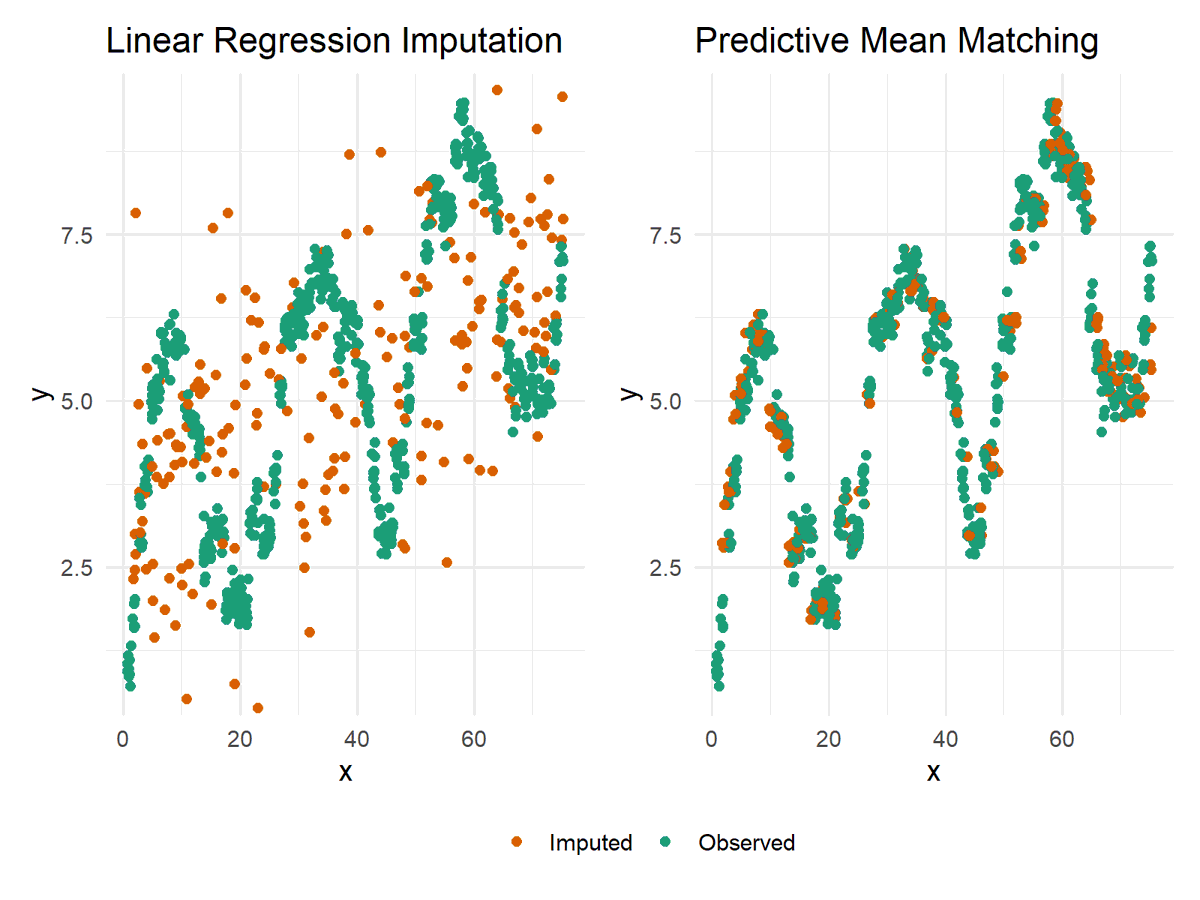
When dealing with missing data, selecting an imputation method that aligns with the data's underlying structure is critical. The attached plot compares Linear Regression Imputation (left) and Predictive Mean Matching (PMM) (right) for handling missing values in non-linear data.
Key Observations:
🔹 Linear Regression Imputation relies on a linear model to predict missing values. As seen in the left panel, imputed values (orange points) align with the regression model but fail to capture the non-linear patterns present in the observed data (green points). This limitation can distort relationships and reduce the accuracy of the imputed data.
🔹 Predictive Mean Matching addresses this issue by selecting observed values closest to the predicted ones. The right panel demonstrates how PMM preserves the natural variability and non-linear patterns of the data, ensuring the imputed values integrate seamlessly with the observed values.
For a detailed explanation of Predictive Mean Matching and how to apply it in R programming, check out my tutorial here: https://t.co/wwsXtaq5GQ.
Discover Missing Data Imputation in R in my 8-week interactive workshop, starting February 20, limited to 15 participants. Take a look here for more details: https://t.co/Zvzj0dl2xG
#RStats #StatisticalAnalysis #database #VisualAnalytics
Understanding the difference between t-tests and z-tests is essential for accurate statistical analysis. Both tests help compare means, but they differ in application based on sample size and population variance.
✔️ t-tests are ideal when the sample size is small or the population variance is unknown. They account for increased variability with smaller samples, providing a more accurate analysis.
✔️ z-tests are best suited for large sample sizes where the population variance is known. They are simpler and faster, making them practical when conditions are met.
❌ Incorrect test selection can lead to misleading conclusions, especially if the sample size is small or if assumptions about population variance are incorrect.
❌ Overlooking assumptions can result in inaccurate p-values and confidence intervals, undermining the validity of your results.
🔹 In R: Use the t.test() function for t-tests and z.test() from the BSDA package for z-tests.
🔹 In Python: Utilize scipy.stats.ttest_ind() for t-tests and ztest() from the statsmodels package for z-tests.
The visualization compares t- and z-distributions, showing how the t-distribution with degrees of freedom equal to 10 is broader, reflecting the higher variability typical of smaller sample sizes.
For a deeper dive into this topic and more, check out my online course on Statistical Methods in R.
More information: https://t.co/7YQCRDKSPO
#datascienceenthusiast #Rpackage #RStats #R4DS
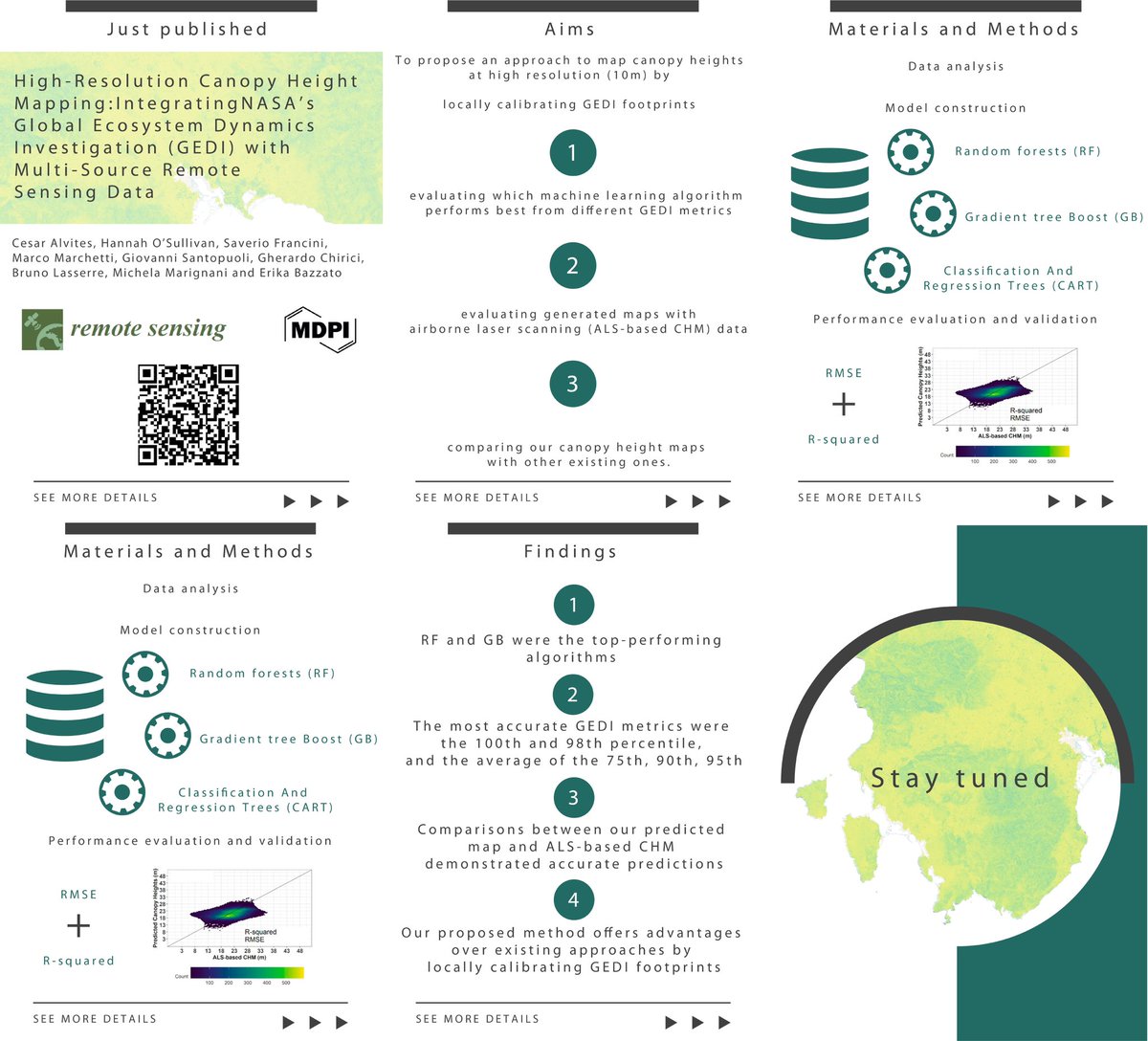
🌳📊Paper Alert: We developed a web app on GEE to map tree heights @globalforests , e.g., Italian forest @GEDI_Knights@NASAEarthData!
Study: https://t.co/MbEsFVJwv5
App: https://t.co/VIQLrenxVT
✅ HR map (10m)
✅ App set e.g, ForestMask
✅ High Precision (RMSE-17% for Italy)
#LatestPaper
☘️High-Resolution #Canopy Height Mapping: Integrating NASA’s Global Ecosystem Dynamics Investigation (#GEDI) with Multi-Source #RemoteSensing Data
by Cesar Alvites, Hannah O’Sullivan, Saverio Francini, Marco Marchetti et al.
https://t.co/E2dgZM9eJo
#vegetation
@Terrasupport__ Hello👋Thanks! I just sent the message to the Support Team to receive details. However, I think that a public thread can be very useful for all the community! Many people posed the same question for the most important exchanges (e.g., binance, FTX and https://t.co/FhUGtrU1pi)!!
@Customer_desk_ Hello👋Thanks! I just sent the message to the Support Team to receive details. However, I think that a public thread can be very useful for all the community! Many people posed the same question for the most important exchanges (e.g., binance, FTX and https://t.co/FhUGtrTtzK)!!
@dalilello@Momir89278563@CriptovalutaI l’eventuale plusvalenza tassabile (una volta verificato il superamento della soglia,art. 67 del TUIR), è data dalla differenza tra:
-Il valore di carico della valuta virtuale;
-Il valore di realizzo dell’operazione di vendita della valuta virtuale.
Vedasi https://t.co/3mXDnb0Smm