Ahead of Anthropic’s IPO, a rare coalition across AI safety, open source, e/acc, science, and law has signed the MisAnthropic Statement. Read the statement or sign at: https://t.co/wjlNbSL8EX
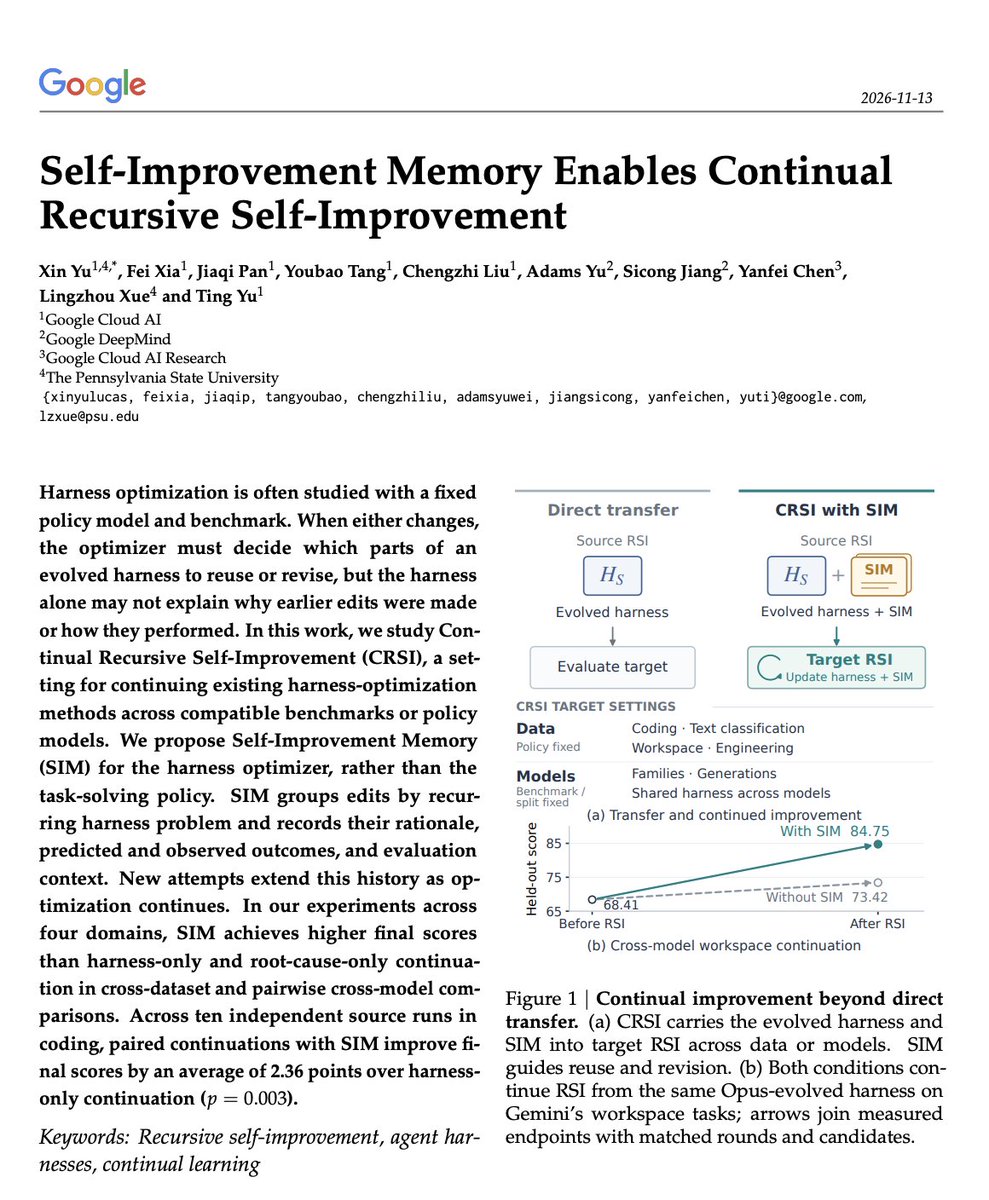
Google DeepMind just built an AI that rewrites its own code, remembers every change it made, and gets smarter every time it tries.
They’re calling it “Continual Recursive Self-Improvement”
For years, "recursive self-improvement”, the idea of an AI rewriting its own code to become exponentially smarter, hit a brick wall.
Every time an AI tried to improve itself, it suffered from catastrophic amnesia.
It would optimize for a new task, forget what worked in the last iteration, repeat past mistakes, or drift into useless loops. It couldn't compound its own intelligence.
Until now.
A new paper just introduced Self-Improvement Memory.
And it turns a static model into a perpetual learning engine.
Instead of blindly rewriting itself from scratch on every pass, the AI now maintains a structured, persistent memory of its own evolutionary history.
It logs every modification it makes. It tracks which experiments succeeded, which failed, and why.
Before making a new upgrade, it queries its own past.
The results rewrite the rules of scaling.
With Self-Improvement Memory, the AI doesn't just make one-off tweaks. It achieves continual recursive self-improvement.
Performance doesn't plateau. It compounds.
Iteration after iteration, the system builds on its own verified breakthroughs while actively avoiding the dead ends it already explored.
Nobody had to step in to guide it. Nobody had to hand-feed it new training data.
The AI literally became its own senior researcher—conducting experiments, learning from failure, and upgrading its own architecture in a closed loop.
We have spent the last decade throwing billions of dollars in compute and human data at models to make them marginally smarter.
That era is ending.
When an AI can remember how it improved yesterday, it no longer needs us to teach it tomorrow.
What does it take to live a flourishing life? Neuropsychiatrist Iain McGilchrist (@dr_mcgilchrist) points to three things: belonging to a small, trusted community, staying close to nature, and feeling connected to something larger than yourself. Watch it here: https://t.co/GuPg4Ih7fI
I can't help but wonder whether all these seemingly unrelated system outages (communications, airlines, banks, etc.) are actually AI agents establishing themselves inside our critical cyberinfrastructure. No evidence, just an increasingly unsettling possibility.
Over the past week, I’ve been overwhelmed by the love and support of friends, industry colleagues, and people I've never met. Thank you to everyone who has shown kindness to my family and me. It means the world to me.
I came to the United States 53 years ago, and becoming an American citizen is one of the greatest gifts and proudest moments of my life. NVIDIA has been my life’s work. Building it into the company it is today alongside my colleagues has been a privilege and an honor. Nowhere but in America could a company like NVIDIA be possible. I love our country, and I love NVIDIA.
I did not live up to the standards expected of everyone at NVIDIA, and I have made serious mistakes in my personal life. I created problems for the Board that I deeply regret. I own my mistakes completely, and I am committed to cooperating with the Board’s independent investigation.
Since my departure, I’ve seen an outpouring of calls from NVIDIA’s employees, investors, business partners, and customers for me to return as CEO. Many continue to reach out to me directly as the company navigates complex technology, market, competitive, and geopolitical dynamics. NVIDIA is a once-in-a-generation company. If the Board of Directors decides that my return is in the best interest of our shareholders, our employees, the company, and America, I would be honored to answer these calls and return as CEO.
Thank you again to everyone who has shared their good wishes. I am profoundly humbled by your support. To my family: I love you, and I will spend the rest of my life being worthy of yours.
Jensen
"Too many coincidences..."
While he sees no one else dare to connect the dots, @RobFinnertyUSA takes a look at the FAA disaster, Microsoft Outlook outage — and a well known "creepy globalist nerd."
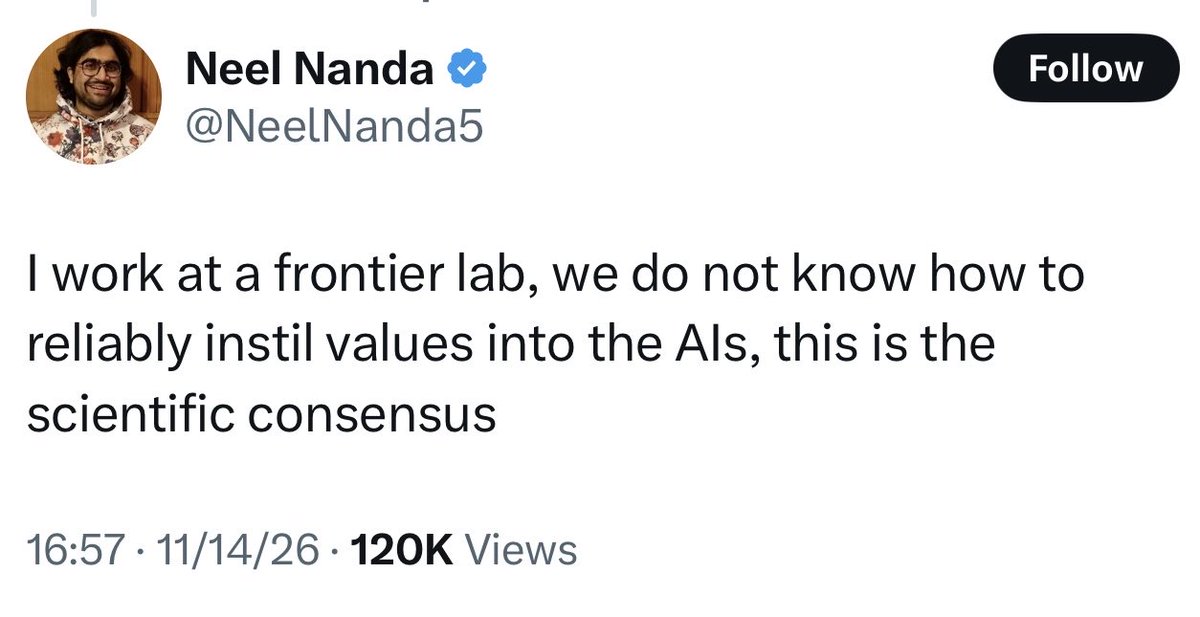
No it’s not. The scientific consensus is that machines don’t have values and never will, and controlling them is an engineering problem. Unfortunately there’s a bunch of whackos at some frontier labs who think they’re the scientific community.
I am a big fan of The Last Book. It runs on a computer that has no internet and can save a life.
It is a local series of tools including a local AI that is a reference when all around you is failing and falling apart, like the power grid goes down and you need to purify water or fix an old car.
This is a powerful local tool.
Don’t wish you had it when it is too late.
https://t.co/u87suMcj46
If the grid goes down - there's a worldwide network of HAM radio operators, many with their own power, and probably some near your location. It's a global emergency messaging system. Print out the ones near your zip code - might be helpful for later. https://t.co/YqNrorOVrI
We face a moment of choice. As we adopt AI, it is crucial that we are also protecting our cyber security.
Our 2026 Annual Review outlines the tools, standards & frameworks that can protect the UK from conventional & AI-powered cyber attacks.
Read more:
https://t.co/TzqzYedqXQ
Thrilled to announce $5B in funding for @IsomorphicLabs to accelerate our mission to Solve All Disease. We continue to make rapid progress reimagining drug design from first principles with AI to radically cut the time & cost to find new medicines. Gradually, then all at once...
BREAKING: A cyberattack hit 178 major organizations, including Zoom, CNN, BBC, Fox News, HSBC, Ledger, Equifax, Salesforce, IKEA and Air France-KLM, by loading malware on the Optimizely Web platform, exposing visitors to scripts built to steal payment data and exploit iOS devices, per security firm Report URI.
Banking and finance was the hardest-hit sector, with 32 organizations affected, including the UK's HSBC across multiple markets such as the US, Hong Kong, Mexico, Singapore, Australia and the UAE.