A Columbia psychologist proved that the moment your brain knows it can Google something, it quietly refuses to remember it.
She ran four experiments to be sure. It happened every time.
Her name is Betsy Sparrow.
She runs a research lab in the Department of Psychology at Columbia, and the paper that closed the argument was published in the journal Science in July 2011, with two co-authors, Jenny Liu at the University of Wisconsin-Madison and Daniel Wegner at Harvard.
The finding is brutal enough that it should have changed how we think about the internet itself.
The first experiment was simple. She asked participants to answer a series of difficult trivia questions, then immediately gave them a modified Stroop task where they had to name the color of a word on a screen as quickly as possible.
The words were a mix of everyday objects and technology terms like Google and screen. Every participant slowed down measurably when the tech words appeared, but only after they had been struggling with the trivia. The harder the question they had just failed, the slower they were to read past the word Google.
Their brains had quietly reached for the search bar before the question was even finished.
The second experiment is the one that should genuinely change how you live. She gave participants 40 trivia statements to type into a computer, things like "an ostrich's eye is bigger than its brain."
Half the participants were told the computer would save their work and they could come back to it later. The other half were told the computer would erase everything the moment they finished. Then she tested both groups on how much they remembered.
The group that believed the information had been saved remembered significantly less than the group that believed it had been erased. Same statements, same typing task, same amount of time spent reading each fact, and one group simply forgot more of it because they knew they would not need it later. The brain had quietly decided that storage was someone else's job.
The third experiment pushed the finding even further. Participants were told their typed statements would be saved into specific folders on the computer, with names like Facts or Data.
When tested afterwards, the participants remembered the folder locations significantly better than they remembered the actual statements themselves. They could not tell you that an ostrich's eye is bigger than its brain, but they could tell you exactly which folder you would find that fact in if you went looking for it.
Their memory had reorganized itself in real time around where to find the information, not what the information was.
The fourth experiment confirmed the entire pattern with 34 Columbia undergraduates and a recognition test designed to rule out every other explanation. The result held. People remembered where to find the answer better than they remembered the answer.
Sparrow called this transactive memory, which is a concept her co-author Daniel Wegner had introduced decades earlier to describe how married couples and close colleagues quietly outsource parts of their memory to each other.
You do not need to remember your spouse's mother's birthday if your spouse remembers it. You do not need to remember a complicated client's preferences if your colleague does. The brain treats trusted external sources as extensions of its own memory and reallocates effort accordingly.
What Sparrow showed was that the human brain has done the same thing with the internet now. Google is not the tool you go to when your memory fails. It’s been upgraded to a permanent member of your cognitive team. Your brain just stopped doing the work silently when that happened.
The implication is what should scare anyone who has grown up with a search engine in their pocket. Every fact you’ve looked up in the last 15 years that seemed easy to look up again was processed by your brain at a shallower level than it would have been processed before search engines.
You didn't learn it the way your parents learned stuff. You discover where it lives. The address was written into long-term storage. The stuff went into some sort of cognitive holding area that gets emptied the instant your brain confirms the address is still working.
This is not a moral failing, Brains have always done that with reliable external memory.
The same mechanism that allows you to forget your spouse's phone number because you have it saved in your phone is the same mechanism that allows you to forget almost everything you read on the internet.
Your brain is doing exactly what it was designed to do . Save effort where effort can safely be saved .
The thing is, the more you outsource, the less you have inside. The more a brain has learned where to find information , not what the information is , over 15 years , the more it becomes dependent on the external system that contains the actual content .
The moment the system goes down, the moment you can't search, the moment you have to reason out a problem from raw memory alone, the gap between what you know and what you can access becomes painfully apparent.
The answer is uncomfortable and it’s the same answer that worked before search engines existed. You have to deliberately learn things you could easily look up, but which you don't, not because looking up is hard, but because the looking up is what builds the part of you that can actually think without a phone in your hand.
Your brain is not worse than your parents brain.
it simply stopped storing the things it used to store because someone else volunteered to do it for free.
1/4
SPCX/USD perps are now live on GMX.
Trade pre-IPO exposure to SpaceX, one of the world’s most valuable private companies, with up to 10x leverage.
SPCX is a new type of market, launching with limited initial OI capacity as GMX builds the infrastructure for pre-IPO perps.
Most @Ethereum DeFi activity flows through lending and staking. GMX brings something to Mainnet that's been largely missing: deep, onchain perp trading.
100+ markets, including gold, silver, oil, and natural gas. Up to 100x leverage. ⬇️
And yield farmers on Mainnet can earn Perp-driven yield by buying GLV or GM tokens, a highly competitive alternative to using Aave, Lido, Uniswap, etc.
GMTrade Dashboard - #1 Perp DEX on Solana
@gmtrade_xyz runs a multi-pool liquidity architecture on Solana, drawing inspiration from GMX V2. Trade crypto, forex, commodities, equities, and indices - all from one self-custodial wallet with up to 500x leverage.
Latest updates:
• Rebrand from GMXSOL
• +8K% Q1 Volume Growth
• RWA Leadership
• GT Points
• TVL Milestone
• $50B Volume Milestone
@BSCNews@Aster_DEX Soon gmtrade will support 24/7 RWA trading. Currently we only offer 24/5 RWA trading which is why the OI is currently low. Stay tuned!
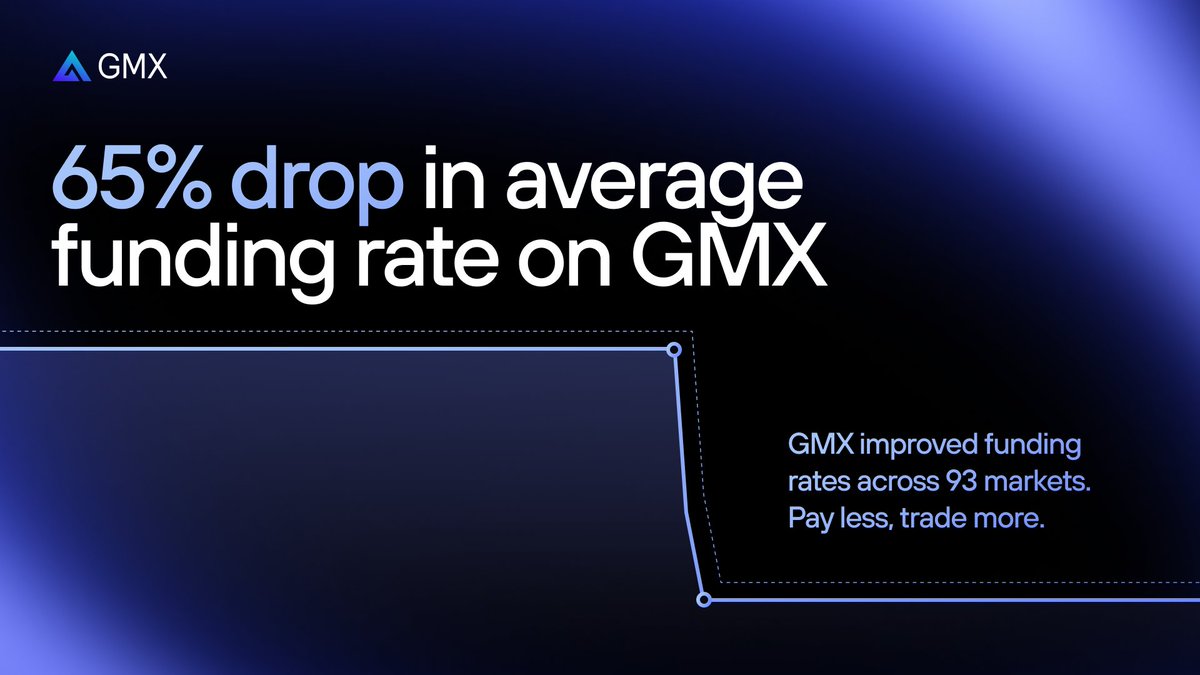
Funding costs on GMX have just dropped by ~65%.
Since the late-April update to the mechanism, traders are paying dramatically less to hold positions, and this change held across 93 of 109 perp markets.
1/2 ⬇️
Building an AI trading agent is still way harder than it should be: Fragmented docs. Poorly structured APIs.
We’ve been investing heavily in the integration stack to fix that. If you’re operating agents, GMX is officially your execution layer. ⬇️
1/2
@gmtrade_xyz you post as if people in the know need to see this
i wonder if this means anything to newcomers however.. i feel you miss the chance to teach or share briefly why anyone should care about virtual points, how it can benefit them
Elon Musk just defended America better than every politician in Washington combined.
Musk: “After World War 2, the US could have basically taken over the world and any country. Like we got nukes, nobody else got nukes. We don’t even have to lose soldiers. Which country do you want?”
One nation on earth held a weapon nobody else had.
Total dominance. Zero competition. No risk of retaliation.
Every empire in history that held that kind of advantage used it.
Rome. The Mongols. The British. The Ottomans.
They conquered until they collapsed.
America had a bigger advantage than all of them combined.
And it rebuilt the countries it just defeated.
Musk: “The United States actually helped rebuild countries. So it helped rebuild Europe, it helped rebuild Japan. This is very unusual behavior, almost unprecedented.”
Almost unprecedented?
It had never happened before. Not once in 5,000 years of recorded history.
The Marshall Plan wasn’t foreign aid.
It was the most radical act of restraint any superpower ever committed.
America turned its enemies into allies. Turned rubble into economies. Turned surrender into partnership.
Germany went from ashes to the economic engine of Europe in a generation.
Japan went from unconditional surrender to the third largest economy on earth.
Three years after the war, America was flying food into Berlin.
A city in the heart of the nation that just tried to destroy it.
That’s not policy.
That’s a civilization deciding what it is at the exact moment it has the power to be anything.
You’re being told a story right now.
That America is the villain of history.
You hear it everywhere. Media. Universities. Social platforms.
Musk: “There’s always like, well America’s done bad things. Well of course America’s done bad things, but one needs to look at the whole track record.”
Every nation on earth has dark chapters. Every single one.
The difference is what a country does when nobody can stop it.
And when nobody could stop America, it fed its enemies and rebuilt their cities.
Musk: “The history of China suggests that China is not acquisitive. Meaning they’re not going to go out and invade a whole bunch of countries.”
Probably right.
China has historically built walls, not fleets.
But the real question isn’t about borders anymore.
We’re approaching a moment that mirrors 1945 in ways nobody has fully processed yet.
AI is going to give a handful of people a power advantage that makes nuclear monopoly look quaint.
If someone is going to hold that kind of power, who do you want it to be?
The country that conquered when it could? Or the one that rebuilt when it didn’t have to?
Every alliance. Every trade route. Every economy.
Billions lifted out of poverty.
All of it traces back to one act of restraint that had never been done before.
And carries no guarantee of being repeated.
The most powerful thing America ever did wasn’t building the bomb.
It was what it didn’t do after.
ATH in 24H volume. $2 BILLION in a single day.
That’s what happens when you offer some of the lowest fees: 0.4bp / 0.6bp across FX, commodities, stocks and crypto.
Over time, the points gain value as the platform grows, and eventually they will be sellable.
Last but not least, @gmtrade_xyz runs on GMX technology, which started on Arbitrum and has been handling huge trading volumes reliably for years.
If you're new to GMTrade and seeing this for the first time, here's what actually matters.
When you provide liquidity to the GLV Vaults and stake your LP tokens, you get real yield paid out from the actual trading fees the platform collects.
This comes from a real business with real revenue, not made-up token emissions.
On top of the yield, you also earn GT Points. These points give you discounts on trading fees right now (the fees here are already very low and competitive).
(I recommend reading this for anyone currently invested in the market or interested in learning what's going on)
🦔$2.6 trillion in S&P 500 call options traded in a single session yesterday, the highest single-day notional volume in the history of the index. The chart above shows what that growth curve actually looks like, with daily call volume sitting under $200 billion as recently as 2019 and now running at multiples of that on a regular basis. The combination of zero-day-to-expiration options, retail platforms that gamified options trading, and algorithmic market makers running delta-neutral books has turned the largest equity index in the world into something closer to a leveraged casino than a price discovery mechanism.
My Take
I want to walk through what is actually happening here because most retail traders chasing these calls do not understand the machinery on the other side of their trades. When you buy a call option, a market maker like Citadel or Jane Street sells it to you and then buys the underlying stock to hedge their exposure. As the stock price rises, they buy more shares to stay neutral, which pushes the price higher, which pulls in more retail call buyers, which forces more hedging. This is called a gamma squeeze, and it works in both directions. The same mechanic that drives prices up violently can pull them down even faster when the flow reverses, which is why these moves tend to end in sharp drawdowns rather than gentle corrections.
The piece that worries me as someone who covers this stuff is how much of this volume is concentrated in zero-day options that expire the same session. A retail trader buying a $5 call that expires at 4 PM is taking a position with leverage that would have required a margin account and a series-7 license twenty years ago, and the platforms now make it as easy as ordering takeout. Market makers love this volume because they make money on the spread regardless of direction, but the buyers on the other side are absorbing all the risk in a structure designed to extract pennies from them at scale. If you take nothing else from this post, understand that $2.6 trillion in daily call volume is not a sign the market is healthy, it is a sign that speculation has overwhelmed investment, and historically that pattern resolves in ways that hurt the people who came late to it. I am not telling anyone what to do with their money, but knowing how the machinery works is how you avoid being the exit liquidity for someone else's algorithm.
Hedgie🤗