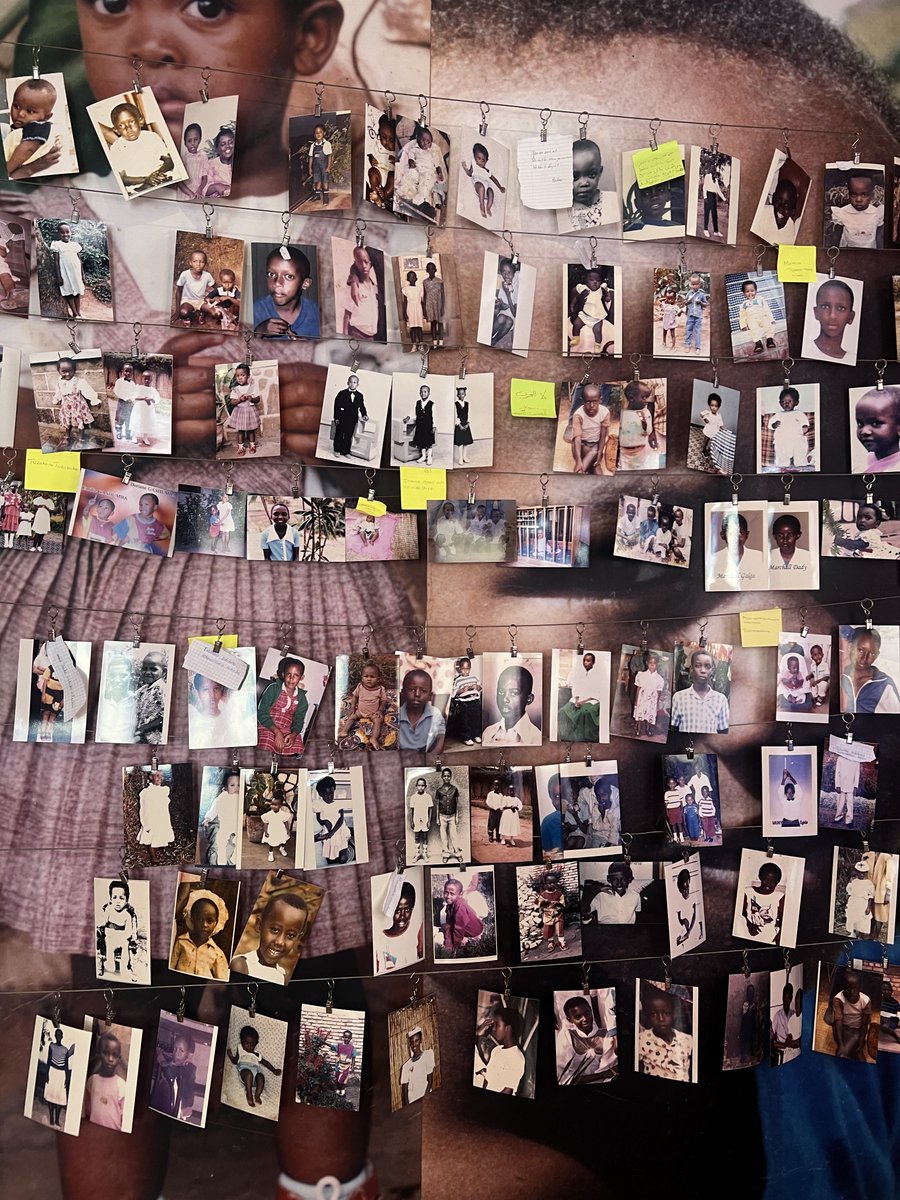
Over 12,000 people gathered with us for a shared commitment to remember, learn, and carry the responsibility of rebuilding our nation.
#Kwibuka32#OurPast26
“Our lives were worth nothing. That’s fine. For Rwandans, the lessons have been brutal, and have not been forgotten. If our lives do not happen to align with someone else’s interests, they are not worth saving.
And so it had to be the Rwandan Patriotic Army that led the Campaign against Genocide, and ended it. Our deepest source of grief, was always that we could not arrive earlier.
This is a simple truth of history, which many today still have reservations about acknowledging, for reasons we do not understand.
The culture and character of today’s Rwanda Defence Force was forged in those dramatic moments.
It guides the conduct of our forces who serve abroad in peacebuilding missions, earning universal respect.
Indeed, no sanctions or insult from outside, can ever tarnish the honour and integrity of Rwanda’s defence and security forces, who are among the finest that can be found anywhere.” President Kagame | #Kwibuka32
“We cannot afford to repeat the mistakes of the past. Genocide ideology is still spreading in our region. Left unchecked, it has the power to take us all backwards again.
There are those who claim that Rwanda exaggerates these concerns, or that we have ulterior motives. This is not only false, it exposes the deep cynicism that led to the tragedy we commemorate today.” President Kagame #Kwibuka32
32 years ago today, something was taken from within us that cannot be described anatomically. I do not know a language that can fully capture that fear, pain, loss, and horror.
By July 1994, Rwanda was shattered in spirit, and in the most practical sense. So when people tell us what we should tolerate, or ignore, I want them to understand that baseline, and what starting from scratch truly took.
I also want them to consider what it says about this country and its people, that we are here today, with what we have built together.
Our rebuilding is, at its heart, an act of remembrance. It is about being alive again and so present, so capable, so impossible to ignore that denial itself becomes the small thing.
To those who survived: You’re here, what a gift. You were Rwanda when Rwanda almost wasn’t. Thank you for holding on, and for telling us what you could find the words for.
To those who were taken from us so brutally: you are not lost to us. You are in everything that is beautiful. You are in the children. You are in the soft evening breeze, and the first light of dawn.
You are in the hills, where your laughter was last heard. And we remember you. Always.
#Kwibuka32
PM of Barbados on H.E. President Kagame.
"Since I last saw you, I visited your Memorial, and I must tell you that for me seeing you again, is a very emotional moment because you are a giant among men. And I feel the need to pay tribute to you tonight"
Since the 1999 Lusaka Peace Accords, more than 10 peace agreements on the DRC conflict have collapsed because of the DRC itself. Let’s walk through it 🧵
🔹 In Nairobi, M23 was barred from dialogue between the DRC Government and other armed groups because it was labeled “foreign.”
🔹 In December 2023, President Tshisekedi expelled the EAC Regional Force after it had secured over 80% of M23-controlled areas. The problem? It wasn’t “offensive enough.”
🔹 In December 2024 in Luanda, the peace process between Rwanda and the DRC collapsed after Kinshasa refused to engage in dialogue with AFC/M23.
🔹 A few months later in Doha, dialogue with the same actors was suddenly acceptable. Interesting…🤨
🔹 In 2025, after intense diplomatic efforts, the Washington and Doha agreements were signed. Yet key commitments were not implemented and bombardments continued, including against Banyamulenge civilians.
🔹 Since the June 2025 Peace Agreement, attacks on villages in North and South Kivu have persisted under the pretext of fighting M23.
🔹 In South Kivu, Banyamulenge communities have been pushed into remote areas with severely restricted access to markets, schools, grazing land and healthcare.
Meanwhile, the existential threat posed to Rwanda by the Kinshasa-backed FDLR has not diminished.
During the fall of Goma in January 2026, FARDC/FDLR elements attacked Rwanda, leaving 16 people dead and 161 civilians injured.
International reports continue to document integration, financing and logistical support, alongside a coalition that includes FARDC, Burundian forces, mercenaries, FDLR, Wazalendo and other militias.
So here’s the bottom line: peace is possible with political will and good faith.
Protecting Rwandans is the JOB of the RDF.
Any serious analysis of this region has to honestly assess the role of DRC Gov/FARDC and those backing them too.
Celebrating Kwita Izina 🇷🇼
Gunners duo Mathieu Flamini and Bacary Sagna took an unforgettable trip to Volcanoes National Park and a gorilla-naming ceremony in Rwanda 🦍
🤝 @visitrwanda_now
"Liberation was not merely the end of a war, it was the beginning of a new vision—a commitment to never return to tribal divisions, hatred, and despair".
Amb. CG Dan Munyuza during #Kwibohora31 in Cairo.
Kwibuka ~ a collective act of memory:
In a place where people were dehumanized and brutally murdered, Kwibuka restores what was denied: dignity, worth, belonging.
The Genocide against the Tutsi took more than one million precious lives—deliberately, systematically—to erase a people. That we remember them, and that we have survivors, is a defeat of the genocide project.
Kwibuka offers the space to name the wound, the courage to face the truth and the resolve to do things differently.
Kwibuka should not be Rwanda’s story alone, but also Africa’s mirror. The division and violence that tore Rwanda apart have echoes across our continent.
All that pain, loss, fear and horror—talk about it. Name it correctly. Record it. Own it.
We have to do this not to remain in sorrow but to heal, restore, and live well.
This is what it means: to remember, unite and renew.
To those who are annoyed that we are commemorating the genocide against the tutsi for the 31st time , fasten your seat belts. We shall hold many more commemorations! It is our duty, our detrrmination!
Je regrette la rupture des relations diplomatiques entre le Rwanda et la Belgique, tout en comprenant pleinement la position rwandaise.
ENGLISH BELOW
Le ministre belge des Affaires étrangères, Maxime Prévot, qualifie sur X cette décision de "disproportionnée". Pourtant, depuis plusieurs semaines, persuadé d’être au centre du jeu diplomatique, il mène au nom du gouvernement belge une campagne agressive pour influencer la position de l’Union européenne et des organisations internationales dans un sens ouvertement hostile au Rwanda. Jamais la Belgique n’avait adopté une posture aussi offensive sur aucun dossier depuis 1994.
Comme je l’ai expliqué dans La Libre (24/02/25) https://t.co/e38GQepVL7 la Belgique aurait dû se tenir à l’écart des conflits régionaux et maintenir une stricte neutralité.
Hélas, comme je le redoutais, le gouvernement belge a réveillé au Rwanda des blessures historiques qui s’étaient apaisées depuis les excuses officielles du Premier ministre Guy Verhofstadt en 2000. Faut-il rappeler :
- Que les Belges n’ont pas seulement introduit la mention ethnique sur les cartes d’identité : ils ont créé ces catégories racialisées, instrumentalisant des divisions artificielles et instaurant une politique de discrimination systématique qui a empoisonné les relations entre Rwandais durant des décennies ;
- Que le revirement brutal de la politique belge en 1959 a provoqué une première "purification ethnique" des Tutsis, causant des milliers de morts et l’exode de dizaines de milliers d’entre eux vers les pays voisins — une mémoire toujours vive, car de nombreux Rwandais adultes aujourd’hui ont personnellement vécu cet exil et la dure réalité des camps de réfugiés ;
- Qu’en 1994, la Belgique disposait de signes avant-coureurs du génocide des Tutsis et n’a rien fait pour l’empêcher, ni même pour alerter sur son imminence ;
- Que le gouvernement belge de l’époque a mené une campagne acharnée pour obtenir le retrait total de la MINUAR, supprimant ainsi le dernier rempart contre les génocidaires ;
- Que certains partis belges ont maintenu des liens avec le gouvernement génocidaire, y compris après le génocide, et ont continué à entretenir une lecture biaisée et révisionniste des événements.
Que le gouvernement actuel ignore ou feigne d’ignorer ces faits est non seulement incompréhensible, mais profondément irresponsable.
De plus, le Parlement belge a voté à l’unanimité une résolution d’une agressivité inouïe à l’égard du Rwanda, appelant à suspendre tous les accords économiques et l’aide, et affirmant que le Rwanda représente une "menace pour la stabilité régionale". Ce texte reflète une méconnaissance criante de la situation sur le terrain — au Kivu, où j’étais encore il y a trois jours — et dans toute la région. Il contient également des affirmations factuellement erronées et inutilement hostiles.
Le gouvernement et le Parlement belges pensent-ils pouvoir insulter, menacer et contraindre sans provoquer de réponse ?
J’espère sincèrement que cette crise diplomatique n’altérera pas les liens d’amitié profonds qui unissent de nombreux Belges et Rwandais, dont beaucoup sont également citoyens belges.
Alain DESTEXHE
Sénateur honoraire belge
Initiateur et secrétaire de la Commission d'enquête du sénat belge sur le Rwanda (1997)
--------------------------------------------------------
ENGLISH
I regret the breakdown of diplomatic relations between Rwanda and Belgium, while fully understanding the Rwandan position.
Belgian Foreign Minister Maxime Prévot called this decision "disproportionate". Yet, for several weeks, convinced that he is at the center of the diplomatic game, he has been leading an aggressive campaign on behalf of the Belgian government to influence the position of the European Union and international organizations in a direction that is openly hostile to Rwanda. Never before had Belgium adopted such an offensive stance on any issue since 1994.
As I explained in La Libre (24/02/25), Belgium should have stayed out of regional conflicts and maintained strict neutrality.
Alas, as I feared, the Belgian government has reopened historical wounds in Rwanda that had partially healed since Prime Minister Guy Verhofstadt's official apology in 2000. Should we remind them:
- That the Belgians not only introduced ethnic classification on identity cards but actually created these racialized categories, instrumentalizing artificial divisions and establishing a system of systematic discrimination that poisoned relations between Rwandans for decades;
- That Belgium’s abrupt policy shift in 1959 triggered the first "ethnic cleansing" of the Tutsis, causing thousands of deaths and forcing tens of thousands into exile in neighboring countries—a still vivid memory, as many adult Rwandans today personally experienced this exile and the harsh reality of refugee camps;
- That in 1994, Belgium had early warning signs of the Tutsi genocide and did nothing to prevent it, nor even to alert the international community to its imminence;
- That the Belgian government of the time campaigned fiercely for the complete withdrawal of UNAMIR, thereby removing the last barrier against the génocidaires;
- That certain Belgian political parties maintained ties with the genocidal government, even after the genocide, and continued to promote a biased and revisionist interpretation of events.
That the current government ignores or pretends to ignore these facts is not only incomprehensible but profoundly irresponsible.
Furthermore, the Belgian Parliament unanimously passed on 23 February a resolution of unprecedented hostility toward Rwanda, calling for the suspension of all economic agreements and aid, and asserting that Rwanda represents a "threat to regional stability." This text reflects a glaring lack of understanding of the situation on the ground — in Kivu, where I was just three days ago — and throughout the region. It also contains factually incorrect and unnecessarily hostile claims.
Does the Belgian government and Parliament believe they can insult, threaten, and pressure without provoking a response?
I sincerely hope that this diplomatic crisis will not damage the deep bonds of friendship that unite many Belgians and Rwandans, including those who are also Belgian citizens.
Alain DESTEXHE
Honorary Belgian Senator
Initiator and Secretary of the Belgian Senate Inquiry Commission on Rwanda (1997)
@prevotmaxime@DavidClarinval@FranckenTheo@GLBouchez@UrugwiroVillage@onduhungirehe@YolandeMakolo@BelgiumMFA@MonarchieBe@Bart_DeWever@MR_officiel@vooruit_nu@de_NVA