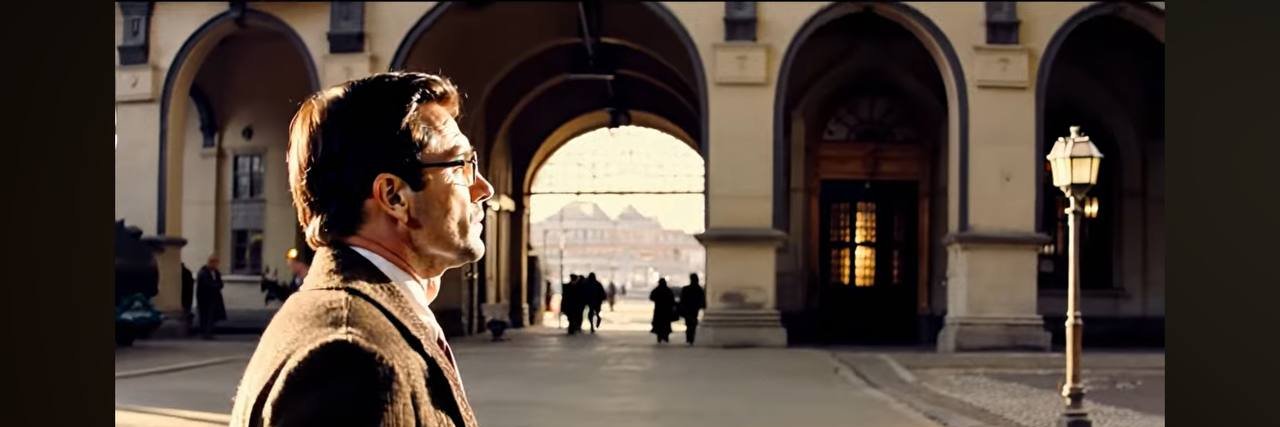
In 1954, Joyce Collin-Smith travels to Rio Naza, Mexico, to visit Rodney Collin, the devoted pupil of the philosopher P.D. Ouspensky, who had died seven years earlier.
Full film available on our channel.
#CapCutCREAITE
"The Curtain of Time" is a short film by Amir Bozorgzadeh. In 1954, Joyce Collin-Smith visits Rodney Collin in Mexico. Pressing him about his teaching, she encounters the miraculous: his face begins to change before her eyes, revealing one life after another.
The next challenge for Gaussian splatting is not only reconstruction quality. It is interoperability. Not just producing a good-looking splat, but making captured worlds easier to move, review, version, and reuse across tools.
→ https://t.co/s6BlMtRYod
While 3D Gaussian splatting represents a static scene as millions of semi-transparent 3D ellipsoids, each with position, scale, orientation, opacity, and view-dependent color, 4D Gaussian splatting extends that idea through time.
→ https://t.co/s6BlMtRYod
A Gaussian splat flythrough is the easiest part to understand: capture a place, render it in real time, move through it. The deeper shift comes when that captured scene becomes addressable.
→ https://t.co/s6BlMtRYod
Most people see a Gaussian splat and think: impressive 3D render. But the render is only the visible output. A well-captured splat can preserve information that a flat image cannot: camera position, scale, geometry, confidence, and spatial context.
→ https://t.co/s6BlMtRYod
One of the most interesting parts of Gaussian splatting is how it captures appearance. A splat doesn't just store color. It can store how appearance changes with viewing angle.
→ https://t.co/s6BlMtRYod
A radiance field is a way of describing how light exists in a 3D space. Given a position and a viewing direction, it tells you what color and density should appear from that point of view.
Gaussian splatting doesn’t invent navigable 3D scenes. Photogrammetry, volumetric capture, and NeRFs were already moving in that direction. What feels new is the representation itself.
→ https://t.co/s6BlMtRYod
The easiest way into Gaussian splatting is a molecule. A molecule isn't a picture of atoms, it's a structure of points sitting in space. You can picture it from any angle, drift around it, move between the atoms. Nothing about it is "framed."
→ https://t.co/s6BlMtRYod
With 4D Gaussian splats, a captured scene can become something closer to a place: navigable, viewable from different angles, and persistent enough to return to. You do not just watch the moment. You can move through it.
→ https://t.co/s6BlMtRYod
Most AI video clips last a few seconds, then the world disappears. That is one of the traps AI cinema is stuck in: generate a scene, the set is gone, generate the next, and you often get a new space, new geometry, and no reliable continuity.
→ https://t.co/s6BlMtRYod
Not a 360 photo, and not quite a traditional 3D model. More like a navigable reconstruction of a place, with depth, light, scale, and eventually time. The goal is to make real-world spaces easier to share, revisit, and build on.
→ https://t.co/s6BlMtRYod
3D Gaussian splatting captures a scene as a set of volumetric points with position, shape, opacity, and view-dependent color. That means the scene can be rendered from new camera positions, and its appearance changes as the camera moves.
→ https://t.co/s6BlMtRYod
3D Gaussian Splatting gave us real-time photorealistic worlds: millions of tiny 3D blobs carrying color, opacity, and view-dependent appearance.
Once it runs in real time, it stops being a scan and starts becoming a world.
→ https://t.co/s6BlMtRYod
Pixels are flat. Gaussians are not. Gauset captures reality as millions of soft volumetric Gaussian splats. Each splat carries position, color, and view-dependent appearance, so the scene can be rendered from new angles instead of locked to one frame.
→ https://t.co/s6BlMtRYod
Space has three dimensions. Time is the fourth. A photograph captures a viewpoint. A video captures a sequence. But reality is not a viewpoint or a sequence. It is spatial, temporal, and navigable.
→ https://t.co/s6BlMtRYod
Announcing Gauset. We’re building a platform for Gaussian spatial media, from capture to navigable scene. A moment becomes a place. A world you can return to, direct, and reuse.
→ https://t.co/s6BlMtRYod
Grateful to share that “Plastics” has received the Best Narrative Short award at the @aifilmfestorg.
Festival editor review:
"The film captures the mystery, surprise, and almost supernatural wonder of that encounter with Gurdjieff, weaving atmosphere and voice into a spell."