🌊Watch our latest video and discover how to unlock your marine biodiversity data & secure €60K funding + a 3 days workshop in Paris 🇫🇷https://t.co/Z5CyRUjrtR
🗓 Deadline: 28 Feb 2025
Apply here: https://t.co/sSB5xTiUB8
#DTOBioFlow#MarineResearch
📢 WEBINAR ALERT: The Role of Digital Twins in Environmental Protection 🌍
As #climatechange accelerates, the need for innovative solutions to protect our environment is more urgent than ever. #DigitalTwins (DTs)—advanced tools for real-time monitoring and predictive simulations—are revolutionising how we address environmental threats, from #biodiversity loss to natural disasters.
Join leading experts from @interTwin_EU , @dtgeo_eu , @TerraDT_EU , #ClimateDT, and #DestinE as they explore how DTs can enhance environmental protection, disaster response, and biodiversity preservation. Discover real-world applications, current challenges, and the power of cross-collaboration in this evolving field.
🗓 Date: 27 February 2025
🕒 Time: 15:00 - 16:00 CET
🎙 Speakers: Top researchers and coordinators from major DT initiatives
📢 Interactive Poll: Engage directly with the experts
Register now: https://t.co/aaCONi6AWN
I'm so proud of this (& EVERY) episode of the PBS series, "American Muslims: A History Revealed." This episode features the stories of Black American Muslims in 1920s Chicago, & highlights the life of Florence Watts/Sister Zeineb, an early convert. 1/9
https://t.co/bJRJDfUXfD
🌍#DTOBioFlow will soon launch its second open call for marine #biodiversity data holders.
It will targeting research centers and institutions with valuable yet unpublished "sleeping" data.
Want to know how to participate? Subscribe to our newsletter:
https://t.co/ZKPlgfF5mJ
🌍 Phylogenetic diversity (PD) represents a fundamental measure of #biodiversity, encapsulating the extent of evolutionary history within species groups.
Learn more about the development of a BioDT (Biodiversity Digital Twin) prototype, aimed at facilitating the calculation and visualisation of biodiversity metrics from global, dynamic data sources.
🌱 Learn more in the paper published in @RIOJournal / @Pensoft : https://t.co/asfzvRkaxV
🌾 How Digital Twins are transforming our approach to agricultural resilience and biodiversity?
🗣️ In the latest BioDT podcast, Dag Endresen highlights the critical connection to UN Sustainable Development Goals, particularly #ZeroHunger, while demonstrating how these technological prototypes can detect emerging crop diseases and create strategic sampling roadmaps. Desalegn Chala (PhD) emphasises the transformative potential for global food security, explaining how advanced breeding pattern predictions could revolutionise crop development. And Tobias Guldberg Frøslev from @GBIF Secretariat expands the vision beyond traditional research, showcasing how these #DigitalTwins will enable unprecedented traceability of micro-organisms, fungi, and complex ecological systems.
By transcending current limitations in biodiversity research, these prototype Digital Twins represent a quantum leap in our understanding of genetic diversity and environmental adaptation.
Discover the future of sustainable agriculture and genetic innovation – listen to the full episode now! https://t.co/vZzDNBQLzF
At least 38 million people have been displaced by the post-9/11 wars in Iraq, Afghanistan and elsewhere.
That's roughly equivalent to the population of California. [1/3]
💥 The fully funded BioDT #Hackathon offers a unique opportunity to explore #digitaltwin technology for environmental science.
🤝 Participants will receive hands-on training in ecosystem modelling, work with high-performance computing platforms, and develop innovative solutions to biodiversity challenges.
Open to students, researchers, and professionals passionate about environmental tech, the hackathon welcomes applicants with curiosity and a drive for innovation—no prior specialised experience required! With all travel, accommodation, and program expenses covered 🛫, this is your chance to bridge digital research with ecological insights.
📝 Apply now: https://t.co/90y17L5tCw
📊 Quentin Groom (@cabbageleek) shares insights on the vision for biodiversity data workflows to overcome systematic challenges, today at @nbfc_italy Symposium 🇮🇹 🇪🇺
🤔What is a Data Paper?
👍 A means to describe a #dataset - like the ones on @GBIF - in a standardised, widely accepted #scientific article format.
👇🧵Highlights from @LyuboPenev's talk at the int'l symposium "#BiodiversityData in montane & arid Eurasia" in Kazakhstan 🇰🇿
1/4
Fanon, Wretched of the Earth (1961), could have been speaking to the 'educated class' in the West these days: 'It so happens that the unpreparedness of the educated classes, the lack of practical links between them and the mass of the people, their laziness, and, let it be said, their cowardice at the decisive moment of the struggle will give rise to tragic mishaps'.
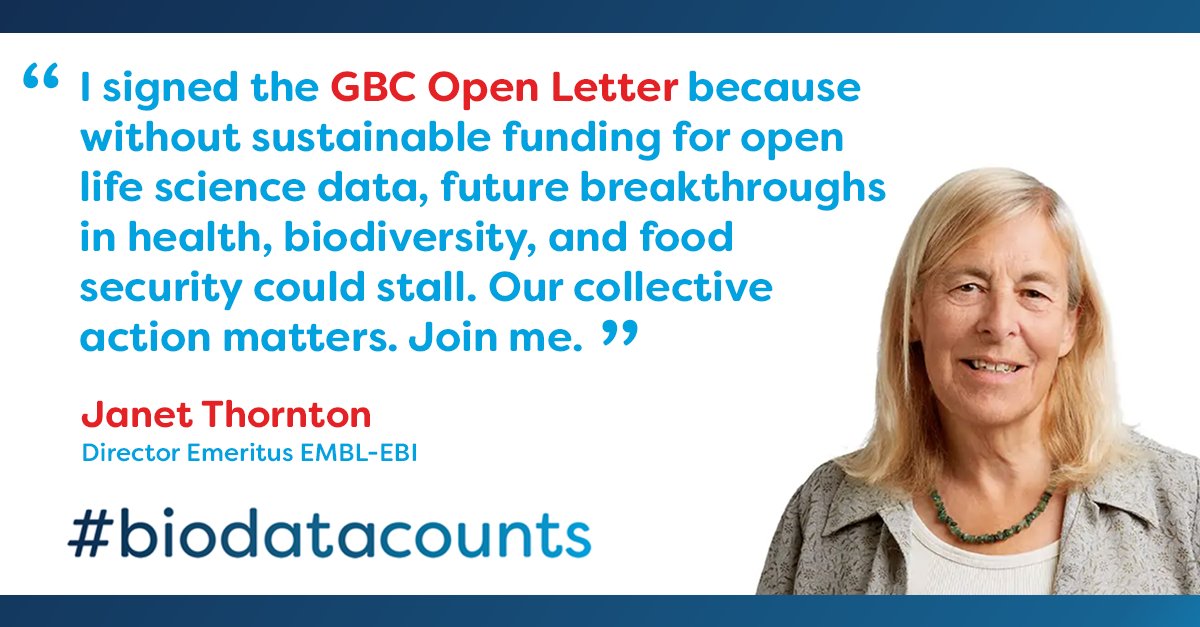
Thank you to leading scientists around the world for signing the GBC’s Open Letter calling for support to sustain global biodata resources. If you haven’t already signed the letter, please do so. Click the link https://t.co/j75uSboQ9Z
#biodatacounts#globalbiodata#openscience
👍There ARE benefits to #publishing#data for ALL stakeholders: ☑️ data authors ☑️managers and ☑️their institutions ☑️data users ☑️#academic#publishers ☑️aggregators AND the ☑️ society at large.
📸Our @LyuboPenev at the #BiodiversityData in montane & arid Eurasia symposium🇰🇿
DNA collections are crucial for #NaturalSciences research.
Our partners at @DisscoFlanders have identified the need for 1) best practices on #DNA collection management and 2) guidance on bringing theory into practice. See the result here! 👉 https://t.co/oumn2GVPJe @REA_research
🌟 DTO-BioFlow is mentioned in the @EMarineBoard’s Navigating the Future VI report🎉
We are recognized for our role in integrating biodiversity data into the Digital Twin of the Ocean (DTO) to address climate change and biodiversity loss. 🌍





![CostsOfWar's tweet photo. At least 38 million people have been displaced by the post-9/11 wars in Iraq, Afghanistan and elsewhere.
That's roughly equivalent to the population of California. [1/3] https://t.co/h7IPAqdaiv](https://pbs.twimg.com/media/GdZk12zbQAA-Xhg.jpg)