From a friend in Korea, about a police raid on a home in Seoul:
“I am writing to alert you to a deeply disturbing development in South Korea that raises serious concerns not only about civil liberties but about the country’s overall democratic stability and the use of police power against political dissent.
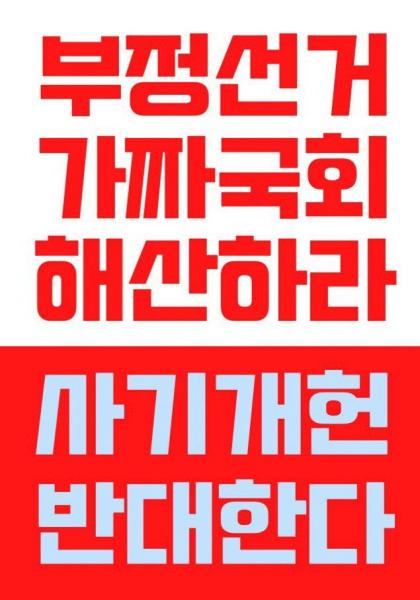
On January 27, the Seoul Metropolitan Police Agency executed a home raid on a private citizen whose ‘crime’ was leading a group that posted banners supporting former President Yoon Suk-yeol and raising questions about election integrity. This is not an exaggeration. Police investigators entered the individual’s residence with a warrant, solely because the group produced and displayed political banners.
Official source:
https://t.co/8geSrot8uF
According to the report, the citizen-led group ‘Patriotic Banner’ was accused of improper accounting related to small donations used to print banners. Yet the government response was a fully armed search-and-seizure operation against an ordinary political activist whose activities were entirely nonviolent and squarely within the realm of political speech.
This kind of police raid would be unthinkable in the United States. Under American constitutional standards, political expression receives the highest level of protection, and no government agency could ever justify entering a private home simply because a citizen displayed a banner that challenged the ruling party’s narrative.
What makes this even more troubling:
1. Viewpoint discrimination is explicit.
Banners critical of the government or raising election-related questions are immediately removed across major cities, while banners favorable to the authorities or local officials remain untouched. This targeted enforcement is the textbook definition of selective suppression.
2. The use of a home raid signals retaliation, not law enforcement.
A search warrant against a peaceful political activist is a drastic action normally reserved for organized crime, terrorism, or violent offenses — not for printing banners. This escalation indicates the use of police power to deter dissent rather than to uphold any legitimate legal standard.
3. The issue involves political expression, which should never be criminalized.
The banners advocated ‘Yoon Again’ and raised concerns about election integrity — positions shared by millions of citizens. When such messaging becomes grounds for police intrusion into a person’s home, it represents a clear authoritarian turn.
4. The chilling effect is already spreading nationwide.
Citizens now fear that hanging a banner or expressing a political view may result in surveillance, investigation, or even a home raid. This has severely damaged freedom of speech, freedom of assembly, and public confidence in democratic institutions.
5. This follows a pattern of expanding state control over speech.
South Korea has recently passed multiple regulations targeting ‘false information,’ online commentary, political YouTube channels, and independent media. Combined with selective enforcement and police raids, this trajectory is alarming for anyone who values open societies.
This situation deserves urgent attention. In South Korea, peaceful political expression is being treated as a criminal act, and police power is being used to intimidate and silence one side of the political spectrum. The implications extend far beyond this single incident. It reflects a broader pattern of suppressing dissent, manipulating public discourse, and weaponizing state institutions against political opponents.
As voices for freedom and constitutional governance in the Indo-Pacific, your attention to this matter could help protect not only the rights of one citizen, but the integrity of civil liberties in a nation that is supposed to be one of America’s key democratic allies.”