Sevim Dağdelen (BSW) beim Betreten der russischen Botschaft im Mai 2025. Empfangen wird sie von einem GRU-Agenten und Kurator des Spionagenetzwerks in Deutschland.
🧵1/22
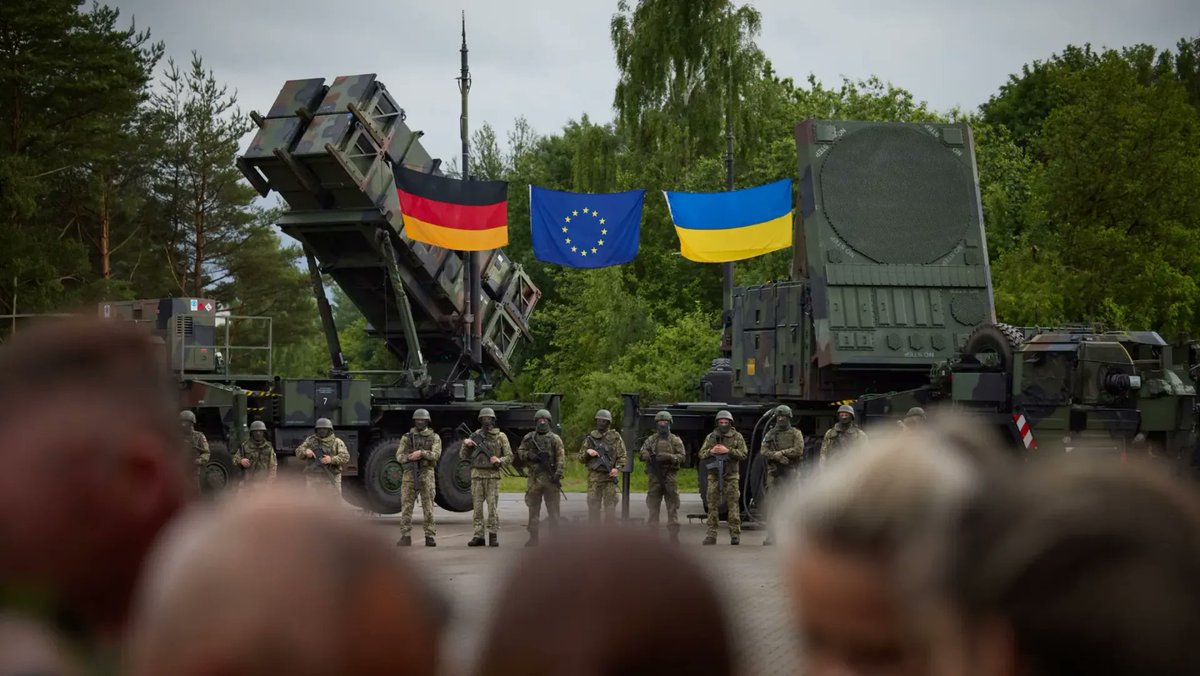
🇩🇪🇺🇦€11.5 Billion. Patriot missiles. Joint drone production. Why Germany's investment in Ukraine is investment in Germany.
Germany is now Ukraine's largest defence partner — providing nearly one-third of all security assistance Ukraine receives. But the relationship is no longer one of donor and recipient. It has become something more strategically consequential: a genuine partnership.
Ukraine brings combat-tested technology, real war data, and operational knowledge that no other country in the world can offer. Germany brings industrial capacity, capital, and the political will to build a European defence architecture that doesn't depend on borrowed time.
Both sides need each other. Both have admitted it. The agreements signed in 2025 and 2026 prove it. 🧵👇
Bitte lesen ‼️‼️‼️
Yahya Sinwar hat alles zerstört.
Über Jahrzehnte verfolgte das Regime in Teheran eine strategische Geduld, die in ihrer Konsequenz bemerkenswert war. Milliarden flossen in ein Netzwerk aus Milizen, Stellvertretern und ideologischen Verbündeten. Das kurzfristige Ziel: Konflikte aus dem eigenen Territorium fernhalten und Gegner in einem permanenten, kontrollierten Spannungszustand binden. Das langfristige Ziel: die strategische Einkreisung Israels – militärisch, politisch, psychologisch.
Der Aufbau dieses „Feuerrings“ folgte einer klaren Logik:
•Hisbollah im Libanon als hochgerüstete Nordfront.
•Die Stabilisierung des Bashar al-Assad-Regimes, um Syrien als operativen Korridor zu sichern.
•Die Bewaffnung der Huthi-Bewegung im Jemen, um strategische Seewege zu bedrohen.
•Massive Investitionen in die Hamas und andere Gruppen in Gaza und im Westjordanland.
•Paramilitärische Strukturen im Irak als zusätzliche Druckpunkte.
Für Teheran schien diese Architektur lange stabil. Israel war eingekreist, die Abschreckung erodierte langsam, die innere Spaltung des jüdischen Staates vertiefte sich.
Dann kam der 7. Oktober.
Im Alleingang, getrieben von ideologischer Verblendung und einem nihilistischen Hass, initiierte Yahya Sinwar das größte Pogrom an Juden seit 1945. Strategisch war es kein kalkulierter Schritt innerhalb einer abgestimmten Achse, sondern ein Bruch mit ihr. Der Angriff war brutal – aber politisch ( für die Mullahs) kurzsichtig.
Das Assad-Regime ist weg.
•Die Hisbollah ist militärisch weitgehend zerstört, schwer beschädigt und im Libanon politisch isoliert.
•Die Huthis stehen unter massivem Druck durch direkte Angriffe und strategische Gegenmaßnahmen.
•Gaza liegt in Trümmern.
•Viele Spitzenfiguren der Hamas wurden getötet.
•Sinwar ist tot, ebenso zahlreiche führende Vertreter der Huthis – ebenso wie Hassan Nasrallah.
Die militärischen Auseinandersetzungen finden nicht mehr stellvertretend in Gaza oder im Libanon statt – nein, sie finden jetzt mitten in Teheran statt!
Und nun, mit dem Tod von Ali Khamenei, erreicht diese Entwicklung ihre letzte Stufe: Der oberste Architekt, der strategische Kopf hinter dem gesamten Proxy-Netzwerk, ist gefallen. Sein Tod markiert nicht nur das Ende einer historischen Ära – er symbolisiert zugleich den Zusammenbruch des zentralen Pfeilers iranischer Außen- und Sicherheitsstrategie.
Am 7. Oktober wirkte Israel unkoordiniert, überfordert und innerlich gespalten. Doch Staaten, die existenziell bedroht sind, reagieren anders als Bewegungen, die vom Tod leben. Israel stand auf – militärisch, gesellschaftlich und strategisch.
Die Abschreckung, die an jenem Tag zerbrochen schien, wurde nicht nur wiederhergestellt. Sie erscheint heute stärker denn je.
#Khamenei #Iran
I spent time in Shenzhen last year and when I saw Merz come back from China saying Germans need to work more I immediately knew what broke his brain because I lived the exact same cognitive shock
my first week in Huaqiangbei I burned through 4 prototype iterations of a motor controller board for less than a thousand bucks total, back home a friend was working on something similar and spent over 12 thousand for a single revision that took almost two months to arrive
when you live that contrast in your own hands with your own project something permanently shifts in how you see the world and it goes way deeper than speed & cost
what Shenzhen actually built is a collective learning organism, imagine 20 PCB fabs 15 injection mold shops 30 component distributors and a hundred firmware freelancers all within a 2km radius, looks insanely redundant from the outside until you realize redundancy is actually information density in disguise
I watched this firsthand with an injection mold supplier I was working with, this guy had seen a hundred founders iterate similar thermal designs over 6 months so he proactively modified his tooling before I even opened my mouth, he knew what I needed before I knew what I needed, the intelligence lives in the relationships between the nodes and it compounds daily
the west thinks about manufacturing as a cost center you optimize by centralizing…
China accidentally built a distributed neural network of manufacturing intelligence where knowledge diffuses horizontally across thousands of agents faster than any single western company can process internally
so when Merz comes back and says we need to work a bit more I think he saw the problem but COMPLETELY misdiagnosed the solution, telling Germans to work harder is like telling a horse to gallop faster when the other side built a combustion engine
the gap is ARCHITECTURAL
it’s ecosystem density, you need a custom connector in Shenzhen you walk 200 meters, in Munich you send an email and wait 3 weeks
it’s iteration speed, parallel search vs sequential optimization at the system level, it’s risk tolerance, Chinese founders ship something broken on Monday fix it Tuesday ship again Wednesday while European companies are still in the approval phase for the pilot program of the feasibility study…
and Merz only saw the surface, what he missed is the tier 2 cities like Hefei Chengdu Wuhan replicating the Shenzhen model at scale right now
BYD going from irrelevant to outselling every european automaker combined in roughly 5 years, Huawei building its own 7nm chip under maximum sanctions when every analyst said it was physically impossible & behind all of that a government that treats advanced manufacturing as an existential national priority while europe debates whether AI needs another ethics committee
I think what we’re watching is the most asymmetric economic competition in modern history and most western leaders are still framing it as a productivity problem when it’s actually an ontological one
Europe & America are optimizing variables that China stopped tracking years ago meanwhile China is compounding on dimensions the west has no framework to even measure
Merz at least had the courage to name
it out loud and I respect that genuinely but working a bit more inside a broken architecture just means you arrive at the wrong destination slightly faster
Laut mehreren Quellen war die Nacht vom 8. auf den 9. Januar die blutigste in der modernen Geschichte Irans – vielleicht sogar eine der tödlichsten weltweit in den letzten Jahrzehnten.
Schätzungen sprechen von bis zu 30.000 Toten innerhalb weniger Stunden.
A woman cuts her hair at her sister’s funeral in #Iran, because the regime shot her sister in the head.
Let me be clear with Western female politicians, especially those in leadership positions in Europe: Do not cut your hair in symbolic solidarity with Iranian women. Cut your ties with our killers.
Believe me cutting your hair for Instagram solidarity, doesn’t scare dictators. It doesn’t save lives. It just makes you feel better. Stop legitimizing our terrorist regime.
Her name was Melika Dastyab.
She was 21, a musician, economics student and she was dead by security forces while her sister stood next to her.
That’s not a hashtag.
That’s a crime against humanity.
Aber der Donbass!
Es wird behauptet: "Die Ukraine hat ab 2014 den Donbass, ein Gebiet mit russlandfreundlichen Menschen in der Ostukraine, beschossen. Es gab dort Tausende Opfer unter Zivilisten." Diese Behauptung ist falsch.
Richtig ist: Diese Behauptung wird von
russischer Seite gezielt als Vorwand für den Angriffskrieg gestreut. Es gab vor der russischen Invasion keine Bombardierung des Donbass
durch die Ukraine.
Immer wieder wird behauptet, die Ukraine sei verantwortlich für „15 000 Tote im Donbass“ seit 2014 und habe „die eigenen Leute“ bombardiert, sodass Russland „schützend eingreifen musste“. Das ist ein durch Wladimir Putin und Russland gezielt konstruierter Vorwand für den Krieg.
Russland verbreitet diese Falschinformationen im Rahmen der hybriden Kriegsführung besonders in Deutschland. Die Zahl „15 000“ stammt aus Aufrundungen der Schätzungen der Vereinten Nationen. Allerdings handelt es sich dabei nicht um Opfer angeblicher ukrainischer Angriffe. Die Zahlen der Vereinten Nationen gehen von etwa 3500 getöteten Zivilisten aus, etwa 4000 ukrainischen Soldaten, etwa 5500 Toten bei den von Russland angeleiteten bewaffneten Separatisten.
Es lässt sich bei den etwa 3500 zivilen Opfern im Donbass der Jahre 2014 und 2015 nicht genau sagen, ob sie sich auf einer Seite der Auseinandersetzung verorteten und ob diese Menschen „pro-ukrainisch“ oder „pro-russisch” waren.
Enthalten sind in der Zahl auch die 298 Passagiere des abgeschossenen Flugs MH17. Es ist besonders zynisch, die getöteten Menschen ausgerechnet der Ukraine anrechnen zu wollen angesichts der Tatsache, dass das Passagierflugzeug durch von Russland gesteuerte Separatisten mit russischen Flugabwehrraketen abgeschossen wurde.
Nach den Jahren 2014 und 2015 sank die Zahl der Opfer im Donbass. Laut dem letzten Bericht der Organisation für Sicherheit und Zusammenarbeit in Europa (OSZE) kamen 161 Zivilisten im Zeitraum von Januar 2017 bis Mitte September 2020 ums Leben – etwa gleich viele auf beiden Seiten. Etwa die Hälfte dieser Opfer starb durch Unfälle mit Minen und Blindgängern.
Es gab vor dem Beginn des russischen Großangriffs auf die Ukraine am 24. Februar 2022 keine „Bombardierungen“ der Zivilbevölkerung im Donbass durch die Ukraine und es gab auch keinerlei Pläne der Ukraine, den Donbass militärisch angreifen zu wollen.
Weder die OSZE-Beobachtermission, die mit dem Einverständnis Russlands seit 2014 die Lage beobachtete, noch der Bericht der Vereinten Nationen vom September 2021 sehen Anzeichen für einen Genozid oder gezieltes Vorgehen der Ukraine gegen die „pro-russische Zivilbevölkerung“.
Ein Bericht des UNHCR (Hochkommissariat der Vereinten Nationen für Flüchtlinge) vom Juli 2016 fasst zusammen: „Der bewaffnete Konflikt, der durch den Zustrom ausländischer Kämpfer und Waffen aus der Russischen Föderation angeheizt wird, ist für die meisten Verletzungen des Rechts auf Leben in der Ukraine in den letzten zwei Jahren verantwortlich.“
Die russische Propaganda hat die offizielle Gesamtzahl nach den Angaben der Vereinten Nationen auf „15 000“ aufgerundet und daraus entgegen der Sachlage propagandistisch „Opfer der ukrainischen Angriffe auf den Donbass“ gemacht. Bis heute wird diese Propaganda in Diskussionen um den russischen Angriffskrieg gegen die Ukraine und die ukrainische Selbstverteidigung ständig wiederholt. Durch Fakten ist sie nicht gedeckt.
@janvbear@NSTRIKE1231 Do you really think that military bases serve to protect Germany? Without these military bases, the US involvement in the Middle East over the last few decades would have been impossible.
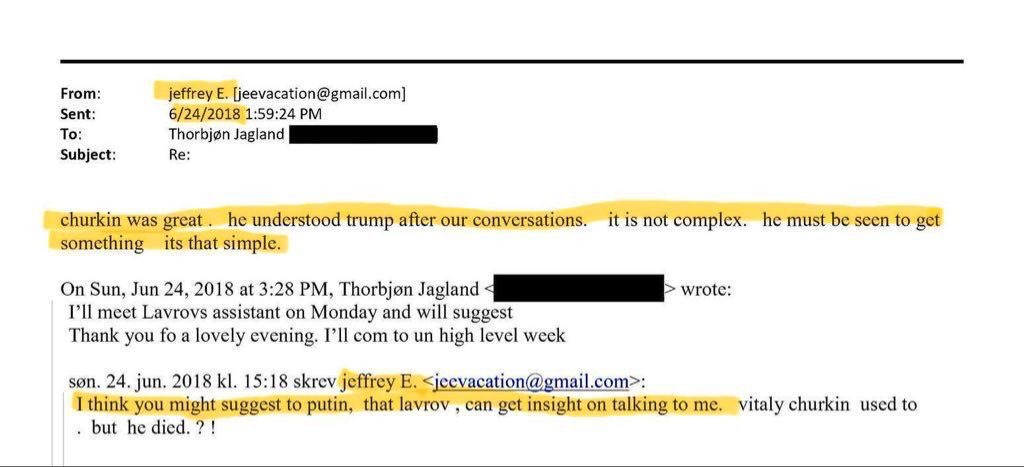
EXCLUSIVE: US presidential envoy Steve Witkoff advised Russia on how to pitch Ukraine plans to Trump, in audio files reviewed by Bloomberg https://t.co/P0wXMFavBS
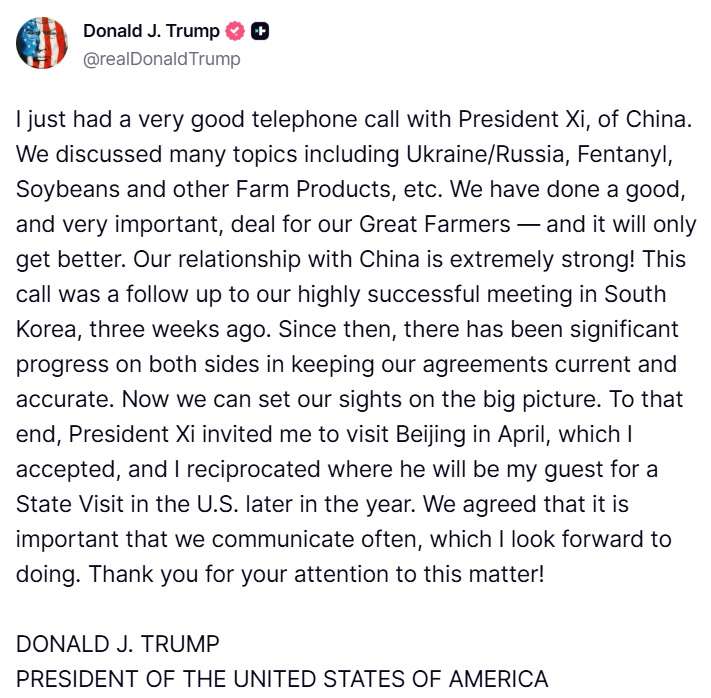
It looks like Trump didn't understand the immensely consequential importance of his call with Xi. Or if he did, he's hiding it very well.
This was the first call EVER requested by Xi to a U.S. president. It never happened before, all previous calls had been made at the Americans' request.
In fact the only other instance in recent decades when a Chinese leader initiated contact with an American president was on Sept. 11, 2001, when then-President Jiang Zemin sent a telegram of condolence to then-President Bush (https://t.co/GmHN7PJp9u).
So already this, in and of itself, is extraordinarily unusual.
Secondly, according to the official Chinese readout (https://t.co/ZnQnCjkxRO), the main topics of the call were Taiwan and Japan.
Chinese official expressions - those used in readouts - are extremely codified. In this specific transcript they used an expression which had never been used before in the US-China context, writing that both countries should "jointly maintain the WWII victory fruits" ("共同维护好二战胜利成果") in the fight "against fascism and militarism", which is an obvious reference to Japan (especially given the current context).
"Jointly maintain the WWII victory fruits" or versions of it (like with "defend" - "捍卫" - instead of "maintain"), has been used before in Chinese official transcripts, but almost exclusively in the China-Russia context.
For instance in the famous China-Russia joint statement on international relations (https://t.co/6hgUUyZV7C) made when Putin visited China in early February 2022, both sides said they 'firmly defend WWII victory outcomes' ("坚定捍卫二战胜利成果").
It's rather extraordinary that China now uses this expression in a US-China context, which indicates that from China's standpoint the relation with the U.S. is entering a new phase where the U.S. can be part of the same "defenders of the post-WW2 order" framework that China has built with Russia.
On Taiwan, the framing used is also completely different from anything used in previous US-China leader communications, and also more similar to the China-Russia language on the matter.
It says that Xi emphasized to Trump that "Taiwan's return to China is an important component of the post-war international order" ("台湾回归中国是战后国际秩序重要组成部分"), which looks like a Japan-centric reorientation.
This framing puts China and America on the same side when it comes to Taiwan, as co-victors of WW2, with Japan as the defeated aggressor whose seizure of Taiwan was reversed, and that reversal needs to be upheld.
Usually, Chinese language on Taiwan in US-China discussions is all about the Three Joint Communiqués as the moment when the US finally acknowledged the PRC's position after backing the losing ROC side in the Chinese Civil War. They're essentially framing the US as a former adversary who came to accept reality.
Which means this is a very significant shift in China-US diplomatic language: China is proposing to reposition the foundational narrative of US-China relations from post-Nixon to post-WWII, which would changes the very nature of the relationship, from pragmatic accommodation between adversaries to historical allies with shared responsibility.
Why do this? The instinctive interpretation would be to understand it as immediate Japan crisis management, in reaction to Japan PM's declaration that it could act militarily in a Taiwan war, as a way to delegitimize any Japanese role in Taiwan affairs as inherently revisionist.
But I think that would be the wrong read.
First of all, it seems hard to believe that China would reframe the foundational narrative of China-US relations opportunistically, just for crisis management purposes. It's far too consequential to be merely tactical.
Secondly, the fact that Xi initiated the call - again the first China-initiated call to a US president in decades - is also a tell. They wouldn't do this to deliver mere tactical crisis management language. This signals something more fundamental
Thirdly, and perhaps most importantly, there are clear signs that this reframing has been prepared long before the recent Japan crisis. Back in October, the Standing Committee of the National People's Congress approved the designation of October 25th as "Taiwan Retrocession Day", a national holiday to celebrate the retrocession of Taiwan from Japan at the end of WW2. There was a big media push around this in China, which I'm familiar with because I was interviewed about it in the Global Times (https://t.co/lS5cX4ALDB).
So this is clearly part of a long-planned strategic narrative shift as opposed to something they improvised in response to recent Japan tensions.
The question remains: why? I think the most likely explanation is because China is repositioning for the post-hegemonic order, a multipolar world where China and the U.S. have a relationship as peers instead of rivals. And to anchor a peer relationship, you need a moment when the two countries actually WERE allies - which points directly to 1945, not 1972. The Nixon framework memorializes American hegemony - Washington acknowledging Beijing's position as a tactical Cold War concession; the WWII framework memorializes joint victory and shared responsibility.
When you understand this context, Trump's post about the call is genuinely hilarious. While China was attempting the most significant reframing of US-China foundational narrative in fifty years, Trump came away thinking the highlight was agricultural trade 🤣
I also wrote about this in article form on my Substack https://t.co/Q6rit0jRTW
"I personally think this has completely compromised Trump. Something is terribly off, really really off. Anyone in America still hoping he’ll suddenly come to his senses, must surely be asking themselves whether their country, the mighty USA 🇺🇸, is being compromised right in front of them"
Trump was all up for giving Tomahawk Cruise Missiles to Ukraine.
Then he got a visit via this plane 19 days ago, and Trumps Russian handlers put him back in his place.
As I said.