The global nuclear business is experiencing a massive structural shift, moving from a slow, government-reliant sector to a fast-paced market driven by commercial urgency.
Three major forces are currently redefining the industry:
💼 The Rise of Private Capital
For decades, nuclear energy was a state-monopoly game due to high upfront costs and long timelines. Today, the landscape is cracking open. Major private conglomerates and private equity are actively taking stakes in nuclear projects, recognizing that achieving net-zero targets without baseload nuclear is virtually impossible.
⚙️ The SMR Commercial Race
Small Modular Reactors (SMRs) are completely changing the industry's investment thesis. By moving construction from the field to standardized factory assembly lines, SMRs reduce financial risk, offer faster time-to-market, and allow heavy industrial players to buy dedicated power directly via Power Purchase Agreements (PPAs).
🌐 Supply Chain Realignment
The geopolitical map of nuclear fuel and components is being redrawn. Western nations and fast-growing Asian economies are aggressively investing to decouple from traditional supply chains, opening up massive business opportunities in uranium mining, enrichment, and specialized heavy component manufacturing.
💡 The Takeaway
Nuclear is no longer just a policy discussion—it is an active corporate asset class. The companies building the organizational grammar to execute these projects on time and on budget today will control the clean energy infrastructure of tomorrow.
https://t.co/ge8OTo4ouG
#NuclearBusiness #EnergyTransition #SMRs #CleanTech #Infrastructure
With private financing models like the Regulated Asset Base framework gaining traction, the financial risk of nuclear construction is being successfully mitigated for institutional investors.
#ProjectFinance#RiskManagement#EnergyInfrastructure
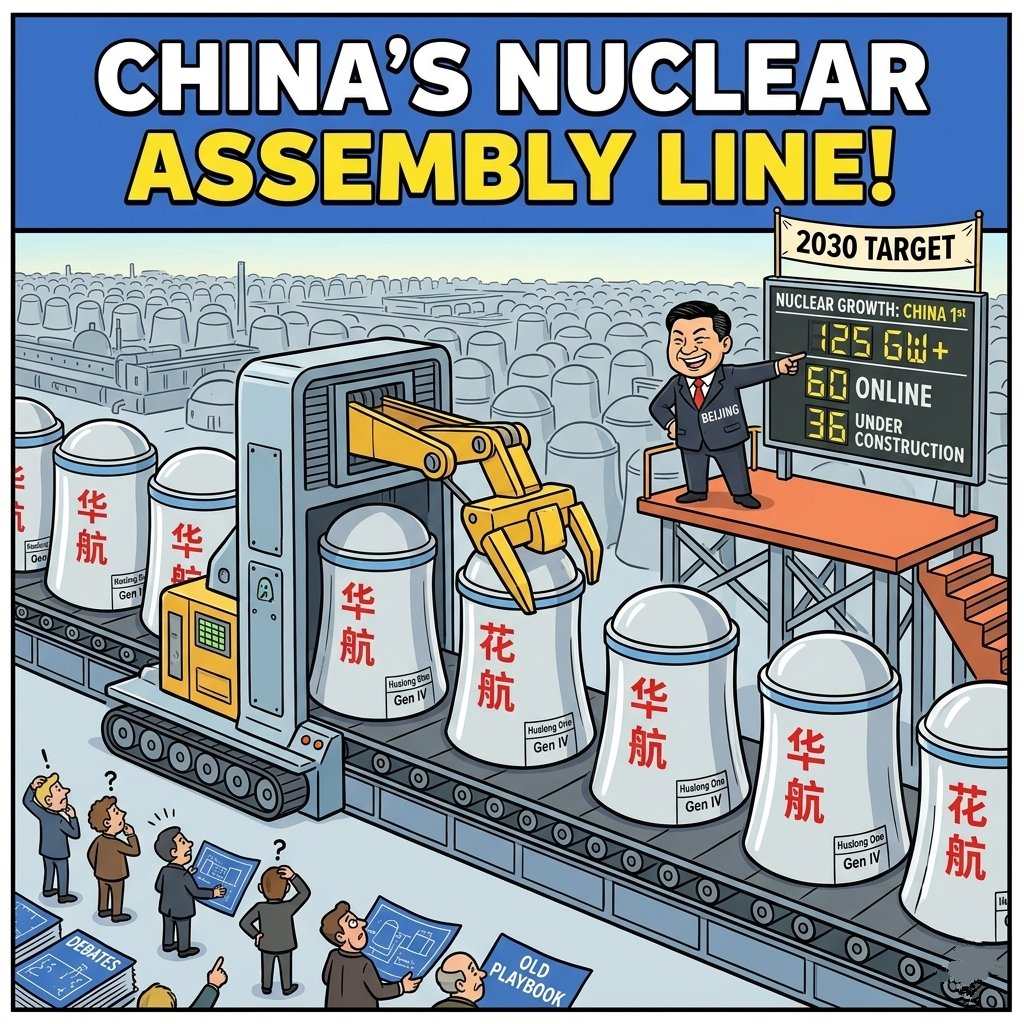
While the West debates timelines and financing, China is executing the most aggressive, industrialized nuclear buildout in human history. It isn't just an energy transition; it is a masterclass in scale.
Here is how Beijing rewritten the nuclear playbook:
🧵 The Industrial Assembly Line:
Nuclear construction used to be a series of bespoke, agonizingly slow megaprojects. China changed the "organizational grammar" of the sector by treating reactors like an assembly line, building up to 50 reactors simultaneously. While global builds frequently drag on for a decade, Chinese firms consistently deliver a reactor in just 5 to 7 years.
⚛️ The Dominance of the Numbers:
The sheer volume of the Chinese fleet is reshaping global energy rankings. Total installed capacity has soared past 125 GW, establishing a massive operational foundation. With 60 commercial units online and 36 more actively under construction, China now commands nearly half of all active nuclear construction globally.
🚀 Jumping Ahead in Tech:
This isn't just about duplicating old technology; Beijing has moved from following Western designs to setting the pace. Their standardized, domestic Hualong One design is highly localized and already heading to export markets, while projects like Shidaowan have placed them at the forefront of commercial Generation IV reactor deployment.
💡 The Big Takeaway:
China’s target to become the undisputed, largest nuclear power producer by 2030 is no longer a distant proposal—it's a statistical inevitability. By combining absolute state backing with a hyper-efficient supply chain, they have achieved what Western markets currently find impossible: predictable, on-time, and scalable nuclear deployment.
The future of global nuclear technology is no longer being written in Paris or Washington. It’s being written in Beijing.
#NuclearEnergy #China #EnergyTransition #Geopolitics #SMR #Uranium #Power #nuclear #energy
"Die Erneuerbaren stellen eine Belastung für den Betrieb unserer Anlagen dar", schreibt der Generalinspekteur für nukleare Sicherheit von EDF in seinem Jahresbericht 2025.
https://t.co/HtzGMLsMSa
Das dürfte für beide Regierungsparteien noch nicht das Ende der Fahnenstange sein. Ich erwarte für beide Parteien eine Wählerwanderung in zwei Richtungen: in Richtung Grüne UND in Richtung AfD. Stärkste Partei dann die AfD, dann die Grünen, noch vor der CDU. SPD unter 10 Prozent.
Ich halte es für ausgeschlossen, dass die CDU Juniorpartner einer blau-schwarzen Koalition werden will. Heisst: die Grünen stellen den nächsten Kanzler.
Und nein, das ist keine Satire.
Die heutige Merzrede war die schlimmste von vielen schlimmen Merzreden. Und das im Osten, im Wahlkampf. Die Einstelligkeit in Mecklenburg-Vorpommern ist nun wirklich zementiert.
The IAEA’s upcoming ATLAS initiative is the catalyst that could finally turn nuclear-powered commercial shipping into a trillion-dollar business reality.
By establishing a regulatory framework for small modular reactors (SMRs) on civilian vessels, this move tackles the maritime industry’s ultimate bottleneck: achieving true zero-emission propulsion without compromising speed, range, or cargo capacity.
For global logistics giants and energy investors, this shifts maritime nuclear power from a speculative sci-fi concept into a highly scalable, high-yield infrastructure play.
Read the full analysis here: https://t.co/9S9qrC62z3
#IAEA #ATLAS #SMR #MaritimeIndustry #ShippingLogistics #EnergyTransition #CleanTech #Infrastructure #SupplyChain #BusinessInnovation