Abu Dhabi's ADGM has become one of the most active homes for regulated digital assets.
Sovereign-linked capital is exploring tokenised private markets. Tether, the largest stablecoin issuer, is backing the infrastructure being built there.
KAIO has had a strong presence in ADGM for a reason.
More to come over the coming weeks👀
The @LaserDigital_ Carry Fund from Nomura's digital-asset arm runs a market-neutral strategy: delta-hedged futures with a staking overlay, engineered to deliver stable, risk-adjusted returns across varying market conditions.
VOLT is available onchain, enabled by KAIO's infrastructure.
KAIO tokenises the top funds because we focus on what they need.
✅Work within their existing ecosystem
✅Focus on compliance and regulation
✅Build the infrastructure that makes it easy
Coinbase will add support for KAIO (KAIO). You can now generate a deposit address for KAIO on coinbase․com, the Coinbase app, and Coinbase Exchange in regions where trading is supported.
Deposits of KAIO will not be available until the asset issuer unlocks transfers.
I just joined the KASH 💰 waitlist from @KAIO_xyz.
Get early access to receive up to 8% non-crypto correlated yield through a curated basket of top institutional RWA funds.
https://t.co/6yaYzpsY0F
LIVE: KAIO × @KaitoAI Leaderboard
We’re rewarding the voices who move the RWAs convo forward.
Details will follow along with rollouts since the leaderboard is just the start.
KAIO x @KaitoAI Leaderboard is live tomorrow.
Rank by quality → not volume.
• Post about KAIO, our gateway, roadmap & integrations
• Threads, research, memes and content
• Track your rank on Kaito
See you on the leaderboard.
Google Cloud Universal Ledger (GCUL) and What We Know So Far.
Google Cloud has quietly been building something significant: GCUL (Google Cloud Universal Ledger), a Layer-1 blockchain which is seemingly designed for financial institutions, exchanges, and payment providers. While still in private testnet, it has the potential to reshape how value moves across global markets. Here is what we know so far:
What is GCUL?
1. Layer-1 blockchain built for institutions, not retail.
2. Public-permissioned consensus and compliance-oriented: KYC, auditability, and fraud detection built in.
3. Neutral infrastructure: unlike Stripe’s Tempo or Circle’s Arc, it is vendor-agnostic.
4. Python smart contracts: lowers the barrier for financial developers and quants, as well as seamless agentic integration.
5. Cloud-scale performance: predictable fees (no volatile gas), 24/7 settlement.
Single Chain or Deployable?
GCUL is positioned as a single, public-permissioned Layer-1, currently run on Google’s infrastructure. No news if it can easily be deployed as a private chain or be deployable anywhere - it is a controlled ledger, with neutral governance designed to attract banks and market operators.
Token Model
1. No native token announced.
2. GCUL is designed to support multi-asset tokenization (stablecoins, securities, payments) without tying institutions to a “gas token.”
3. There is speculation Google could issue a stablecoin in the future, but nothing official has been confirmed.
Why It Matters
1. Legacy rails (ACH, RTGS, card networks) are slow and fragmented. GCUL promises real-time, programmable settlement.
2. In 2024, stablecoin volumes hit $30 trillion - a clear signal institutions need better infrastructure.
3. By blending blockchain, cloud, and AI, Google positions GCUL as a potential institutional Web3 backbone.
Challenges Ahead
1. Regulation: evolving frameworks around stablecoins and tokenized assets. So uptake may be slow.
2. Competition: Ripple, Circle, and Stripe are pushing their own Layer-1 solutions.
3. Adoption curve: winning trust from banks takes time.
Takeaway
GCUL is not “another crypto chain.” It is Google’s bid to build the neutral, compliant settlement layer institutions have been waiting for. If successful, it could do for financial rails what Gmail did for communication: make them faster, simpler, and globally accessible.
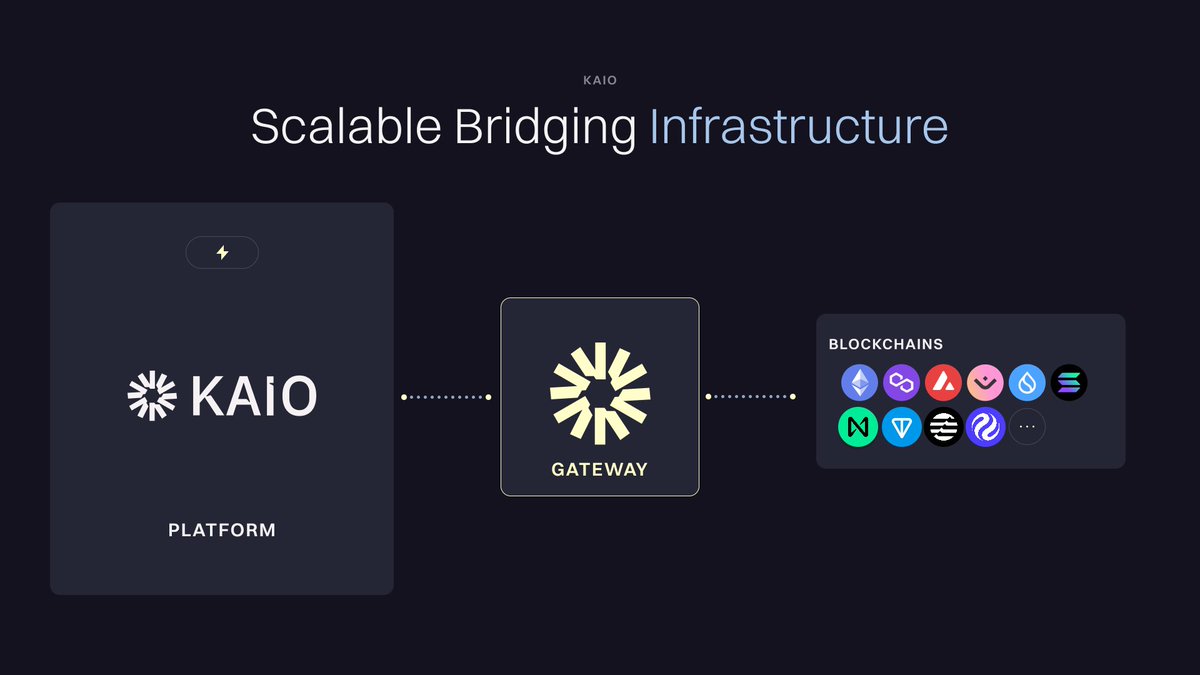
KAIO’s Gateway architecture is optimized for compliant fund issuance, cross-chain interoperability, and composability across DeFi protocols. #RWAs
Learn more.👇
The @KAIO_xyz is bringing institutional products onto Hedera $HBAR's distributed ledger, allowing investors to gain exposure to BlackRock & Laser Digital funds.
https://t.co/Dzy0tjn3rz
This is the future of RWA’s, @KAIO_xyz enables seamless access of high quality assets across any blockchain.
As well as the Laser Carry Fund, you can also access other high quality assets on @hedera network, such as Blackrock, BrevanHoward and HamiltonLane. Just as importantly, the assets have full utility, to be able to be used in composable DeFi services.
This is the future of omnichain capital markets.
Libre Capital is now KAIO (@KAIO_xyz) - a bold new direction representing the fundamental shift toward building the infrastructure needed to make institutional capital programmable and composable on public blockchains.
Nice to meet you🤝