Building @getb2brain for exhibitors at trade shows to generate better pipeline
I pivoted from releasing ships to shipping releases. ex @inmobi @yahoo @zoho
Some clarifications on various themes being discussed about @SarvamAI in the last few days:
1. Government Support: The IndiaAI Mission under MeitY has played a pivotal role in bootstrapping India's AI ecosystem. It gave ~20 startups subsidised access (40% discount) to GPUs for training models. We used that access to train Sarvam 105B from scratch, which we completed and open-sourced this February. The government did not pay Sarvam directly, instead like with every supported startup, the subsidy went to GPU cloud providers, helping seed AI infra in the country.
2. Sarvam Token Factory: Open-weight models saw massive adoption globally this year. They offer a cost advantage over closed models and let enterprises own their AI stack. But this choice is not available to all Indian enterprises, which often need data to remain within the country and low latency for interactive use cases. Sarvam Token Factory is one of the first large inference offerings in India. We serve multiple open-weight models on GPUs we have privately procured, without any government support. We have optimised datacenter scale inference to make our token cost comparable to or lower than established providers such as Fireworks, Baseten and Together.
Today, India consumes a few trillion tokens a day and imports the majority of them. Scaling this consumption up and building sovereign capability requires investing in GPU infra, running efficient token factories, and guaranteeing advantages in cost, latency, and data residency. This is the key objective of Sarvam Token Factory. We will continue to reduce costs further and widen access for inferencing in India.
3. Our own models: Building inference capability does not conflict with our core mission: training our own models. Over the last few months, alongside putting together the token factory and scaling up our enterprise offerings, we optimised our training stack for Blackwell GPUs and achieved significantly higher performance. We used this optimised infra to train an improved checkpoint: Sarvam 105B-1711, which we are open-sourcing today. It improves on reasoning, tool-calling, and co-work tasks, while excelling in Indian languages. It is one of the best Flash-Lite class models, open or closed, achieving high accuracy at a low cost of ₹25 per million output tokens. We also optimised it to run on a single RTX Pro GPU with our agentic product Indus. Along with the weights, we release inference and training recipes so others can build upon it.
In the coming two weeks we will release multiple other models across vision, speech, and edge. And crucially, we are working with partners to get the latest training grade compute into India. This will set us up for training our next generation of much larger models.
4. The Sarvam Journey. To put things in perspective, most AI labs invest 100s of millions of dollars into infra to train from scratch, scaling up to billions for frontier capabilities. We are determined to climb that ladder from India, while building a sustainable commercial engine across population scale and enterprise use cases.
Irrespective of the different narratives, some of which appear manufactured, we firmly believe that India can and must win across the full-stack of AI - we have the talent, the demand, and positivity to adopt AI. At Sarvam we will stay focused and build towards this outcome.
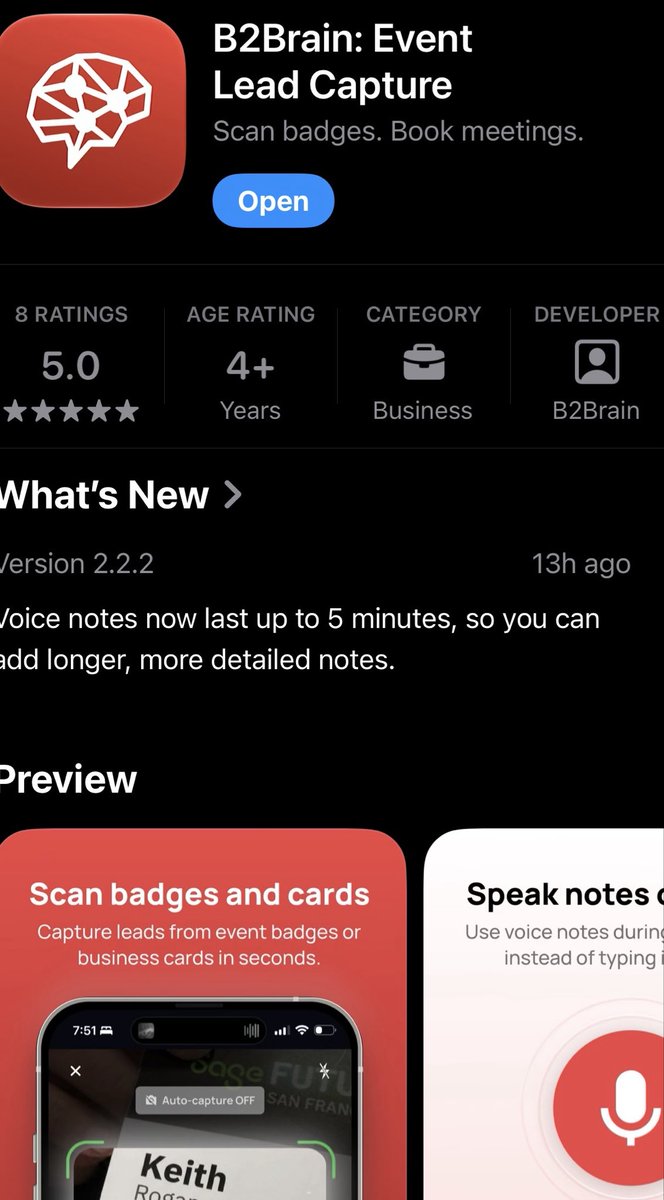
New in B2Brain 🧠
Voice notes can now run for up to 5 minutes—built for those high-value booth conversations where projects, budgets, stakeholders and next steps all come up.
Stay in the conversation. B2Brain captures the context and turns it into action.
Badge scans capture contact details.
Conversations reveal the project, budget, stakeholders, intent, next step.
@getb2brain voice notes now capture up to 5 min of that context, and turn it into a summary, action plan and booked meeting.
Scans go in. Qualified pipeline comes out.
The Great Circle of Crude
Somewhere in the Urals, a barrel of oil is loaded onto a tanker. It has no idea it is about to become the most morally flexible object on earth.
It sails to Jamnagar, where India buys it at a "friendship discount". India calls this strategic autonomy. The West calls it funding the war. The barrel calls it Tuesday.
At the refinery, the crude is heated, cracked and distilled, and something miraculous happens. The Russian molecules leave, and Indian diesel emerges. Nothing about the chemistry has changed, but the paperwork has undergone a spiritual rebirth. It is the only known process that turns sanctions into margins.
Europe now steps in. In the morning, it sanctions Russian oil. By lunch, it fills its tanks with Indian diesel. At dinner, it lectures India on values. Europe does not buy Russian oil. It buys Russian oil that has been to finishing school.
America is furious that India buys Russian crude and slaps on tariffs to show it. It then quietly carries on importing Russian enriched uranium, because principles are like fuel: best refined before use.
Now comes the masterstroke. Ukraine needs diesel to resist Russia, so it buys Indian diesel with money given to it by Europe. India then pays Russia for the next barrel. So European taxpayers fund Ukraine, which pays India, which pays Russia, which funds the missiles that make Ukraine ask Europe for more money. It is the first war in history with a subscription model.
Russia, meanwhile, earns money from the fuel powering the trucks that resist its own army. It is the only belligerent to have outsourced both its revenue and its opposition's logistics to the same refinery.
Final ledger:
Russia: paid for the war, by the war
Ukraine: fighting Russia on Russian fuel, bought with European money
Europe: morally clean, operationally Indian fuelled
America: outraged, selectively
India: charging a refining margin on everyone's hypocrisy
The barrel: has travelled more than most diplomats, and achieved more
The money circles the globe like a vessel on DP (Dynamic Positioning) holding station: burning enormous energy, going nowhere, and everyone on the bridge insists it is under control.
The wildest AI project this week has nothing to do with LLMs. It counts potatoes.
A developer named Viet built a vision system that counts potatoes on a conveyor belt.
He annotated one frame. One. Used SAM 2 to generate labels, trained a tiny YOLO11 nano model, and it works across the entire video. Real-time counting. Production ready.
While everyone is racing to build trillion-parameter models, the fastest wins in manufacturing are systems like this.