Your environment influences your performance. Air quality, temperature, lighting, noise, and travel conditions all affect how athletes feel and function. Optimize the environment instead of expecting athletes to overcome every unnecessary stressor. 🌡️
Think beyond the next opportunity. A college commitment, NIL deal, contract, transfer, or job can affect more than one season. Evaluate the development, expectations, opportunity, finances, and long-term consequences before making the decision. Build a career not just a moment.💰
❌ Training Myth: Change exercises constantly to keep the body guessing. Adaptation requires enough consistent exposure to improve. Progress the stimulus when there’s a reason—not because novelty looks creative.
Coach the person, not just the player. Two athletes may need the same standard delivered differently. Knowing when to challenge, teach, listen, or give ownership is part of coaching. 🤝
Test what you actually intend to train. A testing battery should help establish athlete profiles, identify meaningful qualities, guide programming, and measure whether training created the adaptation you wanted. Testing without action is just collecting numbers. 📋
Rehab should progress from capacity to unpredictability. First restore the physical qualities, then challenge them with reaction, decision-making, competition, and environmental uncertainty. The game won’t tell you what happens next. 🎲
Great route runners understand space, not just routes. Coverage, leverage, defender positioning, and timing can change how space develops. Learn the concept behind the route instead of simply memorizing footsteps. ♟️
Power is load-specific. Heavy loads can develop force and lighter loads can allow greater velocity. Use different loading strategies across training to develop an athlete capable of producing force across a range of speeds. 💥
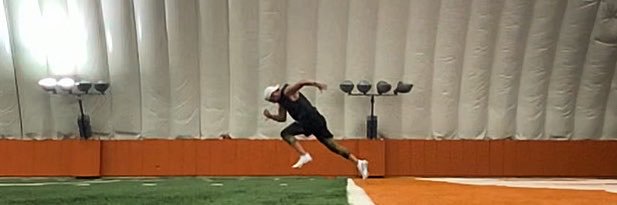
Don’t ignore curved sprinting. Football isn’t played exclusively in straight lines. Athletes need the ability to maintain speed, posture, and force while navigating curved paths without unnecessarily braking. 🏎️
The JUGS machine can build volume, but it can’t replicate football. Real development comes from extra QB-WR routes, footwork, releases, positioning, live catches, and reps under movement and timing with a specialist who bridges speed to skill so the work transfers to the field.
Strength and conditioning isn’t just about who’s bigger, stronger, faster, or more injury-resilient. The real test is the product you put on the field, how athletes move, execute, adapt, and perform when the lights are brightest. Execution is the standard. 🐐
Competition-day nutrition should be practiced before competition day. Test meal timing, food choices, fluids, and portions during training so the athlete already knows what sits well and supports performance. Never make game day an experiment. 🍌
Pain and damage aren’t always the same thing. Pain is influenced by many factors, so listen to the athlete, assess the situation, and use the full picture instead of treating pain intensity as a direct measurement of tissue damage. 🧠
Protect your leverage by preparing before negotiations. Know your value, know your alternatives, and know what you are willing to walk away from before the conversation starts. Confidence is stronger when it is backed by preparation. 💰
❌ Training Myth: A sweatier workout is not automatically a better workout. Sweat reflects thermoregulation, not training quality. Judge the session by the adaptation you created, not how soaked the shirt is.
Sports have treated performance like support staff for too long. If the leader can’t connect strength, speed, movement, braking, cutting, RTP and skill to how the athlete actually plays the game, the system is incomplete. Performance isn’t beside sports. It is the sport! 🔥
Great leaders remove confusion. Athletes should know what the standard is, what their role is, and what happens next. Clear expectations reduce hesitation and improve accountability. 🗣️
Don’t chase every metric. Collect data that can actually change a decision. If a number doesn’t influence training, recovery, availability, or performance, it may just be noise. 📊
Return-to-play should include worst-case positions. Athletes need exposure to awkward cuts, late reactions, off-balance contacts, and imperfect situations before competition. Games are rarely clean and predictable. 🩹
Ball security starts before contact arrives. Anticipate traffic, tighten the ball to the body, and adjust carrying position before the defender gets there. Protecting the football is a skill, not an afterthought. 🏈