Every talk from GopherCon UK 2026 is now on YouTube.
Whether you missed a session, couldn't be in two tracks at once, or just want to rewatch a favourite, it's all there and free to watch.
Huge thanks to our speakers for these, and to everyone who joined us in London. 💙
👉 https://t.co/xc6Ns2tXc1
#golang #gopherconuk26
Just about every modern language comes with sets built in, but Go doesn't, at least not yet.
In this talk, Fluent Python author Luciano Ramalho shows how thinking in sets can replace tangled loops and if statements with code that's simpler, clearer and often faster, then takes an early look at the new set types on their way to Go's standard library.
Watch the full talk here: https://t.co/6Mztp3yTn8
AI is great at writing code that looks right, but that's not the same as code that is right.
In this talk, Bryan Boreham shows a safer way to make big changes to a Go codebase, using Go's built-in tools for understanding code to build your own checkers and fixers, and letting AI help write those tools instead of editing your code directly. It's packed with real examples from Prometheus and other open source projects at Grafana Labs.
Watch the full talk here: https://t.co/hDLikhA7p5
One road trip across Western Canada left Sadie Freeman with 540 one-minute dashcam clips and over 100GB of footage, far too much for any video editor. So Sadie built a tool in Go to turn it all into a timelapse.
This talk follows that project from the simplest thing that worked to a full concurrent pipeline, including the moment unlimited goroutines took the laptop down, and the lessons on when running things in parallel really helps.
Watch the full talk here: https://t.co/zGfF5qihoZ
Engineers are getting tired of constantly having to keep up to date in this era. It's important to protect the thing that originally got you into the industry.
Thank you @gopherconuk for having me 🙏
Running AI on your own machine used to mean extra servers, fiddly setup and a fair bit of Python. With Kronk, @goinggodotnet is making it something any Go developer can drop straight into their app and run on their own hardware.
Watch it in action as a local model builds an Asteroids game live on stage, then follow Bill under the hood to see how a model really turns your prompt into an answer.
Watch the full talk here: https://t.co/e6NyohSFe6
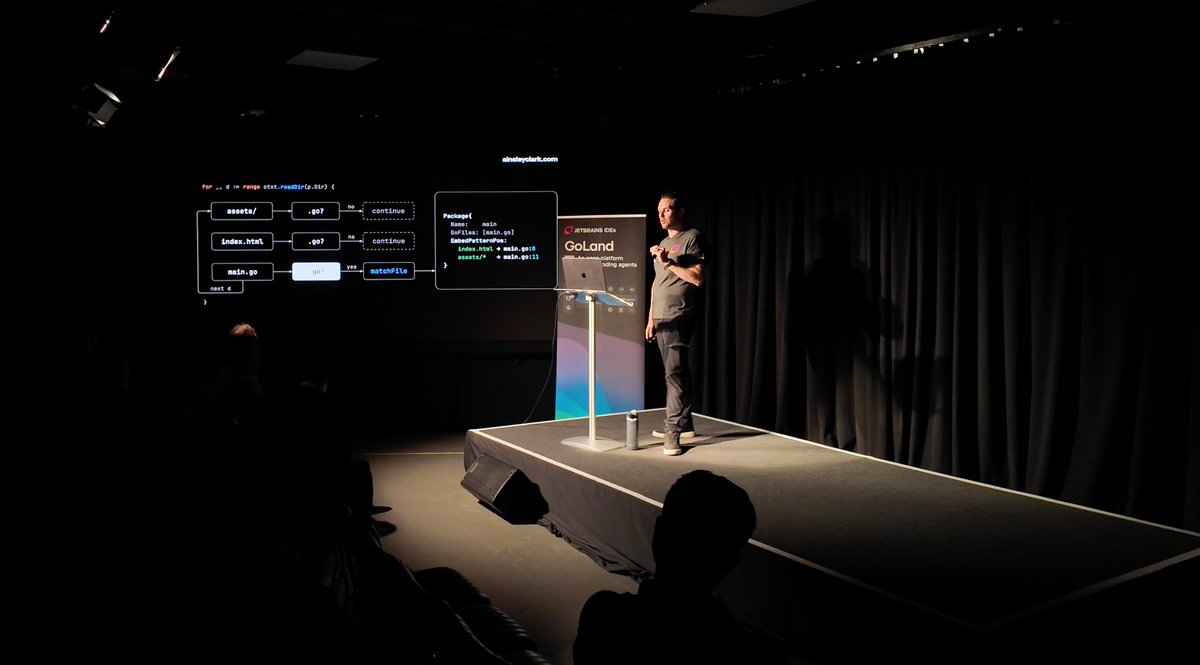
AI has changed the way we code, from speeding up our workflows to taking the grunt work off our plates. But if the machine does the building, where does the pride in our work come from?
In our opening keynote, @ainsleydev explores why the effort we put in is what makes us love our work, and how to keep that feeling alive in the age of AI.
Watch the full talk here: https://t.co/b41rvRwrYN
Some of the biggest slowdowns in your Go code happen deep inside the CPU, where pprof can't see.
In this talk, Christian Simon shows how the processor's own built-in counters can reveal them, walking through real experiments on Prometheus at @grafana and what they uncovered. You'll also see perfgo in action live, a new tool that brings this hardware-level insight straight into your everyday Go workflow.
Watch the full talk here: https://t.co/X0YGEIrrGa
A few weeks into a new job, Tom Coupland joined a small team with a stack of AI tools and one simple brief: see what you can do. What followed was a crash course in shipping with AI, from the early excitement and code that quickly got out of hand to the habits and guardrails that got a real product live.
In this talk, Tom shares the whole journey, and why getting the fundamentals right matters more now than ever.
Watch the full talk here: https://t.co/Fe0uW5POHS
REST has powered the web for years, but it wasn't built with AI in mind. Andy Kuszyk found that out first-hand at @typeform , where building an AI assistant on top of the existing API took far more work than expected.
This talk explores why MCP is becoming the new standard for connecting AI to your platform, using a pizza-ordering example to make it click, and shares the patterns Typeform used to roll it out across the whole engineering team, alongside the REST API they already had.
Watch the full talk here: https://t.co/n1GODTHsMW
Java and Python developers have long been able to add monitoring to their apps without touching any code. For Go, it's always been a manual job, but that's changing fast.
In this talk, Kemal Akkoyun tours every practical way to see inside your Go services without changing a single line, from tools that work deep inside the Linux kernel to ones that step in while your code is being built, and helps you pick the right one for your systems.
Watch the full talk here: https://t.co/t7qs8IfC4L
Building a full web app on your own can feel like a lot, especially if JavaScript isn't your comfort zone.
Haseeb Majid's talk shows a simpler path, using Go, HTMX and a handful of friendly tools to go from idea to finished app with barely any JavaScript. It's an honest, practical look at where this approach shines, where it falls short, and why simple code is easier for both you and AI to work with.
Watch the full talk here: https://t.co/79qC63ygBH
If you've ever wondered where Go fits into the world of machine learning, this talk is a great place to start.
@samb_tech builds a custom neural network from scratch, using a Wordle-solving project to show how Go and the GPU can share the work, with Go running the show and CUDA handling the number crunching. It's a nuts-and-bolts look at how the pieces fit together, from the model's design to the lessons learned along the way.
Watch the full talk here: https://t.co/3KRsjiLxX5
Benchmarks are how we prove our code got faster, but only if the numbers are telling the truth.
Kemal Akkoyun's talk uncovers the sneaky ways Go benchmarks can mislead you, from simple mistakes in how they're written to the background noise that makes results hard to repeat. Kemal then shows how to tame it all, from quick checks on your own machine to catching slowdowns automatically before they ever reach production.
Watch the full talk here: https://t.co/cjelk0dfCZ
Has static analysis become a thing of the past in the AI era? Jonathan Amsterdam of the Go team says it’s just as relevant for agents as it is for people.
What happens when a lifelong programmer teams up on stage with a teenage son who isn't sure he likes coding?
@feyeleanor 's talk is a candid, funny look at why schools are getting programming wrong, with lessons that promise a lot, deliver very little and rarely let students actually build anything.
Along the way, the pair share the Go project they've been working on together, and show how making something you care about can teach far more than any syllabus.
Watch the full talk here: https://t.co/o3seVxVMjW
Once customers get a taste of AI in one part of your product, they expect it everywhere.
That's the challenge @typeform faced after its AI form builder took off, and in this follow-up to MCP is the New REST, Andy Kuszyk shares how the company went from a single assistant to a whole team of specialist agents. It's a behind-the-scenes look at the architecture, the team structure and the lessons learned in making every product team an AI team.
Watch the full talk here: https://t.co/snAifaj0I4
No manual trading allowed. That's the one hard rule behind @_andrewwormald trading company, set up to see what's really possible when AI helps build a trading business and then helps run it.
With real money on the line, Andrew walks through how models are trained in Python, shared through ONNX and put to work in Go, the language behind around 90% of the platform, along with the lessons learned keeping it all running around the clock.
Watch the full talk here: https://t.co/3HdO5iGThR
When you think of desktop apps, Go probably isn't the first language that comes to mind. Andrew Williams is out to change that.
In this talk, @andydotxyz takes you inside FyneDesk and FyshOS, a complete desktop written in Go, from managing windows and virtual desktops to an app launcher with built-in AI, all running live on stage. It might just inspire you to build your next app with Go.
Watch the full talk here: https://t.co/ipF7bfSi7O