the most dangerous aspect of this maneuver is not the mathematical exaggeration but the corporate enclosure of scientific discovery by keeping these frontier systems locked behind outcome based pricing licensing barriers & proprietary API walls openai seeks to privatize the very mechanism of human knowledge converting a synthetic nation of compute into a gated monopoly that tolls humanity for access to scientific truth
@PMCPune this is the situation in front 2 prominent schools in kharadi..hundres of parents students are crossing this everyday...dozens have already fallen into it. Can you fix it? Or we need to fix it ourselves? @aaplasurendra
भारतीय हवामान विभागाने दि. ६ जुलै २०२६ रोजी पुणे जिल्ह्यासाठी #रेडअलर्ट ' जारी केला आहे. संभाव्य अतिवृष्टीच्या पार्श्वभूमीवर विद्यार्थ्यांच्या सुरक्षिततेच्यादृष्टीने खबरदारीचा उपाय म्हणून जिल्ह्यातील सर्व शाळांना सुट्टी जाहीर-जिल्हाधिकारी जितेंद्र डुडी...१/२
@collector_pune
FAQs on Rabies:
1. Once developed, rabies is 100% fatal.
2. Which animals can transmit it: Any warm-blooded animal. Dogs are the most common source. But cats, monkeys, bats, camels, and even pigs can also transmit it.
3. Mode of transmission: Bite; lick on broken skin or mucosa (like eyes, nose, or mouth); scratches if the claws are contaminated with saliva; or saliva splashing into the eyes or mouth.
4. Incubation: Rabies symptoms usually appear in 1 to 3 months but can show up as early as a few days or as late as a year, depending on the bite site and virus load. Once symptoms start, it's too late.
5. What to do immediately after a bite, scratch, or lick: Wash the wound with soap and running water for 15 minutes. Then apply an antiseptic like betadine. This step alone can greatly reduce the chance of infection.
6. When to see a doctor: As soon as possible.
7. What if the animal is vaccinated: It doesn't matter. Vaccination is good and reduces the risk but doesn’t eliminate it completely, especially when pet vaccination in India is not uniformly regulated
8. Vaccination, immunoglobulin, or both: For academic interest only :
Category I (licks on intact skin, animal sniffing, contact without bite/scratch) generally requires nothing except washing.
Category II (nibbling, minor scratches without bleeding) requires vaccination.
Category III (deep bites, multiple wounds, licking on broken skin, or bites on head/face/genitals) requires both vaccination and immunoglobulin.
BUT YOU DON’T DECIDE WHICH CATEGORY YOU FALL UNDER OR WHAT TREATMENT YOU NEED. EVEN CATEGORY I EXPOSURE SHOULD BE SHOWN TO A DOCTOR. LET YOUR DOCTOR, AND NOT YOU, DECIDE WHAT’S BEST FOR YOU.
9. Specially for parents: Kids may downplay licks and minor scratches as harmless. So, educate them. Explain the risks and emphasize that they should never hide any contact with dogs from you.
This is the first and last response I’ll make regarding the OpenCode “drama.”
Not because it’s unimportant, but because I don’t take the people attacking us seriously. I’m too busy building and if they attack me I would most likely not reply at all. But, when someone as decent and principled as Christian Rocha (my CEO) is being slandered for cheap views, I owe it to him and to the truth to set the record straight.
1. Christian Rocha, the CEO of Charm, is one of the kindest and most principled people I’ve met.
When the idea of working together emerged, Christian didn’t just talk, he flew to my home country to meet me in person. That’s the kind of integrity and commitment he shows. He’s not a Twitter loudmouth or a YouTube hot-take machine. He’s a builder. He’s spent millions supporting open-source projects. In fact, most of the Go-based TUI ecosystem runs on Charm’s stack, tools like [Bubble Tea], [LipGloss], [Glamour], and [Bubbles].
Calling him a “dumbass” isn’t just immature, it’s hypocritical coming from people who pretend they fight for open source.
2. I created the project and I brought it with me.
I built what became OpenCode, originally named TermAI. I wrote the initial code. I owned the repo. I never transferred ownership to anyone nor was there any agreement that I should. Some contributors came in later and helped with UI polish and visibility, and I’ve always appreciated that. But support doesn’t equal ownership. Let’s be real: buying a domain doesn’t entitle you to take over a codebase.
3. Charm made an offer which is not a hostile move.
When the project started gaining traction, Christian and the team at Charm offered me the opportunity to keep building it full-time, with backing, infrastructure, and long-term support. I accepted. But let’s stop pretending that an open-source collaboration turning into a funded opportunity is some kind of corporate conspiracy.
4. Open source is about contribution and not about clout.
Charm has contributed more to the open source CLI ecosystem than any influencer ever will. Christian didn’t chase stars. He didn’t start drama. He offered a path forward, and we’re taking it with integrity and focus.
Christian and me didn’t come here to be famous. We came here to build. And I’m proud of the team I’m building with. We’ll let the work speak for itself.
I really want an agent mode of MCP. Hear me out....
This is really simple. Right now in a chat app your message gets submitted to the host which runs a model and that connects to MCP tools. Instead I want my MCP server to expose an "agent" which is really just a tool with a known signature. When I submit my message in the chat app I can then select that I want it to go to that agent exposed by MCP and the chat app will just send the prompt/attachments to the agent tool. It's basically just like calling a tool directly.
It works really well. I have a custom host/client that does this. What this also allows is that I have a standard tool interface to an agent and can now synchronously talk between to agents. Right now my interface is just a
{
prompt: "..."
attachments: ["data-uri"]
}
And the response is just a standard mcp tool response. I then use progress notification for streaming responses but also do the full result in the tool response.
@dsp_
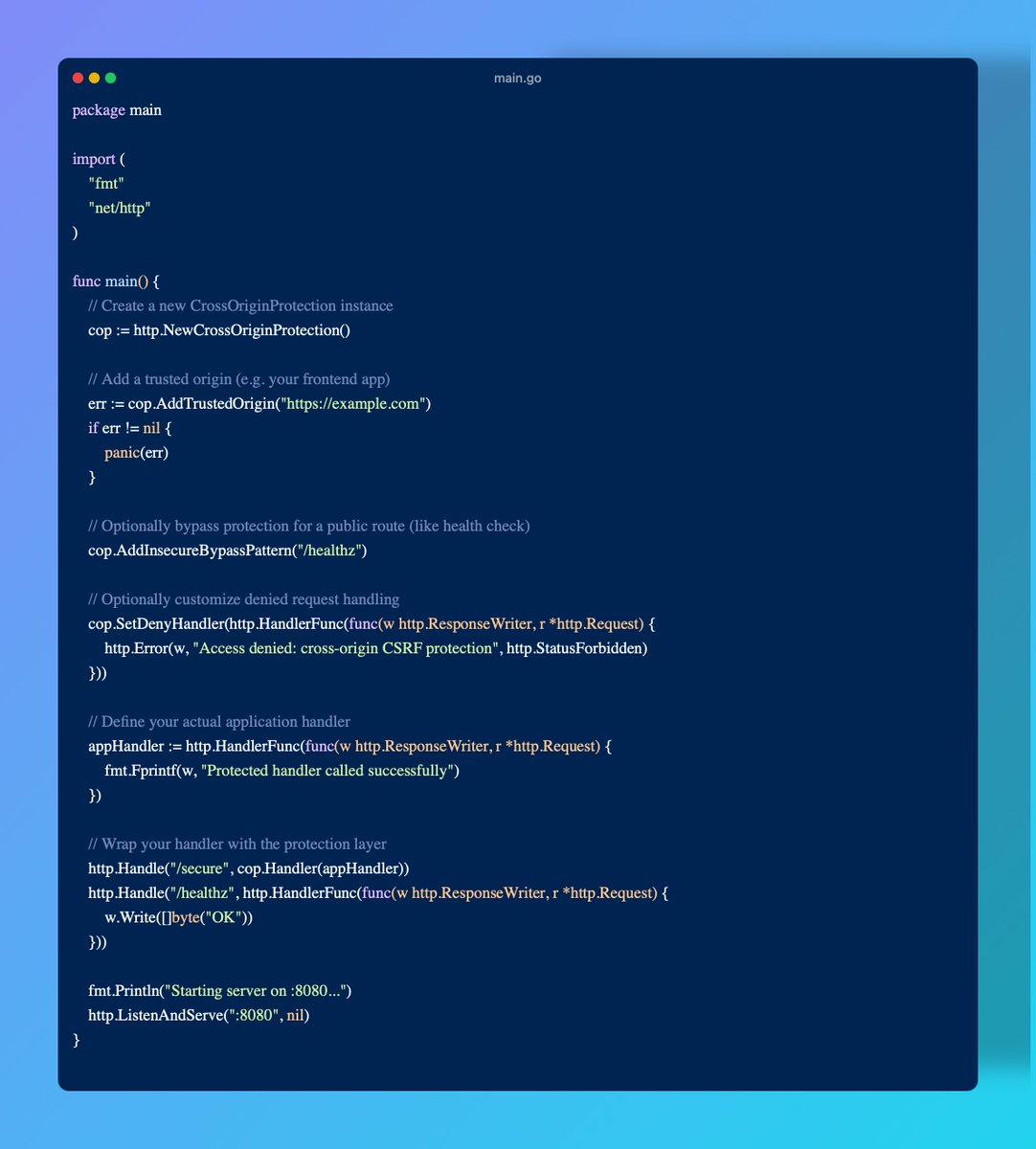
To customize it: use AddTrustedOrigin to allow specific origins, like your frontend domain.
Use AddInsecureBypassPattern to skip protection on routes like /healthz.
Want custom error handling? Set a deny handler with SetDenyHandler.
Then wrap your endpoints with cop.Handler.
Go 1.25 adds built-in CSRF protection to net/http via CrossOriginProtection.
It uses modern fetch metadata (Sec-Fetch-Site, Origin) to reject unsafe cross-origin requests — no tokens, no cookies. Just drop it in.
#golang
Safe methods (GET, HEAD, OPTIONS) always pass.
For others (POST, PUT, etc.), requests are blocked unless:
Sec-Fetch-Site is same-origin or none
Origin matches Host
You’ve whitelisted the origin or path
Before Go 1.25, many relied on uber-go/automaxprocs to fix CPU throttling in containers.
With this update, similar behavior is now built into the Go runtime — no extra dependency needed! 🙌
#golang#uber#gopher#devtools
🚀 Go 1.25 brings smarter GOMAXPROCS behaviour for containers!
🧠 GOMAXPROCS now respects Linux cgroup CPU limits (not just logical CPUs)
🔁 It dynamically updates if CPU limits or logical CPUs change at runtime
Perfect fit for modern containerized apps! 🐳💻
#golang#kubernetes
Want to turn it off? Use:
GODEBUG=containermaxprocs=0,updatemaxprocs=0
📁 Go now keeps cgroup file descriptors cached for the process lifetime — making it efficient & reactive inside containers.
#golang#containers#cloudnative#gopher
https://t.co/8JufyvSYqt
Getting started is simple:
git clone https://t.co/dNN5ztiRiT
cd open-agent-platform
docker-compose up --build
Then hit localhost:3000 and start building agents in your browser.
LangChain just dropped the Open Agent Platform — a self-hostable, no-code UI to build and run LangGraph agents.
Supports tool integration, memory, RAG, and multi-agent workflows.
Everything runs locally, and it's open source:
🔗 https://t.co/Z2BGkDJV0r
What you get:
Web UI to define agents + tools
LangGraph-based execution
Tool calling & output parsing
Built-in Auth + LangServe endpoints
Supervisor to orchestrate multiple agents (like a DAG)
Definitely underrated how good Go is for AI generated code. The fact that the standard library is so widely used and the de-facto way to do most things means the models lean heavily towards using it.
I’m generally much more satisfied with the AI generated code for Go than TypeScript and Node.