UC Berkeley CS grad told me he rates his life 15 out of 100.
Not because he failed. Because he did everything right, and the ground still moved under him. 🧵
Today, we’re open-sourcing the draft specification for DESIGN.md, so it can be used across any tool or platform. We’re also adding new capabilities.
DESIGN.md lets you easily export and import your design rules from project to project. Instead of guessing intent, agents know exactly what a color is for and can even validate their choices against WCAG accessibility rules.
Watch David East break down this shared visual language in action👇. New capabilities and links in 🧵
"Bilingualism may not necessarily make you smarter, but it does make your brain more healthy,complex, and actively engaged. When it comes to our brains, a little exercise can go a long way."
"It's never too late to learn a new language. Even if you didn't have the good fortune of learning a second language as a child, it's never too late to do yourself a favor and make the linguisticleap from hello to hola, bonjour, or ni hao. A little exercise can go a long way."
Mia Nacamulli (TED-Ed) #LanguageLearning
https://t.co/BRVzHnj51b
Brian Chesky on building Airbnb, they combined product management with product marketing.
They start with the story first.
Because the story dictates the product.
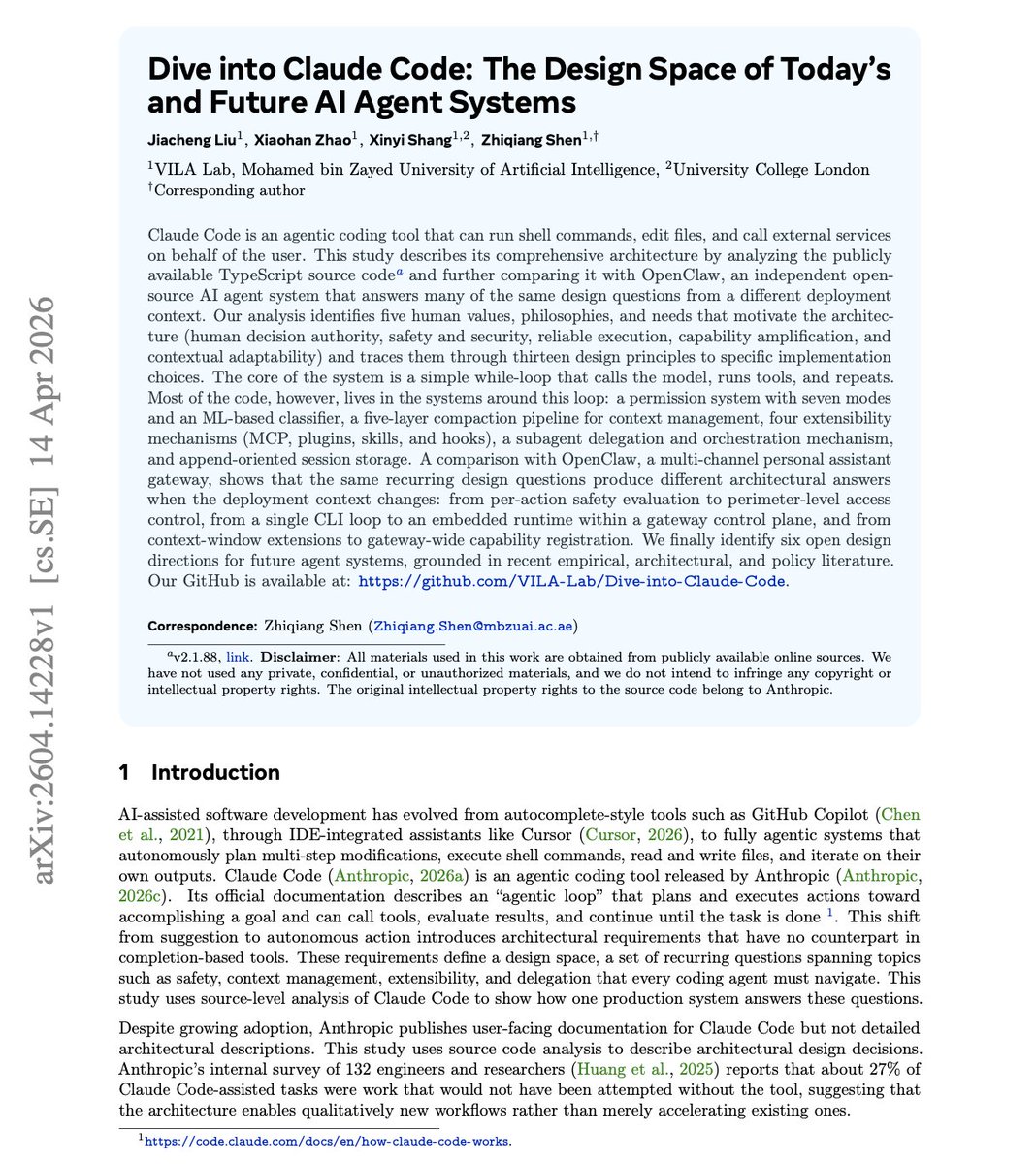
Claude Code fully dissected!
Researchers from UCL reverse-engineered the leaked Claude source. What they found changes how you should think about agent design.
Only 1.6% of the codebase is AI decision logic.
The other 98.4% is operational infrastructure. Permission gates, tool routing, context compaction, recovery logic, session persistence. The model reasons. The harness does everything else.
This is the opposite of what most agent frameworks do today.
LangGraph routes model outputs through explicit state machines. Devin bolts heavy planners onto operational scaffolding. Claude Code gives the model maximum decision latitude inside a rich deterministic harness, and invests all its engineering effort in that harness.
The core loop is a simple while-true. Call model, run tools, repeat.
But the systems around that loop are where the real design lives:
A permission system with 7 modes and an ML classifier. Users approve 93% of prompts anyway, so the architecture compensates with automated layers instead of adding more warnings.
A 5-layer context compaction pipeline. Each layer runs only when cheaper ones fail. Budget reduction, snip, microcompact, context collapse, auto-compact.
Four extension mechanisms ordered by context cost. Hooks (zero), skills (low), plugins (medium), MCP (high). Each answers a different integration problem.
Subagents return only summary text to the parent. Their full transcripts live in sidechain files. Agent teams still cost roughly 7x the tokens of a standard session.
Resume does not restore session-scoped permissions. Trust is re-established every session. That friction is the point.
The bet behind all of this is simple. As frontier models converge on raw coding ability, the quality of the harness becomes the differentiator, not the model.
Paper: Dive into Claude Code (arXiv:2604.14228)
In the next tweet, I've shared an article I wrote on Agent Harness and what every big company is building. Do check.
Had a real "aha" moment today.
When you're out of ideas or stuck on a problem, the default move is to brainstorm with your team, think harder on your own, or go research what others are doing.
But honestly?
The best answers almost always come from talking to users.
And if you can't talk to them right now, go read their reviews, listen to old call recordings, or dig back into past interview notes.
The signal is already there.
You just have to go find it.
The answer is almost never in your head.
It's in theirs.
From Tony Fadell's BUILD.
"We were solving problems 10 years ahead.
Palm solved today's problem."
15 years before iPhone, Fadell was part of a team that built a smartphone. It sold 3,000 units.
Palm won. A simple handheld device. All it did was "carry your phone numbers in your pocket."
Technology changes faster now. That makes it tempting to build ahead.
We're doing exactly that.
But
"solving today's problem"
that's important in any era.
Is Anthropic trying to become the Apple of AI?
Model = iPhone?
Managed Agents = App Store?
Cowork = macOS?
Cutting off third-party agents = Classic Apple?
Meanwhile, Sam Altman says "Intelligence will become a utility like electricity or water."
OpenAI is building the infrastructure of intelligence.
Apple vs Power company.
Same AI industry, but such different paths.
Honestly, I don't know if this directly affects us yet.
But one thing is clear "just using an LLM company's model" is already a different game.