First time catching @AklTransport buses to the #allblacks game - have been waiting 25 minutes and looks like we will be late. Third scheduled bus not showing up #frustratedforthekids
The people you attract with referral programs, free trials, coupons, and gamification — folks who are “incentivized” as a broad umbrella category — are usually MUCH WORSE than organic ones. Worse LTVs, worse conversion, less engaged, and so on.
In a previous life, I headed up Uber’s $300m+/year referral program (“give $5 and get $5”) and learned a ton. Much of the learnings apply to the next wave of gamified consumer apps, web3 games, etc.
So why are these users worse?
When a new product comes to market, usually the team will measure a baseline set of metrics around lifetime value, etc. if the numbers look good, they might say OK let’s roll out some incentives and get more users like this. Spreadsheets are built, budgets are planned, growth is forecasted, and the new growth project kicks off.
The problem is, all of these forms of incentives usually end up attracting a different type of marginal user that wouldn’t have signed up earlier. They are less qualified, more discount seeking, and behave differently. There is negative selection.
This is especially true when the product has been out there for a while and the core market has mostly been saturated. You also see significant amounts of fraud as users scheme to profit from the incentives. This could be a simple as creating a new account to grab an incentive or it could be something much more organized and nefarious.
This is why core metrics like LTV and engagement can often be half as good or lower, which is often enough to defeat the mathematics that justified the program in the first place.
The only solution is to make the customer acquisition natural rather than artificial. If users invite other users, because the product becomes better as a result, then acquisition will naturally happen.
An example of this is at Dropbox, which pioneer many of the early referral programs around, giving and getting free space. By the time I was an advisor, a few years later, most of the growth had shifted towards people sharing folders with each other, the act of doing so provided to both parties. The referral program still existed, but had moved to become a small slice of the total pie.
The ramifications of this are wide, especially on the world of web3, consumer apps that are gamified, etc.
First, it tells you that if you take a game or an app that does not have inherent engagement and retention, it is not enough to add gaming mechanics. If anything, the new mechanics might make things worse, not better, as they attract a group of users who respond to the mechanics, but wouldn’t otherwise use the underlying product. I think we saw a lot of this in web3, where incentivized attracted speculators early on, but struggled to find fun gameplay to attain actual users. Similarly gamified consumer apps (the trad kind) might attract and sustain a certain type of user who is happy to engage in any gamified app, and who will quickly move on because the underlying app doesn’t engage either.
Final story on this from Uber, funny enough the referral program on the driver side attracted very positively selected users. Whereas the rider referral program got discount seekers, the drivers were highly money motivated. Because they were so motivated and signed up for larger referral bounties, they actually performed better after sign up. Even though referrals was 15% of sign-up they were well over 30% of first trips.
Incentives are a form of selection and you need to make sure you know what you’re selecting for.
We don't know what house prices will do in the next 30 years, but we do know that new solutions are needed for first homes. #firsthomesavers#firsthomebuyers#aera
9 months as an Auckland #FloodRefugee when our children were rescued from floodwater and we lost almost everything. We have done the right things, yet not one ounce of support from anywhere in Council or Central Govt. Frustrated. Arbitrary bureaucracy.
When you buy a house in Central Auckland, far away from rivers, lakes and waterways you don't expect overflowing pipes and infrastructure to send water into your lounge.
@ChrisPenknz @CarmelSepuloni@rnz_news And it seems intentional, yet contrary to the spirit and intent of the initial govt announcement. No one on the ground can comprehend why - impacted families, Auckland Council reps, MSD reps. Everyone is going 🤯
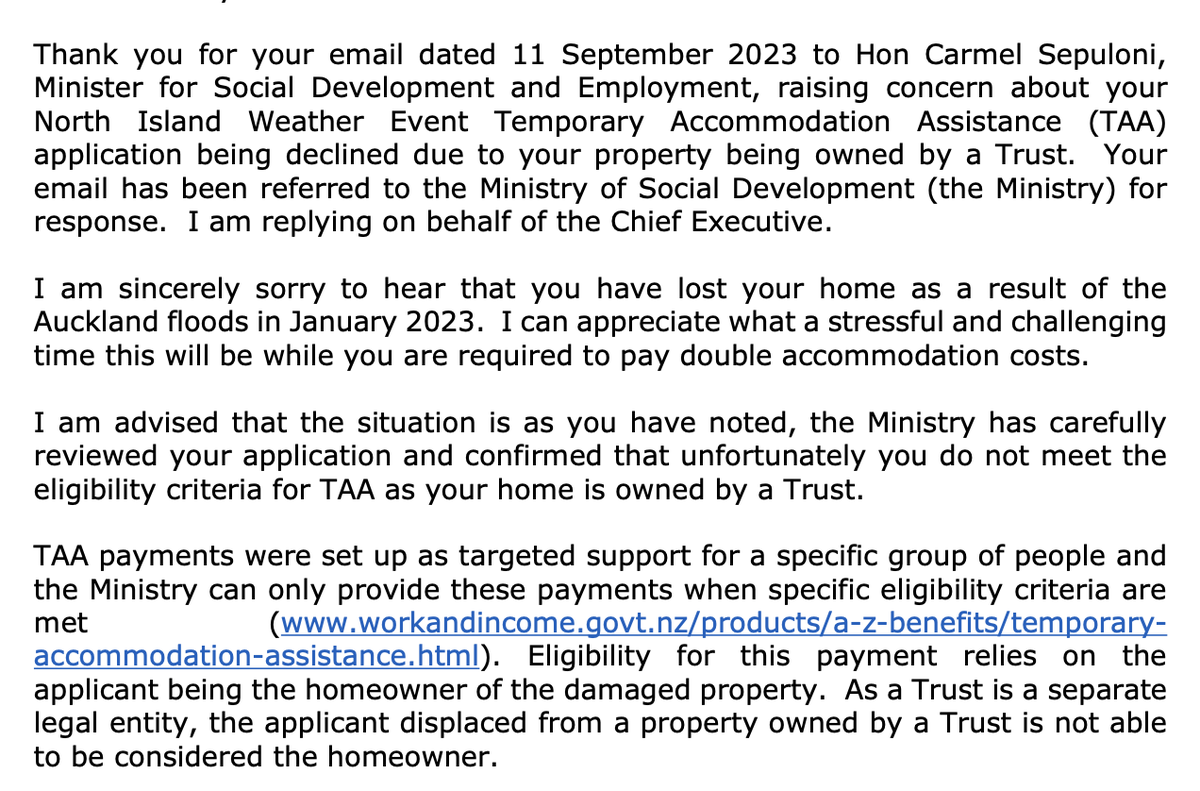
This is wrong. I understand @ChrisPenknz raised this as an issue in August to @CarmelSepuloni. Hundreds of broken people being told arbitrarily no when they have a single home family trust? flood-displaced people miss out on assistance packages @rnz_news https://t.co/63ys9MfktI
@nzhammy The first $250k is likely to be ok. https://t.co/1rmc2l6lf1 anything above that, you’d be getting in line and hoping for a lifeline similar to Washington Mutual in 2008
@dgh@AklCouncil As someone who has lost their home in this I just can’t comprehend. The city was in trouble Fri afternoon and we knew nothing. With some alert we wouldn’t have been stranded across town while our young kids were scared, wet but thankfully saved by neighbours.
In 2011, Pixar employee Emma Coats shared its “22 Rules of Storytelling.”
They’re a masterclass in story, psychology, and human connection.
Here are 10 gems:
@u16_0xFFFF @ZeMariaMacedo For sure the quickest chain I’ve used by far. And more reliable than SOL in my experience. 1s is still fit for most purposes. Will be interesting to see how it scales with the new apps launching the year
I looked through the 2023 macro outlooks from the largest financial institutions including Goldman Sachs, JP Morgan, and BlackRock.
(Links to all reports at the end)
Here’s what they’re expecting next year: