Prediction markets topped $50 billion in trading volume last month, and the biggest names in traditional finance are moving in.
Today, with @multicoin, we filed a joint comment supporting the @CFTC 's proposed prediction markets framework.
These markets have grown up. The proposed framework gives them what they deserve: durable standards, known in advance, under one federal rulebook. Our comment expresses support for the Commission’s approach and offers two recommendations to make an already strong rulebook even more targeted.
Read it here:
HIP-4 is getting big upgrades soon!
1) Validators will first vote on well defined templates that ensure high quality outcome markets
2) Deployers must stake 500K HYPE and is subject to slashing
3 ) Deployers define and settle their own market with approved templates
Hyperliquid
Thesis: $HYPE will do $4B of revenue in 2030 (up 8x from ~$500m run rate today) and be valued at $230/token (up 3.5x from today) NOT as a better crypto exchange but as the #1 winner of RWA perps.
Take: Market is missing that Hyperliquid is NOT JUST a crypto exchange but is becoming THE default venue for investors trading global markets 24/7 from equities and commodities to FX, indices and pre-IPO companies -- taking share from ICE / CME (combined ~$17B of annual revenue) not Binance.
Price Target: We believe Hyperliquid will be a $230/token in 2030 (up 251% from today) with $4B revenue in 2030 revenue.
$4B of revenue at 25x P/S implies $104B in outstanding market cap & $230B of FV in 2030.
Core Assumptions:
> Hyperliquid becomes a generational business from the growth of RWAs perps not crypto.
> Assume $HYPE captures 0.50% of entire 2030 Notational Trading Volume, taking share from CME and ICE.
> Hyperliquid processes ~$21T of annual RWA volume by 2030, at roughly 1.6bps blended take rate (perps is 2 bps, HIP-3 is 1 bps), that generates approximately $3.2B of transaction revenue
> HIP-3 is the #1 growth driver of $HYPE revenue moving forward (50%+ of transaction revenue, up from 15% today)
> Market is missing stablecoin revenue which will contribute another ~$1B annual revenue with $25B of supply and 4% reserve yield.
Full memo to drop tomorrow at 10am ET
Happy Hyperliquid Summit Day in NYC.
Hyperliquid.
@dschamis@HypeStrat@HyperliquidX You guys are joke no one is fucking buying this SHIT in this environment with iran war popping off. Ill enjoy watching you jew clowns blow up like michael saylor while I short hyperliquid to the gutter. Plus competitive platforms like aster are growing daily
An army of traders in China are about to learn about Hyperliquid for the first time.
Expect $CXMT to be another big splash for @tradexyz which just made new ATHs of $5.3B in daily volume.
We are entering a new era of finance where anyone, anywhere, can trade anything, anytime.
To put in perspective how big of a bet Coinbase and Circle made on Hyperliquid when they agreed to share 90% of reserve yield with HL, JPMorgan analysts are writing bear thesis’ for COIN and CIRC as we speak.
The first tranche of reserve yield starts accruing in 6 weeks.
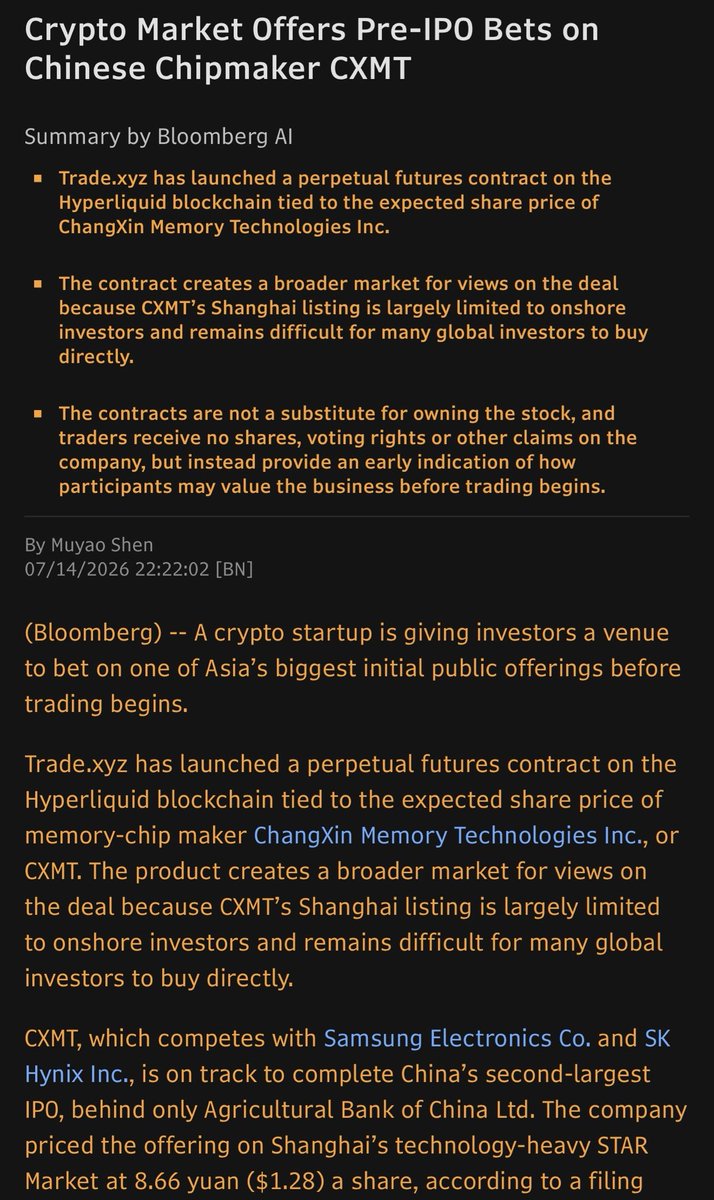
Late (in NYC) but a new story from me: @tradexyz started offering pre-IPO perps tied CXMT, China’s SK Hynix. Not surprised given the demand, but interesting and new product done by crypto - something we haven’t seen in the space for a bit
Thanks for having me on the podcast! It was a great conversation about a new category of integration: the first centralized exchange directly tapping into Hyperliquid's onchain infrastructure.
Following the recent launch of Perps on VALR, and our integration of @HyperliquidX, VALR's Co-Founder and CEO @farzamehsani sat down with Hyperliquid's Co-Founder and CEO Jeff Yan (@chameleon_jeff) to discuss the integration, the future of CeFi and DeFi, and their aspirations to move finance forward.
If you told me a year ago that BTC would fall by -43% and that HYPE would be up +74%, I would have not believed you.
But thanks to new features like PM & HIP-4, @tradexyz's success with RWA perps, and a DAT bid from TradFi, Hyperliquid has proved that not every coin follows BTC.
Africa's largest crypto exchange will power their core perps offering directly using Hyperliquid's onchain liquidity. This is a major milestone that will redefine how the next generation of financial applications are built.
The breakthrough of cloud computing was that any startup could quickly test their idea, with the comfort that the infrastructure would scale with their business. As the most liquid global venue for assets such as BTC, Hyperliquid will play the same role in the global economy. By tapping into the deepest onchain liquidity, builders can instead focus on their product and users.
Huge congratulations to the VALR team. We are honored that they chose to build on Hyperliquid. Excited to scale together!
VALR, Africa's largest crypto exchange by trading volume, is using Hyperliquid as the onchain infrastructure layer to bring perpetuals to its users.
This marks the first time a centralized exchange has integrated Hyperliquid directly. By building on Hyperliquid, VALR can focus on the experience and interface its users trust. Users benefit from Hyperliquid's deep liquidity and onchain transparency, while never having to leave the VALR platform.
It is super exciting to see @VALRdotcom go live.
VALR is a wonderful example of how you can use Hyperliquid's technology as the backend infrastructure to offer your platform's users the deepest liquidity in the world on 200+ markets.
For years, Americans were pushed offshore to trade perpetual futures while the rest of the world could trade them at home. This spring, U.S. regulators finally opened a compliant path to these markets here. Today, the largest U.S. exchange, CME, went to court to close it.
This is what happens when one company controls a market. By @BetterMarkets' count, CME runs about 92% of U.S. exchange-traded derivatives. When one venue holds that much volume, everyone else carries the cost. Less choice, higher prices.
Perpetual futures are the first genuinely new derivatives product to reach U.S.-regulated markets in over a decade. More competition among exchanges is best for the people who actually use these markets. These products deserve clear rules.
The real question is whether Americans get access to innovative new financial products, or whether one incumbent keeps them locked out. We think they deserve access. As CFTC @ChairmanSelig put it: "Incumbents will always fear the future." But none of us should fear the incumbents.