AI agents can now book your flight.
United Airlines just said: not on our site. 🛑
Why they blocked it:
• Agents could expose MileagePlus data
• Agents can make purchases nobody intended
• It may break FAA and DOT rules
The real lesson for anyone building agents:
→ Give agents the least access possible
→ Make every action safe to retry (no double bookings)
→ Ask a human before money moves
→ Log every action so you can audit it
Would you let an AI agent spend your money? 👇
#AI #AIAgents
AWS Emulator: Can you run EC2 and EMR on your laptop? 🤔
"AWS runs locally, with no AWS account needed" can easily create the wrong expectation.
Here are three myths worth clearing up:
❌ Myth 1: I can launch a working EC2 machine or EMR cluster locally.
Emulating commands that create resources doesn't automatically provide the underlying machines or a working Spark cluster.
❌ Myth 2: It only returns fixed responses from dummy endpoints.
It can remember emulated resources. For supported operations, you can create a resource, list it, describe it, and delete it. It also aims to reproduce AWS validation errors.
❌ Myth 3: Every AWS feature works exactly as it does in the cloud.
Support varies by service and operation. AWS currently reports its closest match for resource management APIs. Unimplemented operations return "501 NotImplemented".
A simple EMR example:
Your application sends "Create a cluster," receives a cluster ID, and checks its status.
The emulator can help test that interaction where supported. A returned cluster ID alone doesn't prove your Java Spark job can execute.
What can you save? 💰⏱️
- AWS testing costs: Avoid creating real cloud resources for tests the emulator can handle.
- Development time: Catch request errors and response-handling issues before deploying.
- Setup effort: Run supported tests without provisioning AWS resources or needing an AWS account.
- Cleanup work: Emulated resource state disappears when the emulator stops.
These savings apply to the tests you move locally. Your laptop or CI infrastructure still has costs, and testing actual workloads on AWS remains necessary.
#AWS #AWSEmulator #CloudComputing #DataEngineering #SoftwareTesting
25 Reasons Why SQL Is Still One of the Most Important Skills in Tech
1. Almost every company uses it.
2. It works on every major database.
3. It's been around for 50 years.
4. Even NoSQL tools offer it now.
5. Cloud data warehouses run on it.
6. Dozens of tech roles need it.
7. It comes up in almost every data interview.
8. You can learn the basics in a day.
9. Mastering it takes years.
10. You can answer your own data questions.
11. You say what you want, not how.
12. It works on billions of rows.
13. It reads like plain English.
14. Results are exact and repeatable.
15. It processes data where the data lives.
16. Every dashboard runs on it.
17. Data pipelines are built with it.
18. Transactions keep data correct.
19. AI starts with data, and data starts with SQL.
20. AI writes SQL, but you still have to check it.
21. It teaches you to think in sets.
22. One query can find a bug.
23. Good indexes make pages load fast.
24. It makes you better at designing systems.
25. It's a language every team speaks.
Tools change. SQL stays. 💡
What's inside a Data Engineer? 👨💻
Spark, Airflow, Hadoop, Cloud, dbt, Databricks, Snowflake, Iceberg, SQL and Python!
But where should you actually start?
If you're planning to become a Data Engineer, don't try to learn everything at once. Follow a structured roadmap.
1. Build your foundations
SQL: Joins, CTEs, Window Functions, Query Optimization
Python: Core Python, Functions, OOP, File Handling
Linux: Commands, Shell Scripting, Basic Networking
2. Learn Data Engineering fundamentals
ETL vs ELT
Data Warehousing
Data Lakes
Batch vs Streaming
Data Modeling
3. Master Big Data
Hadoop: HDFS, YARN
Apache Spark: PySpark, Spark SQL, DataFrames
Understand distributed computing
4. Learn orchestration
Apache Airflow
DAGs, Tasks, Scheduling
Dependencies and Monitoring
5. Get hands-on with Cloud
Choose ONE cloud platform first:
AWS: S3, Glue, EMR, Redshift
Azure: ADLS, Data Factory, Synapse
GCP: GCS, Dataproc, BigQuery
6. Explore Modern Data Stack
dbt: Transformations and Testing
Snowflake: Cloud Data Warehouse
Databricks: Lakehouse Platform
Apache Iceberg: Open Table Format
7. Build real-world projects
Don't just watch tutorials. Build projects that combine these technologies.
For example:
Build an ETL pipeline using Python and SQL.
Process millions of records using PySpark.
Orchestrate pipelines using Airflow.
Store data in a Cloud Data Lake.
Build transformations using dbt.
Query data using Snowflake or Databricks.
My recommendation:
Start with SQL + Python, build strong fundamentals, learn Spark, pick one cloud platform, and gradually move towards modern data engineering tools.
You don't need to master all these technologies to get started.
You need to understand the fundamentals and know how to connect the pieces.
Learn one technology at a time. Build one project at a time. Keep going!
Save this roadmap if you're starting your Data Engineering journey.
#DataEngineering #SQL #Python #ApacheSpark #Airflow #BigData #CloudComputing #Databricks #Snowflake
WTF is happening in Data Engineering?
Keeping up with Data Engineering these days feels like a full-time job!
Just look at what's happening:
- Airflow DAGs are getting loops!
- Is 3NF dead?
- Who is Jev, and why is everyone talking about it?
- Is AI changing how we build data pipelines?
- What's worth learning, and what's just hype?
Every week brings a new tool, framework, or trend. But do we really need to learn everything?
Let's talk about it!
Join Tamara Fingerlin and Volker Janz from Astronomer on November 18 for a casual, honest conversation about what's happening in Data Engineering, what's worth your attention, and what you can safely ignore.
You'll also walk away with useful resources and code to take home.
📅 November 18, 2026
🕚 11 AM ET / 4 PM GMT
Register Link - attached in 1st comment
#DataEngineering #ApacheAirflow #Astronomer
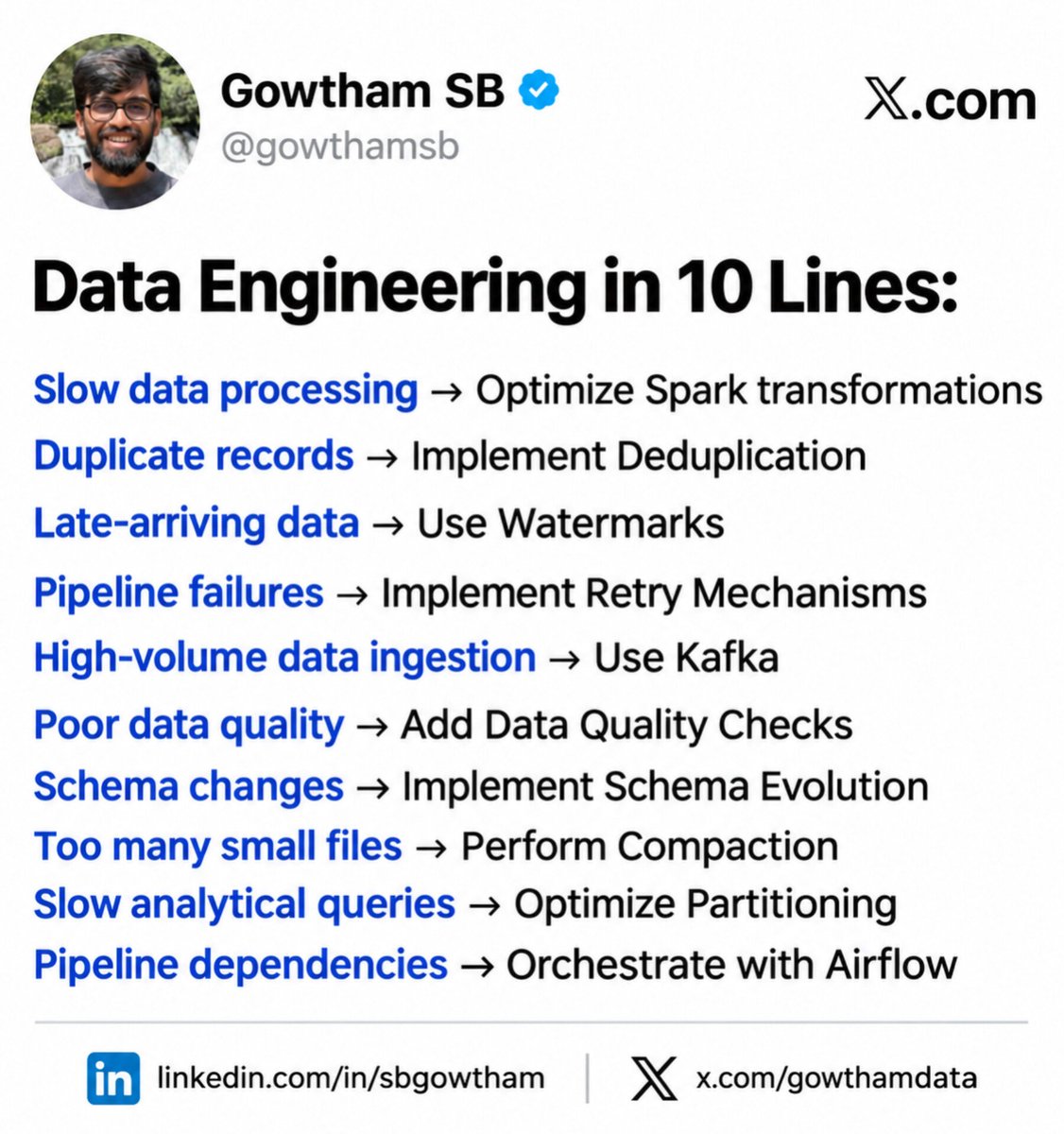
30 Data Engineering Problems Every Data Engineer Should Know How to Solve.
Data Engineering is not just about writing SQL queries or building Spark jobs.
It's about solving real-world data problems.
Here are 30 common challenges and how we typically solve them:
Data Ingestion & Processing
1. Slow data processing → Optimize Spark transformations
2. Duplicate records → Implement Deduplication
3. Late-arriving data → Use Watermarks
4. Pipeline failures → Implement Retry Mechanisms
5. High-volume data ingestion → Use Apache Kafka
6. Missing records → Implement Data Reconciliation
7. Incremental data loading → Use CDC (Change Data Capture)
8. Unreliable source systems → Implement Fault Tolerance
9. API rate limits → Implement Throttling and Backoff
10. Data ingestion bottlenecks → Implement Parallel Processing
Data Storage & Management
11. Too many small files → Perform File Compaction
12. Schema changes → Implement Schema Evolution
13. Growing storage costs → Apply Data Lifecycle Policies
14. Slow analytical queries → Optimize Partitioning
15. Concurrent writes → Use ACID-compliant table formats
16. Data versioning → Use Apache Iceberg or Delta Lake
17. Unstructured data → Use Data Lake Architecture
18. Repeated full data loads → Implement Incremental Processing
19. Data duplication across systems → Establish a Single Source of Truth
20. Poor storage performance → Choose the Right File Format (Parquet/ORC)
Data Quality & Pipeline Reliability
21. Poor data quality → Implement Data Quality Checks
22. Null values → Apply Validation and Handling Rules
23. Incorrect data types → Enforce Schema Validation
24. Pipeline dependencies → Orchestrate with Apache Airflow
25. Failed pipeline recovery → Implement Checkpointing
26. Data inconsistencies → Implement Data Reconciliation
27. Broken downstream pipelines → Implement Data Contracts
28. Difficult debugging → Implement Centralized Logging
29. No pipeline visibility → Build Monitoring and Alerting
30. Unexpected data changes → Implement Data Observability
Remember:
A good Data Engineer doesn't just make pipelines run.
A great Data Engineer makes sure they run reliably, efficiently, and at scale.
Which of these problems have you faced in your Data Engineering journey?
Share your experience in the comments!
#DataEngineering #ApacheSpark #PySpark #ApacheKafka #Airflow #DataLakehouse #SQL #BigData
Where is the error in this SQL query? 🤔
SELECT name AS user_name
FROM users
WHERE user_name = 'gowtham'
Looks perfectly fine at first glance, right?
But there’s a catch
Can you spot the issue?
Here’s a hint: Pay attention to the order in which SQL processes a query.
Drop your answer in the comments before looking it up!
Let’s see how many SQL enthusiasts can crack this one.
#SQL #SQLInterview #DataEngineering #LearnSQL #Database #SQLTips
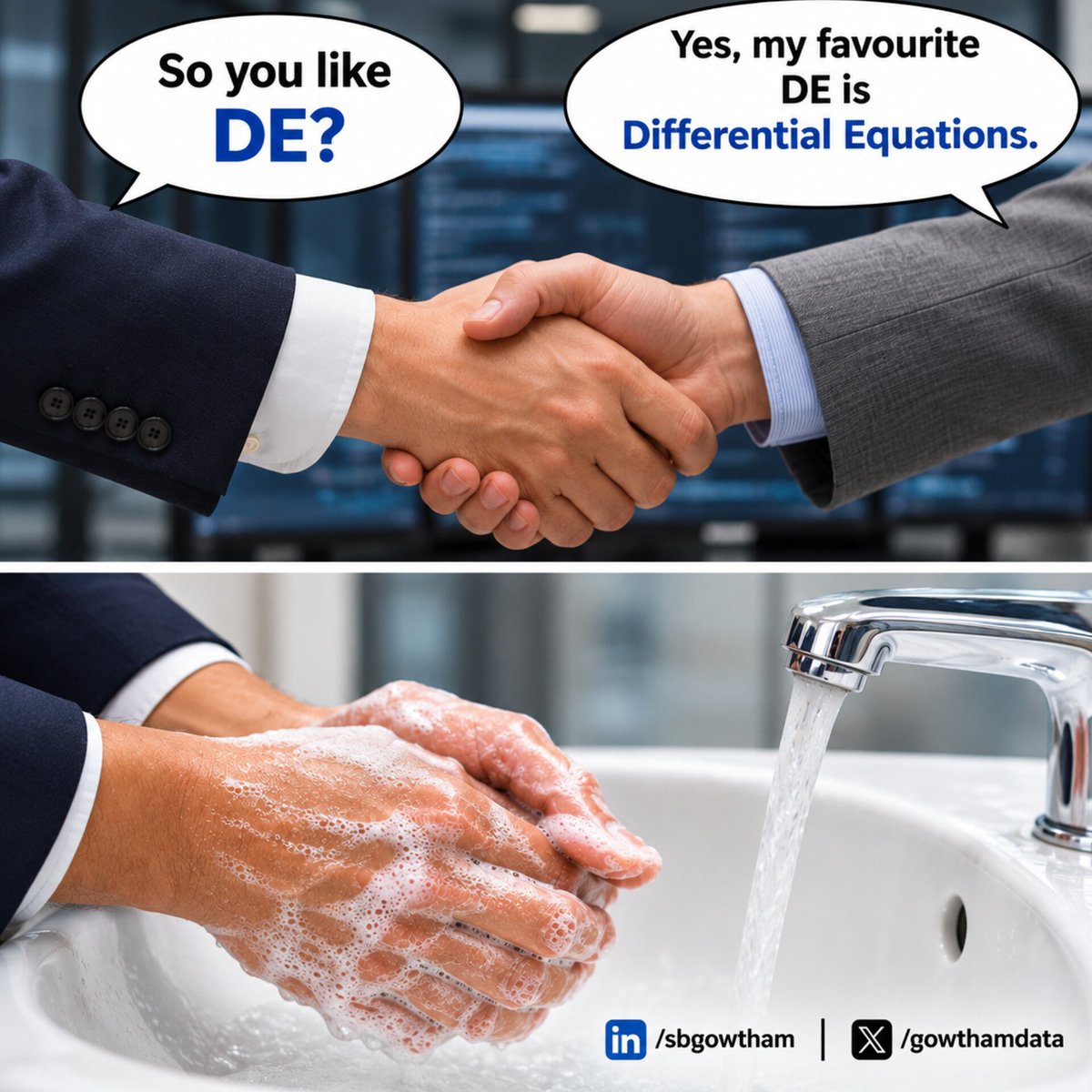
DE means two completely different things depending on whom you ask!
In Mathematics, DE stands for Differential Equations.
In Technology, DE stands for Data Engineering.
But what's the connection between them?
Let's break it down.
1. DE in Mathematics: Differential Equations
Differential equations are mathematical equations used to understand how things change over time or with respect to another variable.
For example:
- How does the speed of a moving vehicle change?
- How does a population grow over time?
- How does the temperature of a room change?
They help us model and predict real-world behaviour.
2. DE in Technology: Data Engineering
Data Engineering is about designing and building systems that collect, process, transform, and deliver data.
For example:
- Building ETL/ELT pipelines.
- Processing millions of records using Apache Spark.
- Streaming real-time data using Kafka.
- Orchestrating workflows using Airflow.
- Building data lakes and warehouses.
3. How are they related?
Here's where things get interesting!
Both fields deal with understanding how things change.
- Differential Equations use mathematical models to describe how variables change.
- Data Engineering builds pipelines that capture, process, and make changing data available for analysis.
For example, imagine predicting traffic congestion.
A mathematical model can describe how traffic density changes over time.
A Data Engineering pipeline can collect real-time traffic data, process it using Spark, and deliver it to a system where those predictions can be made.
Different disciplines, but they can work together!
So, if someone asks you whether you like DE, make sure you know which DE they're talking about! 😂
Are you from the Differential Equations DE or the Data Engineering DE?
#DataEngineering #Mathematics #DifferentialEquations #BigData #DataScience
We've spent years optimizing SQL queries on CPUs. Is it time to rethink that with GPUs?
The good news? You can explore this and many other real-world data engineering challenges at a FREE virtual summit!
Two sessions at NEXT QUERY 2026 caught my attention:
1. NVIDIA: GPUs for Analytics
GPUs have traditionally been associated with AI and machine learning. But how practical are they for large-scale analytical queries? Which workloads actually benefit?
2. Carbon Arc: Swapping the Engine Serving 1 PB of Live Data
What does it take to replace the engine serving 1 PB of live data, moving from Trino to StarRocks while keeping the data in Apache Iceberg?
I'm particularly interested in the architecture, query performance, and cost trade-offs behind this change.
Both sessions offer interesting insights into the future of large-scale analytics and data infrastructure.
NEXT QUERY 2026 brings together engineers from NVIDIA, Apple, AWS, Coinbase, Microsoft AI, and more to share real-world production experiences.
📅 Wednesday, November 4
⏰ 9 AM PT
💻 100% FREE | Virtual Summit
Register for free:
https://t.co/ggu0xMoy3b
Which session would you be more interested in: GPU-powered analytics or replacing the engine serving 1 PB of live data?
#ad #NextQuery2026 #DataEngineering
Every Data Engineer knows this feeling. 😂
Sometimes, the table that saves your pipeline today becomes the table you delete tomorrow!
Here's a common scenario in incremental data loading:
1️⃣ Take a backup: Create a copy of the existing "MAIN_TABLE" as "TEMP_TABLE".
2️⃣ Historical Load: Load the missing or historical records.
3️⃣ Merge: Merge the historical data with the latest data and bring the target table up to date.
4️⃣ Cleanup: Once everything is validated and the merge is successful, drop the temporary backup table.
CREATE TABLE TEMP_TABLE AS
SELECT * FROM MAIN_TABLE;
-- Perform historical load
-- Merge with current data
DROP TABLE TEMP_TABLE;
And poor "TEMP_TABLE" says:
"You liked me when I was the MAIN table!" 😂
In Data Engineering, sometimes a table's entire lifecycle is just to exist temporarily!
Have you ever created a temporary or backup table just to drop it after a successful pipeline run?
#DataEngineering #SQL #ETL #DataWarehouse #DataEngineer #DataPipelines
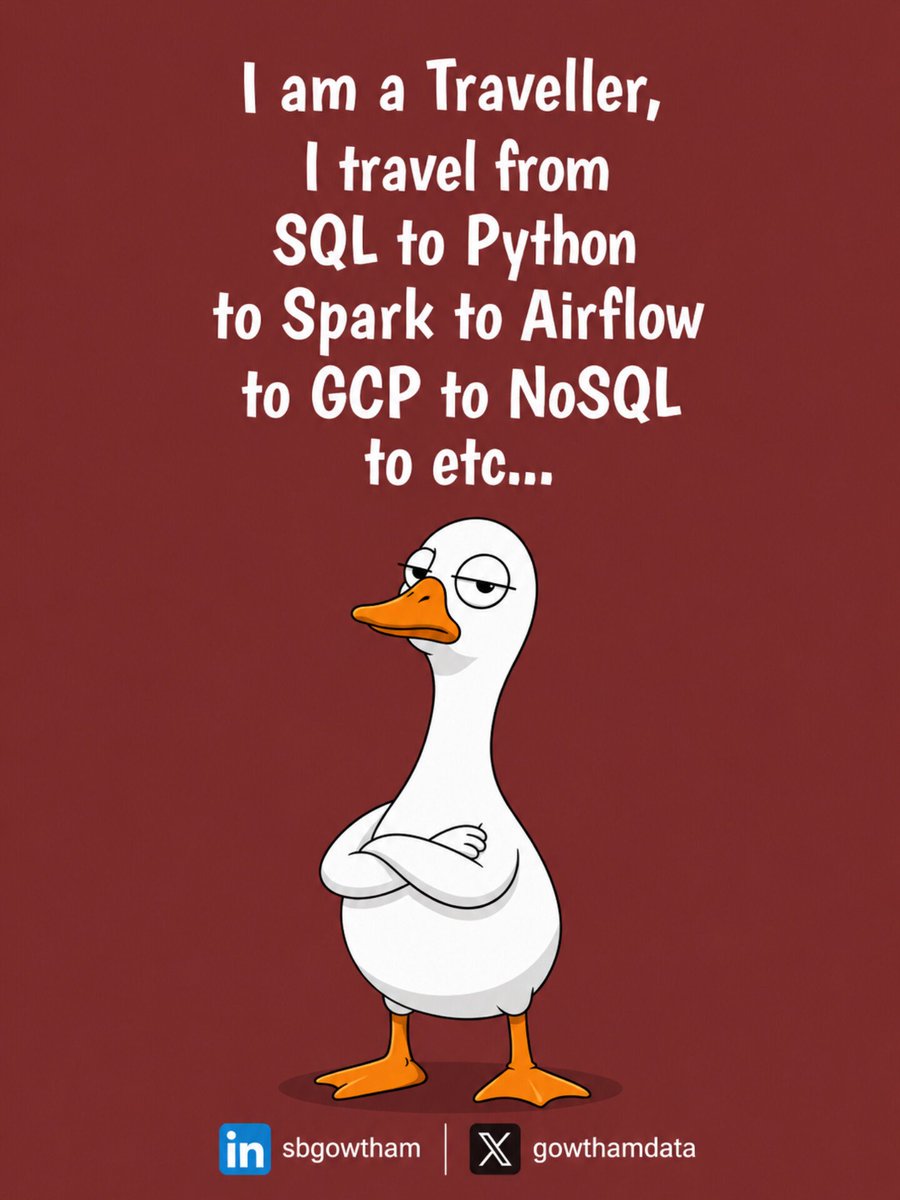
Imagine you're building an E-commerce Data Pipeline. 🛒
Your journey might look something like this:
1. SQL – Extract orders, customers and transaction data from RDBMS.
2. Python – Validate data, handle errors and perform basic transformations.
3. Apache Spark – Process millions of records at scale.
4. Airflow – Orchestrate and schedule the entire pipeline.
5. GCP – Store and process data in the cloud using BigQuery, GCS and other services.
6. NoSQL – Store application-specific data for low-latency access.
And guess what?
Tomorrow, your project might introduce Kafka, Snowflake, dbt, Databricks, Iceberg or another technology!
That's the life of a Data Engineer.
We don't travel between countries. We travel between technologies! 😂
#DataEngineering #DataEngineer #SQL #Python #ApacheSpark #Airflow #GCP #BigData