A golden performance indeed! Proud of Asmita Dey for winning a Gold in the Judo Women's 48KG Final! This performance will always be remembered and will contribute towards Judo becoming even more popular. Best wishes for her endeavours ahead.
#CWG2026
India sets golden landmark in Squash.
Congratulations to Anahat Singh for scripting history by clinching Gold medal at the 2026 World Squash Junior Championships. By becoming the first Indian to win this prestigious title you have scripted a golden path of inspiration for budding squash players.
@Anahat_Singh13
This day in 1980, ISRO’s SLV-3 placed India’s first indigenously made Rohini #satellite into #orbit, marking India’s arrival as a spacefaring nation.
Today #Skyroot’s young team with an average age of just 28 has became India’s first private company to place satellites in orbit.
#Vikram Sarabhai must be smiling today.
When the Second World War broke out in 1939, Vikram Sarabhai was pursuing his doctoral research in cosmic ray physics at the University of Cambridge.
As the war spread across Europe, universities slowed down, research became difficult, and many Indian students were advised to return home. Sarabhai came back to India, uncertain about when he would be able to resume his studies.
What appeared to be an interruption would instead become one of the defining turning points of his life.
His family approached Nobel laureate Sir C. V. Raman, who was then heading the Physics Department at the Indian Institute of Science (IISc), Bengaluru. Raman, celebrated for discovering the Raman Effect and awarded the Nobel Prize in Physics in 1930, believed deeply in nurturing exceptional young scientists. Raman’s research was in optics and spectroscopy, he welcomed the young Sarabhai into his laboratory, recognizing his extraordinary curiosity and potential.
At IISc, Sarabhai continued his work on cosmic rays under Raman’s guidance.
Cosmic rays are highly energetic particles arriving from the Sun, distant stars, and exploding galaxies. Long before satellites existed, they offered scientists one of the few ways to study the universe beyond Earth. Understanding them required much more than theoretical physics. Sarabhai had to build sensitive instruments, carry out observations at different altitudes and latitudes, and understand how Earth’s atmosphere and magnetic field influenced the particles reaching the ground.
These 5 years with CV Raman trained him in experimental physics, instrumentation, data analysis, and large scientific investigations; skills that would later become indispensable for space research.
When the war ended, Sarabhai returned to Cambridge and completed his PhD in 1947. But he came back with much more than a doctoral degree. He had developed a deep understanding of the upper atmosphere and radiation from space, built an international network of scientists, and gained the confidence to lead ambitious scientific programmes.
Just a decade later, in 1957, the Soviet Union launched Sputnik, the world’s first artificial satellite. While much of the world saw it as a symbol of Cold War rivalry, Sarabhai saw something else; a powerful scientific tool that could help a developing nation leapfrog in communication, weather forecasting, education, and resource management.
His background in cosmic ray physics had already convinced him that to truly understand space and the atmosphere, scientists had to make observations above Earth’s surface. Rockets and satellites were the natural next step. Here comes his interest in space programmes.
This vision led him to establish the Physical Research Laboratory (PRL) in Ahmedabad, often called the cradle of India’s space programme. He went on to create the Indian National Committee for Space Research (INCOSPAR) in 1962, laying the institutional foundation that later evolved into ISRO. Rest is history.
Looking back, it is remarkable how a global crisis changed the course of Indian science. Had the Second World War not forced Vikram Sarabhai to return home, he might never have spent those formative years under C. V. Raman at IISc. Those unexpected years shaped not only a brilliant physicist but also the visionary who would build India’s space programme.
Sometimes, history advances because an unforeseen detour places the right mentor and the right student together at exactly the right moment.
#Skyroot has named its launcher on Dr Vikram Ambalal Sarabhai. Vikram -1 is India’s first privately developed orbital rocket.
#PadmaAwards 🏅
President Droupadi Murmu confers #PadmaShri to Rohit Gurunath Sharma.
One of India's finest cricketers and former captain. The only player with 3 ODI double centuries, led India to the ICC T20 World Cup 2024 and Champions Trophy 2025 titles.
#PeoplesPadma2026 #PadmaAwards2026 #PadmaAwards @PadmaAwards
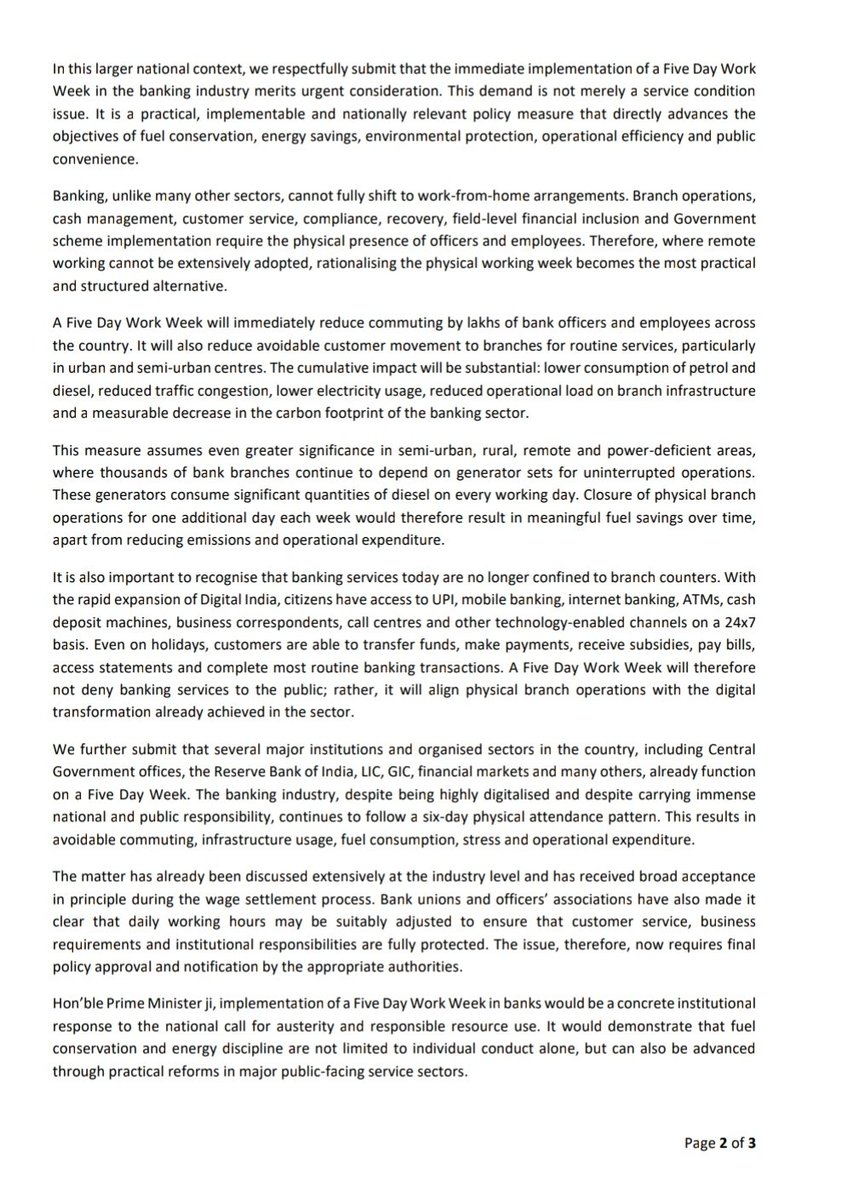
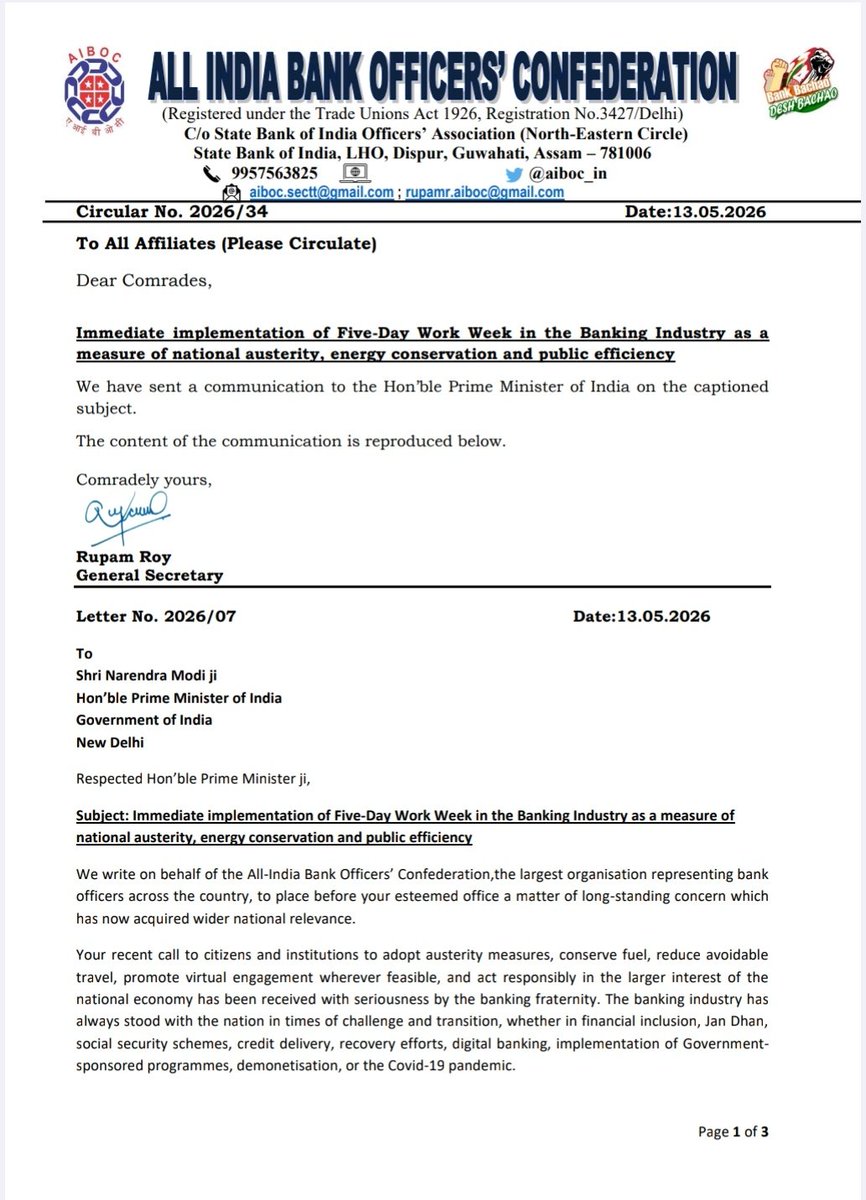
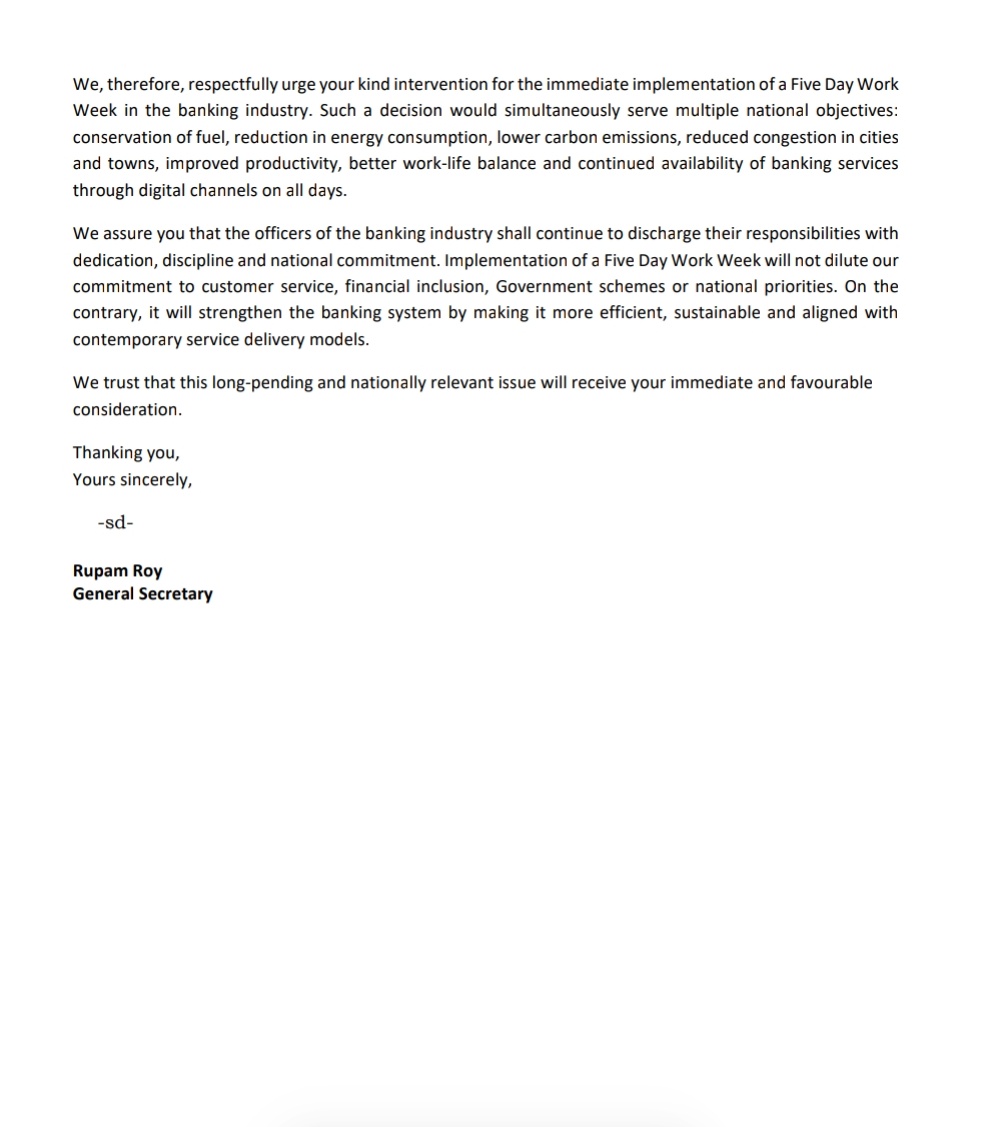
AIBOC urges immediate implementation of #5DayBanking, citing energy conservation, efficiency and better work-life balance for bank employees.
@aiboc_in