#WATCH | Bhubaneswar: Anushka Yadav, who won the gold medal in hammer throw (67.02 meters) at the 65th National Inter-State Senior Athletics Championship 2026, says, "... I am receiving full support. I am currently recovering from an injury. I practice in the evenings. My father has worked very hard for me. My goal is to give my best at the Asian Games..." (24.06)
Happy Father’s Day
Age 5 – Dad knows everything!
Age 7 – Dad knows a lot.
Age 10 – Maybe Dad doesn’t know everything?
Age 12 – Dad doesn’t know anything.
Age 14 – Dad lost his mind!
Age 16 – I can’t take Dad seriously.
Age 18 – What does Dad even know?
Age 22 – Dad talks nonsense!
Age 24 – I know more than Dad!
Age 26 – Turns out, Dad actually knows a few things.
Age 30 – I should probably ask Dad about this…
Age 40 – How did Dad make it through all of that?!
Age 45 – Dad was always right.
Age 50 – If only Dad were here… I’d have so much to learn.
To the man who sacrificed his entire life for our happiness
I am always amazed and inspired everytime you handle any situation.
You are our strength ✨️
Happy fathers day!❤️
AI can now generate a unique textbook for every child based on their interests, which is genuinely impressive.
But interactive whiteboards were genuinely impressive, and they didn't help learning.
The classic failure mode of ed tech is the solution in search of a problem - the genuinely impressive technology that does not solve any of the actual problems schools face.
https://t.co/xWA1wmoT4P
Gen Z is the first generation to score LOWER than its parents on IQ tests since we started keeping records.
Researchers say this isn’t random. And much of it traces back to screens.
Equally alarming, test scores have also declined: 13-year-olds’ reading scores are now seven points lower, and math scores roughly 14 points lower, than they were a decade ago.
@MarinatZhang explains why putting more screens in the classroom may not be the best choice for your child. 👇
@rpraggnachess Proud not only of your chess achievements chellam, also of your good character, honesty, integrity, tremendous hard work, love for our nation and its values, and not letting success or fame get to your head. Forever remain this way.
Kevin Hines went to the Golden Gate Bridge in 2000 intending to end his life. He's one of 39 people in history to survive that jump. Of the 19 other survivors who've come forward publicly, every single one reported the same thing: the millisecond their hands left the rail, they wanted to live. He calls it instant regret.
Years before that pattern showed up in survivor interviews, a Berkeley researcher named Richard Seiden was already finding something similar in the data. He tracked down 515 people who had been physically stopped from jumping off the same bridge between 1937 and 1971. The assumption at the time was that they'd just find another way. They didn't. By the time Seiden's 1978 follow-up was published, 94% were either still alive or had died of natural causes. Only 6% later died by suicide.
A 2009 study at Innsbruck Medical University in Austria went one step further. Researchers asked 82 patients who had just attempted suicide how long it had been between the first thought and the act. Almost half (47.6%) said 10 minutes or less. A separate CDC analysis of 153 almost-fatal attempts put it at 5 minutes for nearly a quarter.
That window is the entire crisis. Whatever feels permanent and obvious in those minutes usually looks completely different an hour later.
The recovery data points the same direction. Richard Tedeschi and Lawrence Calhoun, two psychologists at UNC Charlotte, invented the field of post-traumatic growth research in the 1990s. Their core finding: about 9 out of 10 trauma survivors report at least one major positive change after coming through the worst of it. Even people who almost died. A 20-year German trauma center follow-up of 337 patients who had survived life-threatening injuries found 96.5% reported improvements in some part of their life. About a third said they appreciated being alive more, and had stronger relationships, than before the thing that almost killed them.
The thing that pulls people out is the boring part. A 2014 review of 26 clinical trials covering 1,524 patients found that something called behavioral activation, a fancy name for "do small things even when you don't want to", beat both control conditions and antidepressants in head-to-head tests. The kinds of things that move the needle: a short walk, one real meal, replying to a message you've been avoiding, showing up to one thing you said yes to. The doing comes first, and the wanting to do follows.
The brain doing the math tonight is not the brain you'll have in six months. Stretch the window between the thought and the action. That window is the whole game.
If you're in crisis right now: US/Canada 988, UK 116 123, or visit https://t.co/GFvPdUpLxc for the global directory.
#WATCH | In this year’s European Girls' Mathematical Olympiad held in Bordeaux, I won a silver medal. In today’s Mann Ki Baat programme, PM @narendramodi mentioned India’s achievement. This was a great encouragement for me, and I’m sure it will inspire many others as well.
I plan to study Mathematics and Computer Science in the future. I hope India’s achievements at these Olympiads inspire many more students to follow their passions.
I am truly grateful for all the support I received throughout my Olympiad journey. My parents and my younger brother have always encouraged me to pursue my passions, especially my younger brother, Michael, who has been my biggest supporter. I really love spending time with him.
I also received immense support from the principal and teachers at St. Thomas Residential School. I would also like to thank our mentors who accompanied us to this competition: Sanjana Philo Chacko from Kerala
@PMOIndia #EGMO #MathOlympiad #EuropeanGirlsMathematicalOlympiad #MannKiBaat
#WATCH | Pune, Maharashtra: Math Olympiad Gold Medalist Shreya Mundhada's mother, Rekha Mundhada, says, "... It feels great that Prime Minister Modi acknowledged and encouraged. When recognition comes from that level, it inspires both parents and children. Too often, society asks children what they will become—doctor, engineer, etc.—instead of asking what they want to learn. His words highlight the need for an education system focused on conceptual understanding rather than rote methods. PM's address gives us confidence that real change is possible. It is a very positive step and a source of encouragement for all of us."
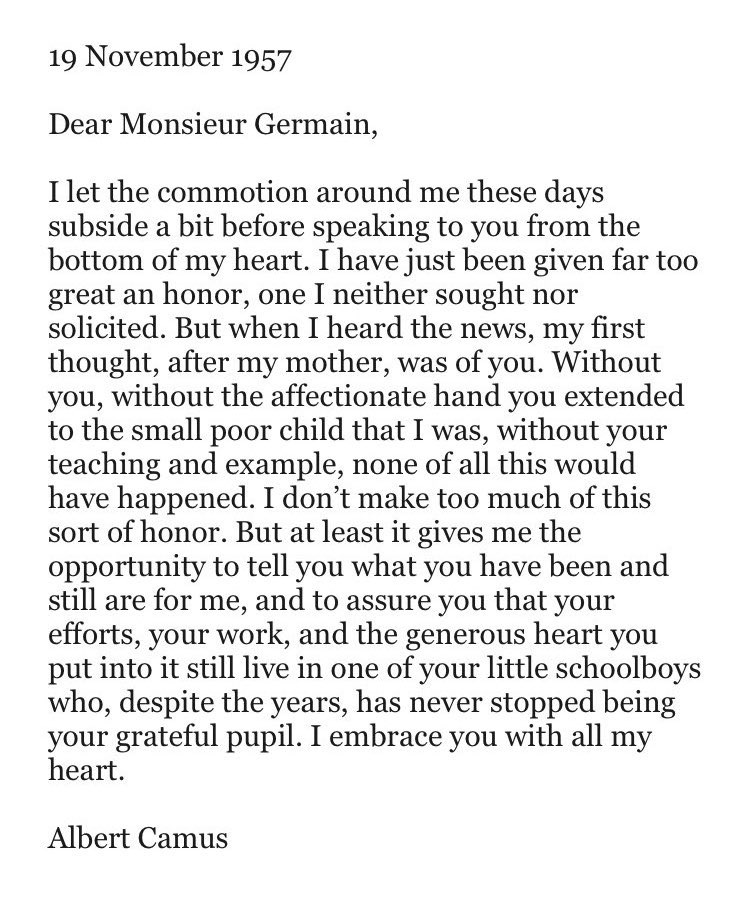
After he won the Nobel Prize in Literature in 1957, Albert Camus wrote a letter of thanks to his favorite childhood teacher, whom he'd never forgotten. It's beautiful.
*Sanju Samson*: "
When people talk about my journey, they usually start with stadiums.
*For me, it always begins with a bus.*
I was eleven. My kit bag felt heavier than me. *I would leave home in Vizhinjam before the sun came up, change two buses, and reach the Medical College ground by 6 in the morning. Some days I was sleepy. Some days I was sore. But I don’t remember ever wanting to skip it* .
After practice, I would bathe under a small tap at the corner of the ground. No dressing room. Just cold water, a towel in my bag, and a quick change into my school uniform. Then I’d walk to catch another bus to St Joseph’s. School, homework, and then back again for evening nets.
That was my life. Every day
I didn’t think of it as a sacrifice. I just thought — this is what it takes.
*My grandfather was a fisherman. Watching him, I understood something early. You can’t control the sea. You can only control how prepared you are when you go out. Some days you come back with nothing. But you still wake up the next morning and go again. That stayed with me* .
There were phases when I felt close to my dream. And phases when I felt very far from it. Being dropped. Sitting out. Hearing opinions. Smiling outside but questioning yourself inside.
I won’t lie, it hurts. I’m human.
*But every time I feel that doubt, I go back in my mind to that small tap at the ground. To the buses. To my parents adjusting their lives around my practice. I remind myself that this journey was never built on comfort. It was built on consistency* .
When I play in Thiruvananthapuram and hear the crowd shout my name, it feels personal. They didn’t just see me succeed. They saw me grow. They saw the process.
I am still that boy from Vizhinjam. I still love batting the same way. I still get nervous. I still want to prove myself. The only difference is the stage.
*The fight hasn’t stopped. It probably never will* .
*Because for me, cricket was never about fame* .
*It was about a dream I chose , and keep choosing : every single day* . "
*~ Sanju Samson*
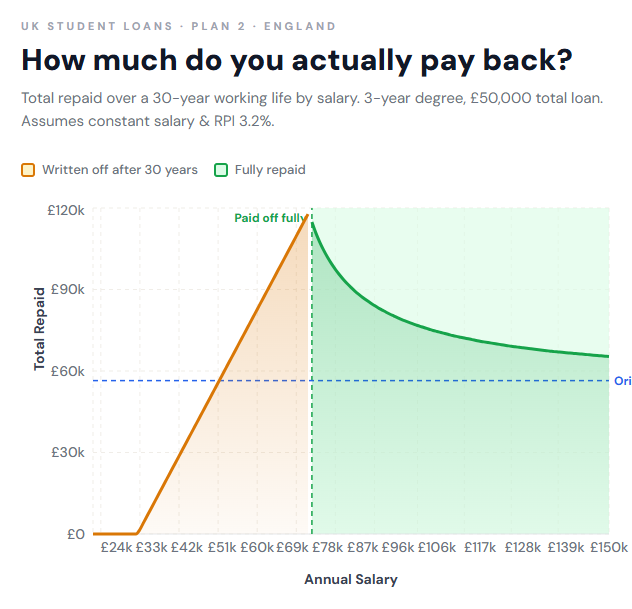
What not many people realise about UK student loans is that earners in the middle of the salary range end up paying back far more than either lower or higher earners, as they earn enough to pay the loan and interest back before the 30 year cut off, but not enough to pay it off early before the interest balloons.
Someone earning £70k ends up paying almost double someone on £150k.