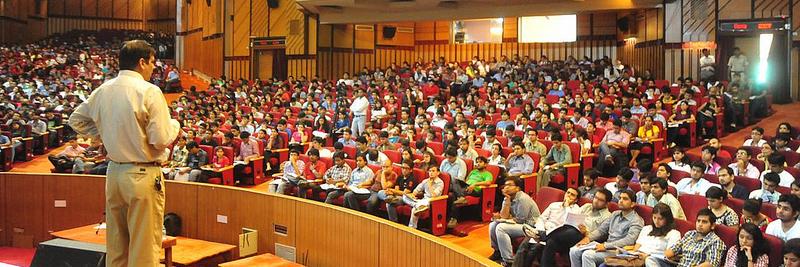
In 2000, I was preparing for CAT at Career Launcher. For those who remember those days, you'll know Satya the legendary co founder of CL - he took our final doubts session towards end of November.
I was quite good with arithmetic, AP/GP, and data interpretation. But algebra, trigonometry, and calculus? They kept me up at night.
I nervously asked Satya how to handle my weak areas.
He looked at me, then asked me to walk to the window.
"What worries you most?"
"Differentiation," I said.
"Chuck it out."
"Then?"
"Trigonometry."
"Chuck it out."
We went through four more topics. Chuck them all out.
Then he said something that changed how I approached not just CAT, but my entire career:
"You are super in arithmetic and DI-that's 60% of the paper. Why are you worried about the 15% you struggle with? Instead, work on making sure you don't miss a single point in your strength areas. That's how you'll crack it."
He was right. I did.
This lesson has proven true repeatedly, and I see it play out with every senior leader I work with:
→ The VP Engineering at a unicorn who became CTO by mastering product architecture and technical vision not by forcing himself to become great at people ops. He hired a strong Head of Engineering Ops and focused entirely on what he was exceptional at: seeing 3 years ahead technically.
→ The CEO of a Series B startup who's exceptional at product intuition and fundraising but struggled with operations. Thankfully - the investors guided him to bring in a COO, and the founder doubled down on what made him irreplaceable - vision, product, and being the face of the org. The company scaled from ₹50 Cr to ₹400 Cr in 3 years.
Sam Altman said it perfectly: "The highest ROI comes from getting even better in areas where you're already strong, not improving in areas where you're weak."
Yet most senior leaders do the opposite.
We obsess over our gaps. We spend 80% of our development energy trying to go from terrible to mediocre at things we'll never be great at.
Meanwhile, our natural strengths- the things that could make us truly differentiated at the CXO level - get just incremental attention.
𝗦𝗼 𝗪𝗵𝗮𝘁 𝗦𝗵𝗼𝘂𝗹𝗱 𝗬𝗼𝘂 "𝗖𝗵𝘂𝗰𝗸 𝗢𝘂𝘁"?
Here's a framework I use:
1. List your top 2-3 super skills (things people specifically seek you out for)
2. List your bottom 3 skills (things that drain you and where you're mediocre despite effort)
3. Ask yourself: "If I spent the next 2 years getting 10x better at my super skills instead of trying to become 'good enough' at my weak areas, what role would I command?"
4. Now do that.
As simple as that :)
So - What's the one super-strength you should be investing more in? And What should you be "chucking out"?
READ THIS before you "rent" your bank account/Credit card or sell that voucher for extra cash.
**
A thread on Money Mules, Bank Liens, and how you could be jailed for a simple mistake. 🧵👇
Rishi Patanjali (2nd c. BCE) tells us how students never change - he refers to ancient students joining Chārāyana's school for kambalas (blankets), Pānini's school for rice, Raudhi's school for Ghee & even Simps joining Daksha's school just to get access to girl classmates.😅
Indigo abruptly canceled the flight, rescheduled it 24 hours later, and exhibited rude behavior, including inappropriate language. No accommodation was provided, leaving individuals with ailments, comorbidities, and senior citizens in a challenging situation. Ministry, take note
@imYadav31 This is not new - SBI does not allow spending more than the credit limit in any statement cycle so clearing the outstanding will not restore your credit limit.
The total amount that you can spend a a statement cycle is limited to your credit limit.