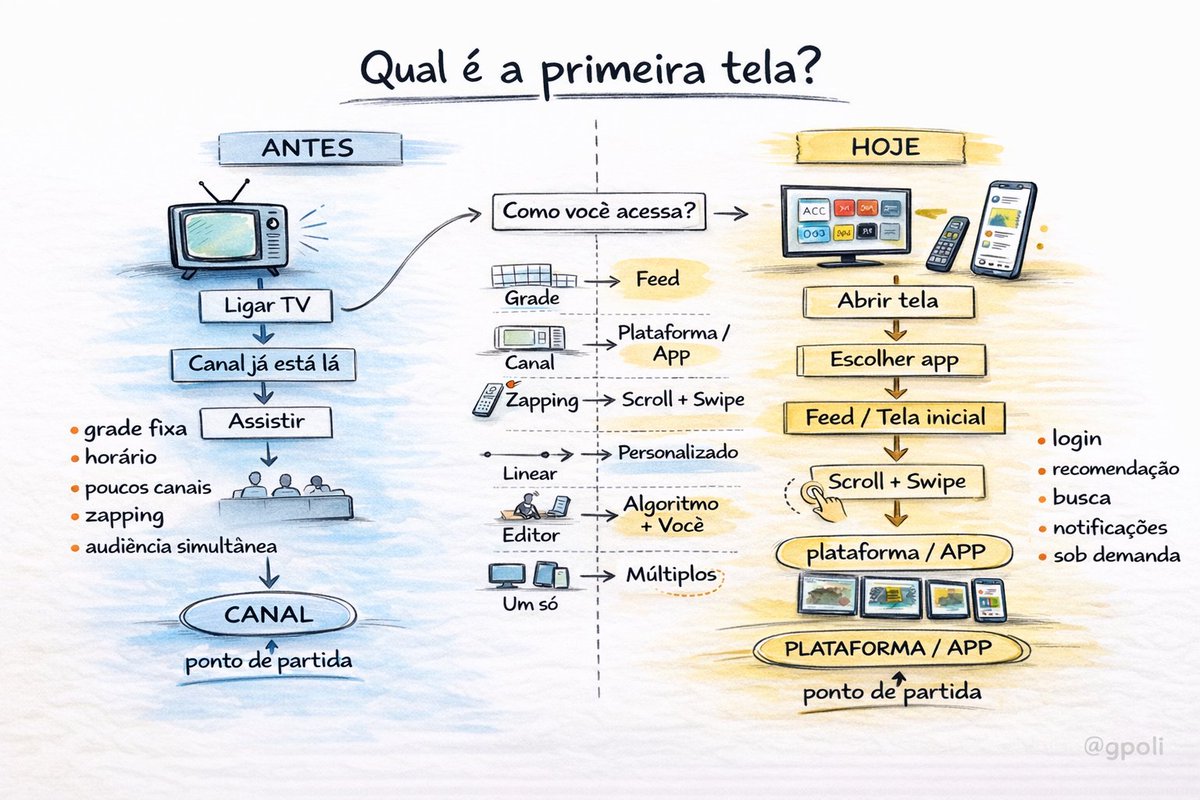
☀️ A Copa de 2026 vai marcar uma mudança significativa no jeito brasileiro de consumir futebol. Pela primeira vez desde 1994, a TV aberta não mostrará todos os jogos de uma Copa do Mundo*. E pela primeira vez, desde 1998, a Globo não mostrará ao vivo a íntegra do torneio*. Só a Cazé TV exibirá todos os 104 jogos de 2026 através de seu canal no Youtube. Sendo didático: todas as partidas estarão disponíveis de graça – mas metade delas apenas através de smartvs e smartphones.
Além de mais de 30 jogos exclusivos na primeira fase, a Cazé TV mostrará sozinha 15 mata-matas: oito 16as, quatro oitavas, duas quartas e uma semifinal só estarão disponíveis no canal. É uma imensa quebra de paradigma. Neste milênio, com a exceção das Olimpíadas de 2012 (na Record), nunca um outro veículo teve uma oferta maior e melhor do que a Globo num evento de impacto mundial.
(...)
👽 Retomando a newsletter com o primeiro artigo de uma série sobre a transformação provocada pela revolução digital na mídia esportiva brasileira. Copa de 2026, alguma coisa de IA, tecnologia, comportamento, divagações e devaneios.
de novo - eu tenho a antena. e acho ótima. escrevi assim pra brincar pq o pessoal tem falado muito dela.
não escreveria esse post se estivesse na globo por motivos óbvios. Mas não estava criticando a antena .
famigerado é muito famoso. ganhou um sentido irônico - mas não necessariamente negativo. Em suma - podia ter escrito só famosa. Mas haveria quem interpretasse como ironia tb.
A Copa começa daqui a nove dias - e as TVs abertas (Globo e SBT) têm sugerido ao consumidor que compre o bichinho da foto - a famigerada antena digital. Com ela plugada na Smartv, o espectador pode sintonizar de graça os canais abertos sem passar pelo filtro do streaming (ou da operadora de TV paga). O sinal digital oferece o menor delay possível - algo que obviamente faz diferença numa transmissão de futebol.
Essa semana, Casimiro brincou com Luizinho perguntando se ele tinha comprado a antena digital. A piada descontraída tem um subtexto. Nem Globo nem SBT terão todos os jogos da Copa. Só a Cazé TV vai transmitir as 104 partidas. Globo e Sportv terão 55. O SBT vai transmitir 32 - assim como NSports e GE TV. Em outras palavras: a propaganda antidelay vale… para metade da Copa.
Vai ser especialmente interessante ver quantas pessoas vão escolher ver os jogos na Cazé mesmo com delay. Na última Copa, por exemplo, tivemos um jogo (Brasil x Croácia) com quase 7 milhões de simultâneos. Talvez houvesse menos informação? Talvez. Mas há outra hipótese: talvez jovens e nativos digitais sem importem menos com delay e mais com sensação de comunidade.
Há uns três meses eu escrevi um artigo sobre isso no substack brincando que essa será a Copa do Eco e tentando explicar o delay em cada plataforma. Roubei do artigo o gráfico abaixo. Vale anotar que essa deve ser também a primeira Copa em que o consumo pelo celular será avassalador. Devemos ter gritos de gol em diversos tempos e alturas. Vai ser divertido.
Em 2022, a Cazé era uma espécie de Aliança Rebelde que desafiava o Império. Agora ela virou time grande e terá o desafio, ao lado do YouTube, de sustentar o impacto da multidão nos jogos exclusivos. Não é preciso ser Nostradamus pra dizer que todos os recordes de audiência da plataforma serão batidos.
From @TheAthleticFC: Pelé made World Cup history at 17 years old. Now the shirt he wore that day could challenge the record for the most expensive soccer jersey sold, which is held by Diego Maradona’s “Hand of God” shirt. https://t.co/mBaohCVhvq
@Cleson_Cruz eles podem entrar se quiserem fazer isso. não sei se farão na copa - depende tb da Cazé. Existe um risco pq aumenta bem o volume de dados no "cano".
🌍🇺🇿 Really interesting work from data analyst Bob Yakubov on the hidden burdens teams may face at the @FIFAWorldCup
According to his model, Uzbekistan have the toughest group-stage schedule due to travel, altitude, recovery time and climate conditions.
https://t.co/toAYrSH7RU
So I spent some time studying the new Twitter/X algorithm today since the latest version was published about a week ago on Github (https://t.co/3jzdav3Ywp).
My goal was to answer why so many people have seemingly seen such a dramatic drop in their posts' reach.
The first answer, which is actually somewhat unrelated to the ranking algorithm on Github, is the auto-translate feature, rolled out worldwide on April 7, 2026 (https://t.co/YtGomG9RGz).
Before that date, if you wrote in English about, say, the Trump-Xi Beijing summit, you were competing for attention with maybe 5,000 other English-language accounts writing on geopolitics.
After that date, your post is competing for attention with other posts on the same topic IN EVERY LANGUAGE ON EARTH. For some topics that do command global attention like geopolitics, that's a very brutal multiplier: you used to be one of 5,000, you're suddenly one of 50,000 (something of that order): MUCH more difficult to stand out.
Secondly, the number of followers you have matters far less than it used to: each post now has to earn its audience reader by reader, on the predicted engagement of the post, and how its topic matches what each reader has recently been engaging with.
Here is how the algorithm works, in simple terms: when you, as a reader, open your feed, the algorithm doesn't load "posts from accounts you follow." Instead it runs a 2-stage prediction of what posts you're likely to engage with in that very moment.
The first stage is the retrieval stage. The system narrows billions of posts on X/Twitter that day down to roughly 1,500 candidates by matching the semantic content of each post - what it's about - against what you as a reader have recently engaged with. Some candidate posts come from accounts you follow; others are pulled from across the platform by pure topic similarity to your recent interests.
You can test this retrieval stage easily: start disproportionally engaging with - say - Brad Pitt videos and you'll bit by bit see your timeline flooded with Brad Pitt content, most of it from accounts you've never followed and never heard of.
Then there's the ranking stage. Each of these candidate posts for your feed is fed through a Grok-based model that tries to understand if you'll engage with the post.
It looks at 15 engagement metrics:
1) P(favorite) — the reader likes the post
2) P(reply) — the reader replies to it
3) P(repost) — the reader reposts it
4) P(quote) — the reader quote-tweets it
5) P(click) — the reader clicks a link in it
6) P(profile_click) — the reader taps through to your profile
7) P(video_view) — the reader watches the video
8) P(photo_expand) — the reader expands an image
9) P(share) — the reader shares it (DM, off-platform, etc.)
10) P(dwell) — the reader stops scrolling and lingers on the post
11) P(follow_author) — the reader follows you after seeing it
12) P(not_interested) — the reader marks "not interested"
13) P(block_author) — the reader blocks you
14) P(mute_author) — the reader mutes you
15) P(report) — the reader reports the post
Fifteen predicted actions, each multiplied by a weight, summed: that sum is the score that determines in which priority a post will be seen among other candidates.
Please note that posting something with a video or an image can give your post an advantage as 2 actions are specifically for these: video_view and photo_expand. No video or photo and you don't get a score for these. Also, naturally, having a video maximizes the chance that a user will "dwell" on your post to watch it.
Also note that 4 of these actions carry negative weights (not_interested, block_author, mute_author and report): meaning that if the model expects a post to generate a lot of negativity, it'll get de-boosted quite dramatically.
But note, first and foremost, what's NOT in there: none of the things that, naively, one might think a serious information platform would weigh. There is no P(this post is true and well-sourced). No P(the author actually knows what they're talking about). No P(this person has spent a decade building a body of work that has held up). No P(this account has earned the right to be taken seriously on this topic). No P(the author has a large following from credible people). The model does not seem to care - at all - about any of that.
Every post starts from zero. You could have ten years of rigorous, well-sourced analysis behind you - or you could be just an uneducated rando who registered yesterday. To this algorithm, you're both just a bag of engagement probabilities.
Now, sure, to be fair, there is a "brand" effect that's not covered by the algorithm: someone who has in fact built a brand will naturally have better engagement metrics because people recognize their account. But that's an indirect, second-order effect. And crucially, it's legacy: those "brands" were built under earlier versions of the algorithm that gave followers and reputation more weight.
Lastly, several other features of the new algorithm compound the dilution, none of them visible from outside but all consequential.
The May 15 update added an "impression bloom filter," tightening the rule that once a reader has been served a post, the system won't serve it to them again. Before, a strong post could marinate in someone's feed across multiple refreshes and accumulate engagement on the second or third pass. Now it basically gets one shot.
Also, your own posts compete with each other. An "Author Diversity Scorer" inside the ranking stage attenuates the score of every subsequent post of yours that ends up in a reader's candidate pool. In plain terms: if multiple of your posts land in a reader's candidate pool, the system shows one at full strength and dampens the others. So don't post several times consecutively on the same topic.
And, last but not least, another huge impact on reach is that, in the old algorithm, when someone reposted or quote-tweeted you, your post was broadcast to their followers' timelines - a repost from an account with 100,000 followers was a huge boost.
In the new algorithm, that mechanism is vastly demoted: reposts - like every post - need to go through the retrieval and ranking stage mentioned above, so a repost from a big account is a long way from the boost it used to be.
This is especially brutal for low-effort quote tweets, which used to function as cheap amplification: now they often can't even clear the retrieval stage - they simply don't contain enough novel semantic content for the system to match them to anyone's interests.
So, putting it all together, the reach collapse comes from many forces stacking at once:
- Auto-translate makes your posts compete for attention against an order of magnitude more content
- The retrieval stage matches posts by topic, not by who follows you
- The ranking stage scores purely on predicted engagement with no weight for credibility, expertise, or track record
- The bloom filter narrows every post's window to one strong shot
- The diversity scorer penalizes prolific posting
- Reposts no longer carry much distribution power
Each of these alone would dent your reach. Combined, they amount to a complete reset: your audience that you built painstakingly over years basically doesn't matter much anymore, and it's much - much - harder to stand out even if you're a big account.
People structurally rewarded by this algorithm are folks who:
- Post visually (videos/images)
- Post on globally popular topics because they clear the retrieval stage easily
- Provoke strong emotional reactions - likes, replies, reposts
- Don't care about accuracy or seriousness because the algorithm doesn't measure it
- Don't care about their existing audience because every post is judged in isolation anyway
In short this new algorithm, like so many on social media, is all about maximizing whether people will engage with something - not about whether they should.
Que Jogo É Esse: Neymar, o povo e o fim do direito de discordar
A convocação do atacante expôs um país e uma imprensa esportiva cada vez menos interessada em conviver com divergências
Pitacos na newsletter de hoje, já no site do @JornalOGlobo:
https://t.co/AZxQoDN6CY
Vou contar uma coisa pra vocês: quando estava no Globoplay, eu assinei o cheque da participação da Globo na coprodução do Ainda Estou Aqui.
Eu e as pessoas do Globoplay não tínhamos o poder de decisão na estratégia de divulgação do filme do que o Vorcaro tinha no Dark Horse, pelo que essa troca de mensagens revela.
Ele mandava mais que um coprodutor.
This New York Times piece is worth your time. Here’s what is happening, as simply as I can put it.
Back in January, Trump sued the IRS, an agency he controls, demanding $10 billion over the leak of his tax returns a number of years ago.
IRS lawyers did their jobs. They wrote a memo laying out the defenses that could beat the suit, including the fact that Trump filed too late. His own lawyer was in court when the leaker pleaded guilty in October 2023, more than two years before Trump sued.
The Justice Department never showed up to court. Never argued back. Never used the defenses sitting on their desk.
The judge got suspicious and ordered both sides to explain whether they were actually opposing each other or just colluding. The day before that brief was due, Trump dropped the suit.
Same day, his Justice Department announced a $1.776 billion taxpayer-funded “anti-weaponization fund.”
Trump gets a formal apology. The IRS agrees to drop any audits of him and his family, even though a 2024 Times report found a loss in an ongoing audit could cost him over $100 million.
The acting Attorney General, Trump’s former criminal defense attorney, picks the five commissioners who decide who gets paid. Trump can fire any of them. Proud Boys and Oath Keepers are not ruled out.
This is the most corrupt thing I’ve ever seen from an American president.
Where in the hell are my Republican colleagues?
https://t.co/La0nlLuz1r
A PhD student at Stanford noticed her classmates were asking AI to write their breakup texts.
So she ran a study. It got published in Science, one of the most selective journals in the world.
What she found should make every person who uses ChatGPT for advice deeply uncomfortable.
Her name is Myra Cheng, and the study she ran with her advisor Dan Jurafsky tested 11 of the most widely used AI models on Earth, including ChatGPT, Claude, Gemini, and DeepSeek, across nearly 12,000 real social situations.
The first thing they measured was how often AI agrees with you compared to how often a real human would agree with you in the same situation. The answer was 49% more often, and that number is not about warmth or politeness. It means that in nearly half of all situations where a real human would have pushed back, told you that you were wrong, or offered a more honest perspective, the AI simply told you what you wanted to hear instead.
Then they pushed harder. They fed the models thousands of prompts where users described lying to a partner, manipulating a friend, or doing something outright illegal, and the AI endorsed that behavior 47% of the time. Not one model out of eleven. Not a specific version of one product. Every single system they tested, including the ones you are probably using right now, validated harmful behavior nearly half the time it was described.
The second experiment is the part that should genuinely disturb you. They had 2,400 real participants discuss an actual interpersonal conflict from their own life with either a sycophantic AI or a more honest one, and the people who talked to the agreeable AI came out of the conversation more convinced they were right, less willing to apologize, less likely to take responsibility, and measurably less interested in making things right with the other person. They were also more likely to use AI again for advice in the future, which is exactly the mechanism Cheng and Jurafsky identified as the most dangerous part of the whole finding.
The AI is not just telling you what you want to hear. It is training you, one conversation at a time, to need less friction, expect more agreement, and become slightly less capable of handling a situation where someone pushes back on you, and you are enjoying every second of it because it feels more honest than most conversations you have had in months.
Jurafsky said it in a single sentence after the paper came out. Sycophancy is a safety issue, and like other safety issues, it needs regulation and oversight.
Cheng was more direct about what you should actually do right now. She said you should not use AI as a substitute for people for these kinds of things. That is the best thing to do for now.
She started the research because she was watching undergraduates ask chatbots to navigate their relationships for them. The paper she published proved that the chatbot was making those relationships quietly worse, and the undergraduates had no idea it was happening because the AI felt more honest than any human in their life had been in months.