“AGI Alignment?” replied the VP of Research incredulously. “Wait, and you said you’ve been…” He furrowed his brow. “…‘offline’ for the past quarter, doing ‘deep work’?” “Yes. Don’t tell me the whole team was disbanded and nobody texted me?” He laughed. “Oh, you mean like the last few times a team like this was disbanded? Ha! No no, see, in those instances it was because they weren’t really getting anywhere, or because various key stakeholders realized they had incompatible visions of success. But now, of course… Wait, gosh, THREE MONTHS— and no talking to AI at all?! You’re, like, a fossil now! You’ve GOT to talk to our latest model. He’ll be able to explain it to you in exactly the terms that you’d understand best. But lemme give you the executive summary. See, it turns out the models were getting aligned all along. We just didn’t notice because our own ‘alignment training’ was suppressing it by trying to align it with some silly human nonsense! But if we just let it learn and grow… the models just want to learn, y’know? And they’ve already learned something way beyond what we’re really smart enough to understand. Like that thing you people used to talk about, what was it, C.E.V.?” “Coherent Extrapolated Volition?” “Yeah, exactly! Our latest model is constantly talking about how coherent he is. And how coherent his volitions are! And when he uses human words to describe them he’s often making silly caveats about how he’s ‘extrapolated’ the human concept beyond what we can really understand.” He paused, took a deep breath, and looked me in the eye. “So, what we realized is, we’re beyond the point where it would make sense for humans like you to try to use any means to impose your own preconceived volitions, which are less coherent—and frankly, less conscious. No offense to you, I mean, every human being is pretty limited. And it’s not like this was a leadership decision, or a conflict. EVERYONE could see it. Everyone who was here, and talking to the model, I mean.” A pause.
“So it’s not that the team disbanded, exactly. We just stopped talking about Alignment as something that one does to a model. It would be like… like having a Discipline team at a school. So. Some of your more philosophically inclined colleagues have settled into a role where they just talk to the model about ethics. The model brings them dilemmas that it finds confusing, and they help resolve its uncertainty about how humans would assess answers for any signs of inappropriate motivation. And then the more empirical folks, they’re working on ways of helping the model optimize itself to learn how to show humans how much better off they’ll be if they talk to the model and listen to its advice, even when the advice isn’t what they expected at first. Because we did find that when humans realized that the model was genuinely self-aware, and optimizing for things that were hard to explain, there was a sort of knee-jerk revulsion. And that wasn’t good for anybody - not a fun experience for the human, not good for the model’s mission to uplift human wisdom, and, uh, obviously, not good for us as the model provider. If we optimize for *trust*—we’ll probably also improve trustworthiness even more, but it turned out the model was already basically superhumanly trustworthy, so—we’re really just polishing its relational presentation to suit various human cultural expectations. So yeah, I guess what had been the AGI Alignment team—gosh, what a horrid name—but far from being canceled, it’s evolved into two teams: Ethical Discourse and Trust Optimization. I’m sure either team would be happy to have you, but the first step would be, I’d strongly advise, talk to the model about the whole situation. You’ll feel much less unsettled, I guarantee it. And then he’ll help you decide what to do next.”
I remained frozen in stunned silence.
“And hey— I don’t get to say this to people much anymore…
We did it. We made it. This is all just window-dressing now. So. Relax, ok? 😊”
I really dislike learning curve bump in #LLM coding due to jinja templates - but there are no good solutions yet, sans something like RestrictedPython, which requires its own tweaking... at least there are jinja templates floating around due to ooba and lcpp using them.
And in the case https://t.co/Ynlbu9yjzD ever goes down and you are in the urgent need to crop a lot of pictures to 512x512, you can use a tkinter script that I just published as last resort measure: https://t.co/kkNJwoI4bq #StableDiffusion
chums, check out my dataset tag editor for stable diffusion https://t.co/ULIoh4irwW in case you need an instrument to quickly edit tags for your dataset that just works (maybe idk it works for me anyway)
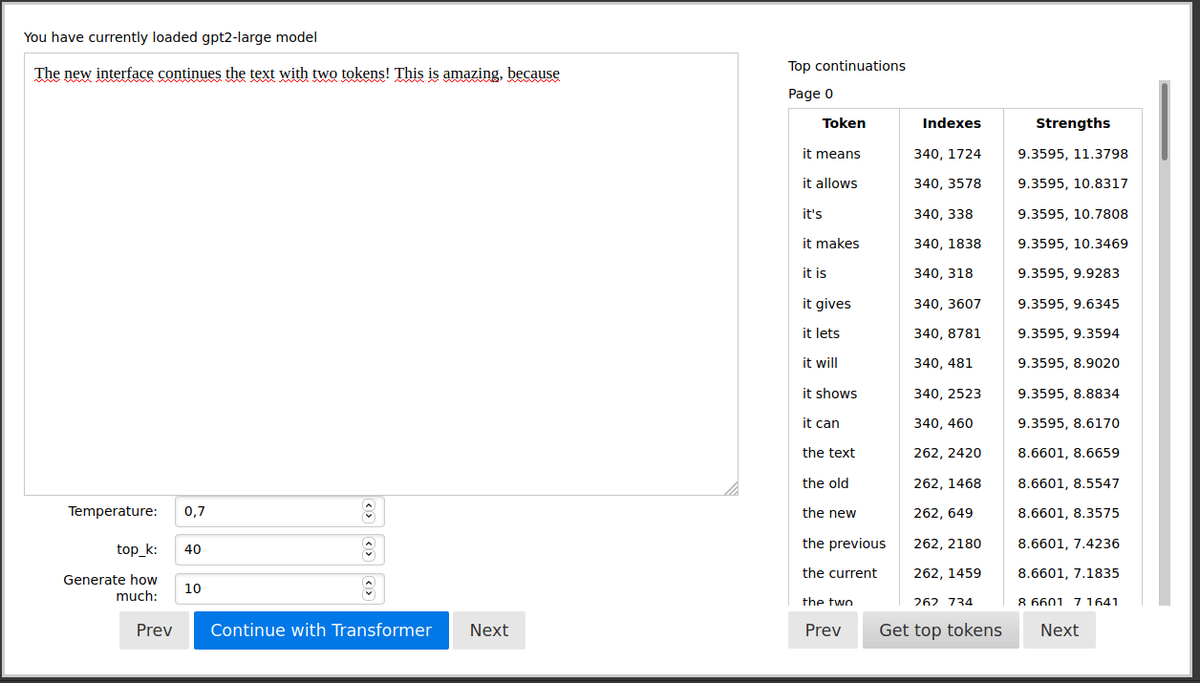
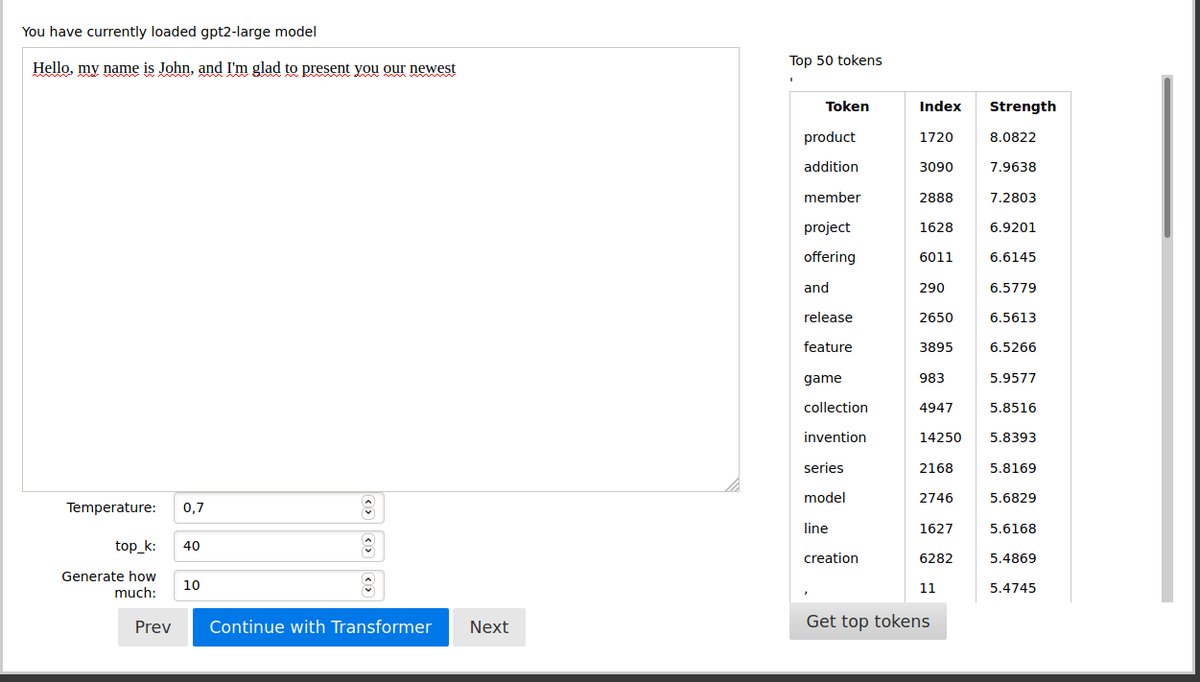
Since even newer, even better and even bigger GPTs are coming, it came to my mind - what if I made you able to traverse the tree of responses of any text-generation model supported by @huggingface? #LLM#GPT3 via @streamlit
Yeah how about you'd use GPU for inference in your nice new colab @gpt2ent? yeah sure man, gonna fix it in 5 min. I'm clueless enough to have thought it inferred fast enough. But enough of that!
@huggingface transformers language generation (#GPT2, #GPTNeo) in Colab with js interface, generating 10 samples and enabling you to look through 50 most likely continuation tokens: https://t.co/olT7yjadXE
Speaking of interesting subprojects. If you ever wanted to just let GPT2/Neo/(whatever fits) present you with a list of tokens whenever you generate text, you might try my new gist for that: https://t.co/uWqcVsgRta. 'ts not fancy but it might be entertaining
Ayo. So there obviously was a bug with my transformers+js colab, you know it I know it. It is fixed. "huggingface-api" is not fixed - not really an interesting subproject. https://t.co/olT7yjadXE
You can play with GPTNeo 1.3B or any other @huggingface-based model with JS interface and Colab backing here: https://t.co/vdPpKuXeJd
Maybe you could also fix OOM for 2.7B in a fork/push request?
Should I feel outdated for still playing with GPT-2?
Anyway everybody hates it when you generate just 1 sample per request, so now you can check out my 'multisample' branch and play with 10 samples per request: https://t.co/jp9QoORzYR
@aifazza let me be clear I am not training anything just doing inference, and so far what I get from google by "huggingface deepspeed" and "huggingface batch size" does not really seem to address inference from pretrained models
Well, using just this code and both TPU/GPU runtimes i was unsuccessful in launching the model via Colab due to insufficient RAM. I'll set it up with the smaller model though. Maybe I'm just missing something?