My latest piece on growth, degrowth and social development.
While growth is a legitimate economic conduit necessary for social development, degrowth is unquestionably positive for the environment. We need a shift in how we approach growth, not less of it.
@Entrepreneur
Explore a new in-depth series created with @FightPoverty on how companies can put climate justice principles into practice and emerging solutions from different industries that are taking action. https://t.co/blBjQnoyyy
"Everything in politics is really about wellbeing - even if people don't use that word", says @joswinson at #OxWellConf "Growth in the economy does not automatically equate to growth in wellbeing" #GDWe 👏🏻
"As stated by @WBCSD in its latest report on sustainable consumption, current approaches to #sustainability do not commercially bond well with the growth goals of most retail companies," says @graceavcs of @cisl_cambridge in @Entrepreneur.
https://t.co/IxV2PLohGE
@SimeonTegel I’d say @Peru_APP ‘s entire leadership team is in itself a political misstep that’s starting to cost them hundreds of supporters. Also @CesarAcunaP’s short lived presidential campaign back in 2016 was pretty epic.
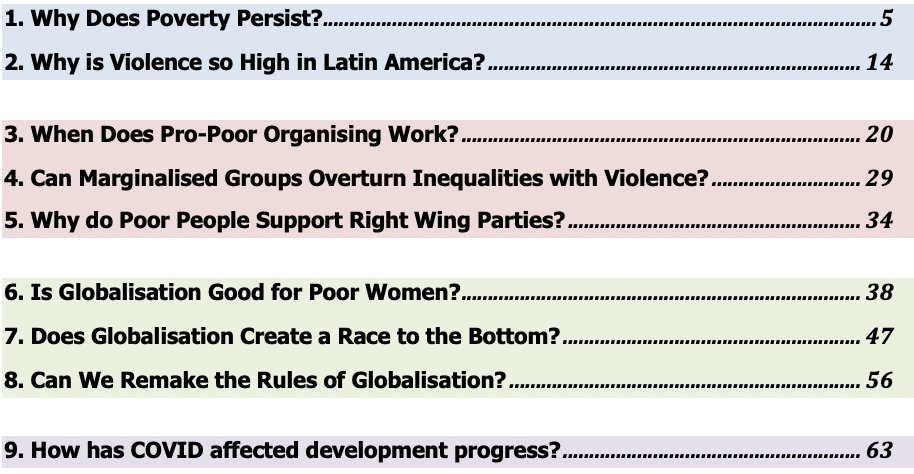
I've written another Tiny Textbook on Development Studies.
It discusses key challenges (poverty, inequality, & violence); organising, insurgencies, right-wing populism; global supply chains; & the impacts of COVID.
Reading suggestions are very welcome!
https://t.co/xZ3QkCszVw
“The current system is based upon short-term transfers and its narrative suggests that the ‘problem’ is poor people living in poor countries and the “answer” is ODA resource transfers” –@andypsumner
NEW ON THE BLOG - @graceavcs discusses the #future of development aid post-COVID 19, and why we need an urgent shift. Read in full: https://t.co/cLmI0S8Qm8 #COVID19
@andrewleedaly Well put. Iterative remote work as a public, private & nonprofit sector initiative could also help in decarbonising the economy, #quarantinefortheplanet suddenly wouldn’t be that crazy #postCOVID19
But the returns to capital and skilled labour might be higher than the returns to unskilled labour-leading to higher inequality. Conversely, policies that cause moderate inequality based on rewards for saving, investing, innovating and taking risk can lead to higher growth.
Causation goes in both directions. Some mechanisms/policies lead to a trade off, and others allow both higher growth and more equality. I.e.: higher growth can create more job opportunities and resources for redistribution, lowering poverty and reducing inequality.
Case in point: in Indonesia, this low-carbon growth path will outpace economic growth under business-as-usual from the first year it is pursued, while also unlocking an array of economic, social and environmental benefits.
The latter will also fight two major crises head-on: air pollution and the growing climate emergency. Good news is that plenty of evidence demonstrates that pursuing low-carbon and climate-resilient growth is the best way to unlock lasting economic and social benefits.