@guywwallace Obviously it is a fluid concept and one that can not, nor should be condensed to 9 simple categories. However, whether or not their is science to support it yet, there is no doubt that kids do excel more at certain things in life that schools do not offer in their curriculums.
In 1983, Howard Gardner discovered that humans have 9 different intelligences, in his Theory of Multiple Intelligences, and realized people excel at all different types of them. We must wonder then, why, 37 years later, do schools only reward kids for excelling at 2 or 3 of them?
@MrPranPatel@tootler74 Power depends on environment. If you are white, and your environment (job, neighborhood, etc.) is run by a majority of POC, then the POC can absolutely be racist towards, since they have the power in that scenario.
@Ed_by_design I agree that the way we perceive ourselves becomes who we are. However how society views us can affect us just as much. It is true though, that we need to get rid of the things that determine our self worth, grades, class rank, and other ranking systems.
@Ed_by_design But this isn’t looked at as excelling. If students fail the class, they are lacked “stupid”, even though they are taking a math class above their grade level. If students are passing or excelling in the class, they get almost no praise for excelling at a higher level class.
@Ed_by_design This is true in math students specially. I know that in our school district, students are pushed to the highest possible standard in math, causing almost every student to be in a math class that is above their normal grade level.
So I was listening to @NPR this morning and it turns out that some Administrators don't like the A through F system for evaluating schools because it's unclear what those letters mean. #ModernMeasures#personalizedlearning#edu
Also check out episode one of our podcast “from the minds of gradeless students” -An inside to the gradeless classroom
Featuring @Ed_by_design
https://t.co/v8DF8nIwVT
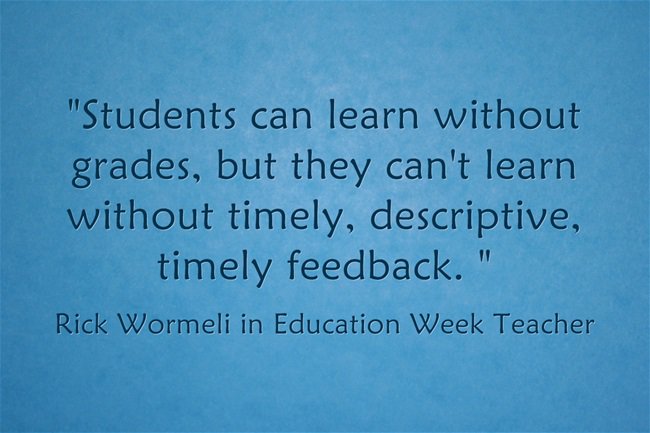
In gradeless classrooms, feedback can act as grades, to give students a reference of how they're doing. This allows them to grow with individualized teaching to lead them towards a path that best suites them, personally.
In the absence of grades, a student has to make a moral decision. They must decide whether to sacrifice their learning, by not doing the work that grades traditionally held them accountable for, or to be responsible and do the work assigned, simply for the benefit of learning.
We need more kids to take classes that will push them to learn, rather than classes that they can simply get an easy grade in. Grades discourage students of pushing themselves in any sense, for fear of getting bad marks. We need to put a focus on learning, not numbers on paper.
@BonitaEdu Completly agree. Some students need to fail in order to learn and grow from their mistakes, but teachers are hesistant to allow them to. This comes from the fact that failing has such a horrible stigma attached to it, while instead it should be looked at as an opportunity.