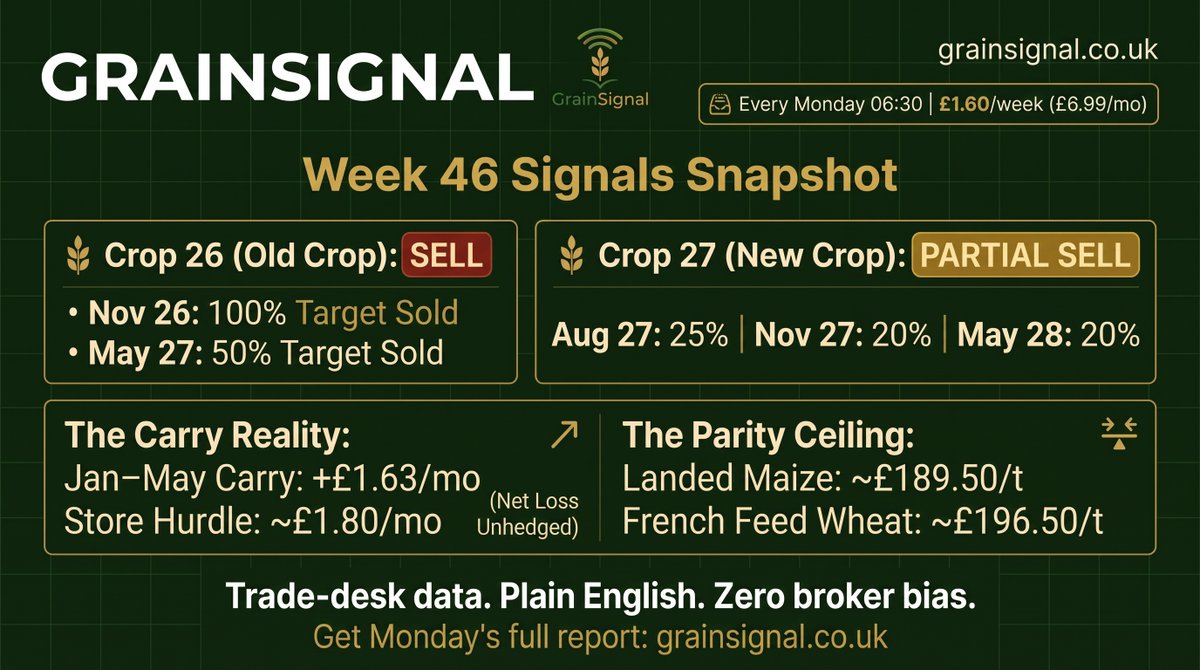
Institutional grain intelligence built for UK arable growers.
Weekly selling targets, physical store carry math, and coastal import parities delivered every Monday at 06:30 for £6.99/month (£1.60/week).
🟢 Crop 26: Nov 100% Target Sold | May 50% Sold
🟡 Crop 27: 20%–25% Covered (Pause on new sales)
📉 Carry Reality: Jan–May carry (+£1.63/mo) trails store costs (~£1.80/mo).
⚓ Parity Ceiling: Transatlantic maize (~£189.50) & French wheat (~£196.50) cap coastal bids.
⚠️ The Macro Watch: Funds sit -82.4k contracts net short ahead of Tuesday’s Abu Dhabi peace talks and USDA WASDE. Any failure in talks or yield cuts risks triggering a sharp short-covering bounce.
Independent. Data-backed. Zero broker bias.
🔗 https://t.co/MWoB7Dgdhn
@TWBFarms Exactly this. With UK wheat area stuck around 1.66m hectares, we are a structural net importer for years to come, meaning UK growers take all the hit on lost chemistry for EU export access we don't even use.
@FearlessGrain@kannbwx Agreed, good to see European crushers stepping in while US Gulf prices have the edge ahead of Brazil's new crop arriving in late Q1, especially with firm EU rapeseed values supporting crush interest.
@sizov_andre Even fading off the €248.50 high to close at €246.25 (+€2.50), MATIF still finished green. Zero chance Moscow signs a food truce without oil cover.
@thegraingeek Doesn't move the needle for UK growers either way. Whitehall's CO2 rescue deal came with zero mandate to buy British wheat, so Ensus has been happily pulling imported grain and maize off the boat at Teesport instead of bidding up local farmgate prices.
@financialjuice Submitting an offer to allies will not reopen insured shipping lanes on its own. Until Moscow separates food corridors from its oil export demands, buyers keep leaning on EU cargoes and European wheat stays supported.
One to watch closely if you are holding wheat. Ukraine's FM says Kyiv has submitted a Black Sea food export ceasefire offer to allies. It is only a proposal while Russia holds out, but if a corridor deal ever gains traction it would take the heat straight out of Euronext wheat and UK import values.
Today at the Food from Ukraine summit, Zelenskyy warned that Black Sea disruptions are choking exports and urged international backing to protect food corridors, noting Russia's blockade is still blocking shipments. Until safe passage is actually agreed, buyers keep leaning on EU ports, keeping European replacement costs firm for UK growers.
Add the spring drought's hit on winter forage supplies into that 15-year low cereal balance and any cold snap this winter leaves compounders short of wiggle room. Are local buyers chasing nearby feed loads in your area yet?
Hard to miss the split between US and European wheat right now. CBOT has been sliding (~7.5% down on the month) while Paris (Euronext) has climbed over 6.5% to €242/t.
Yesterday's AHDB balance sheet shows why UK physical prices take their cue from Europe rather than Chicago. UK cereal supply is at a 15-year low of 27.135 Mt, and filling a 2.750 Mt wheat import requirement leaves domestic bids tied to European replacement values.
How are merchant bids looking on your farm heading into December? #UKFarming #Arable
What makes that 839 kt wheat surplus even tighter is what is happening alongside it: barley just posted its smallest harvest in 14 years (5.614 Mt) and oat production fell 25%. Compounders have far fewer cheap alternatives to pull wheat out of rations this winter.
AHDB says UK wheat production actually rose 116 kt this year to 12.074 Mt, despite the spring drought and some brutal regional crop disasters.
Yet look past the harvest headline and the UK wheat balance is still tighter than last season. A 466 kt drop in opening stocks plus firmer feed demand leaves just 839 kt of free surplus, keeping the UK reliant on 2.750 Mt of imports while Q1 arrivals sit 31% behind last year.
Did your farm yields match a bigger national wheat crop, or is the December Defra update due a reality check? #UKFarming #Arable
Milder early December weather here is great news for UK growers still drilling late winter wheat behind sugar beet. Meanwhile, that deep cold anomaly across Eastern and South-Eastern Europe is worth watching closely for Black Sea and Danube export logistics as we head into winter.
Food security only works when domestic production is actually profitable. Between rising input and compliance costs, tighter tax rules, and growing import reliance, UK arable capacity is being eroded from the ground up. You cannot treat domestic food production like an afterthought and expect resilience when global supply chains tighten.
@agricontract Bet you are relieved to have that wrapped up. Just imagine what it would have been like if we had actually had a catchy back end this autumn. Well done!
@FarmingUK Farm tech is ready to go, yet basic connectivity is still the bottleneck. Variable-rate applications, telematics, and live grain marketing tools do not work properly when signal drops out the moment you leave the farmyard gate.
@TheFarmingForum Exactly the issue in UK grain. Red Tractor functions as a baseline entry requirement rather than delivering a market premium, meaning growers absorb the audit and compliance costs while buyers get the due-diligence cover.
This is the real trade-off for UK arable growers. Easier cross-border trade helps on paper, yet dynamic alignment on pesticides and precision breeding risks locking British farms out of the exact yield-lifting genetics and crop protection tools needed to bring down per-tonne cost of production.