Your strategy is as good as the data on which it has been tested. Have tried different sources of historical options data and to be honest, either it's incomplete or incorrect, in both ways, it's not usable.
Trying something in the regulatory framework to get users the access to historical data for backtesting.
@Abhi13027 Don't know much so can you explain as a retail trader what difference does this speed make. I understand when I am paying money faster is better but on objective basis will speed make much difference. I found the collaction of arrow impressive. Just curious so asking.
Hi!
There are several situations where having a faster trading setup can make a real difference:
It allows you to take advantage of certain low-risk opportunities that may only exist for a very short time.
In fast-moving markets, especially for momentum trading or scalping, getting in and out a little quicker can improve your profits.
If you're trading large quantities that need to be split into multiple orders, faster execution can help you get better prices and reduce slippage.
In short, lower latency doesn't matter for every strategy, but for some trading styles it can have a noticeable impact on overall profitability.
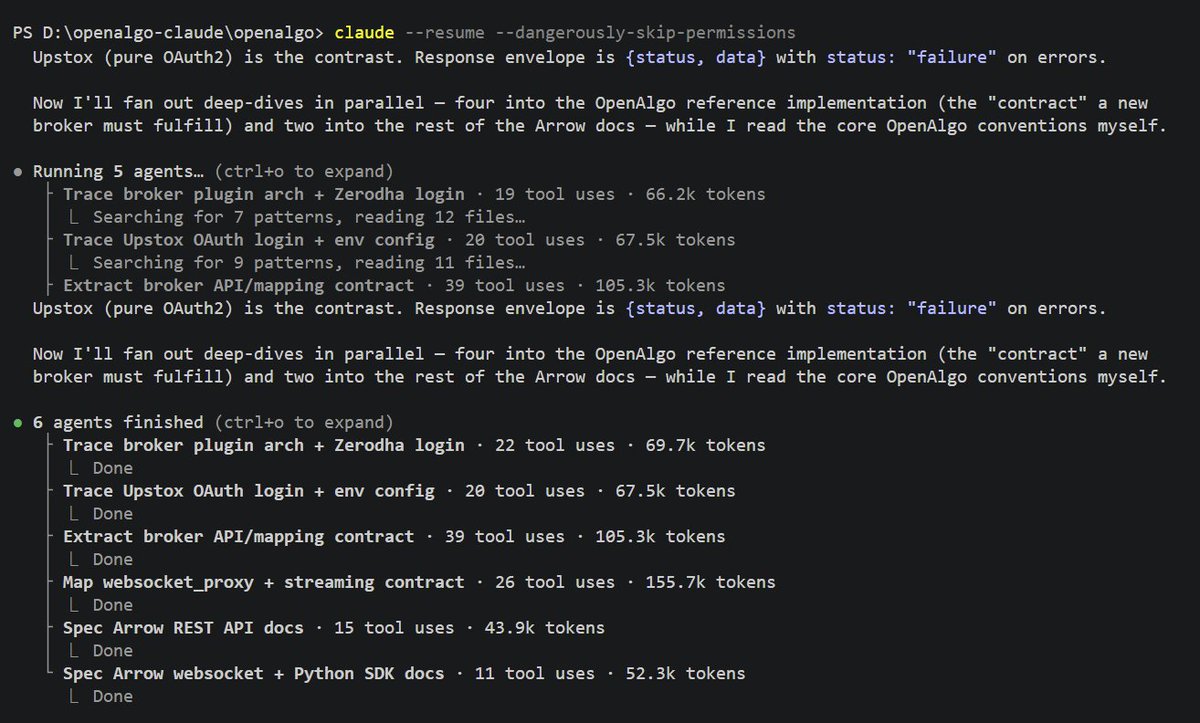
Integrating https://t.co/gDKO0Fdl8V using Claude Fable 5. It is all about Fable 5 is effortlessly spinning Multi Agents , Multi tools to Explore, Find patterns and Build things.
At this rate probably https://t.co/k1DjS6vK2U will be done in another 1-2 hours cutting down the time from 1 week of build time using AI.
Why does Higher Frequency API data matter?
Imagine RBI MPC announces a surprise policy move.
https://t.co/fkmkSHxv3t 50 ms feed + 10 ms latency = algo reacts at ~60 ms.
A 1-second feed + same 10 ms latency = algo reacts at ~1010 ms.
That is 950 ms faster reaction time.
In markets, that is not small. That is execution edge.
Feed provided by any broker is a 1 sec snapshot. ( min delay of 1 sec, at places it is higher, ~5-6 secs ). Orders on the other hand gets executed in ~100 ms. if traders are operating on data that’s already stale, what is the real benefit of improving order execution latency while the market data itself remains delayed?
Fair point. Though I'd be curious how much of the observed drift is actually data latency, and how much is the market reacting to the order itself.
Price impact, liquidity removal, queue-position changes, LOB rebalancing, spread adjustments... The moment we interact with the book, we become part of the system we're trying to measure 🙂
Interesting rabbit hole either way.
Not using API?
App & Web still institutional-grade.
20-30ms execution via browser or mobile app.
Proprietary order & risk management infrastructure.
Collocated servers at NSE & BSE.
Great for manual and semi-automated strategies.
iOS: https://t.co/3Gqb8jxJBG
Android: https://t.co/KEqTCmKeZ5
The API is built for developers.
WebSocket API with sub 5ms execution
Real-time market data feeds upto 20 ticks/sec
Direct order routing (no throttling)
Multi Language SDK ready https://t.co/ck11Gpa539
Everything you need to build a bot that competes with institutional traders