Historically the sector that keep hiring during a downturn are the ones that lead the upturn. Will it be the biosciences sector this time that leads? Or the digital sector? Or finance?
New time use survey from BLS shows how ecommerce has reduced household shopping hours.
Time spent on purchases of consumer goods declined by roughly 20% between 2006 and 2021, or roughly a half hour per week.
(This figure includes online shopping time)
/1
Online inflation slowed to only 2% in May, according to Adobe's Digital Price Index.
But the official CPI may undercount this slowdown.
To understand why, read IFP’s new paper on the dynamics of digital inflation
https://t.co/l5y0VnFkpQ
https://t.co/cK7PIXk9wU
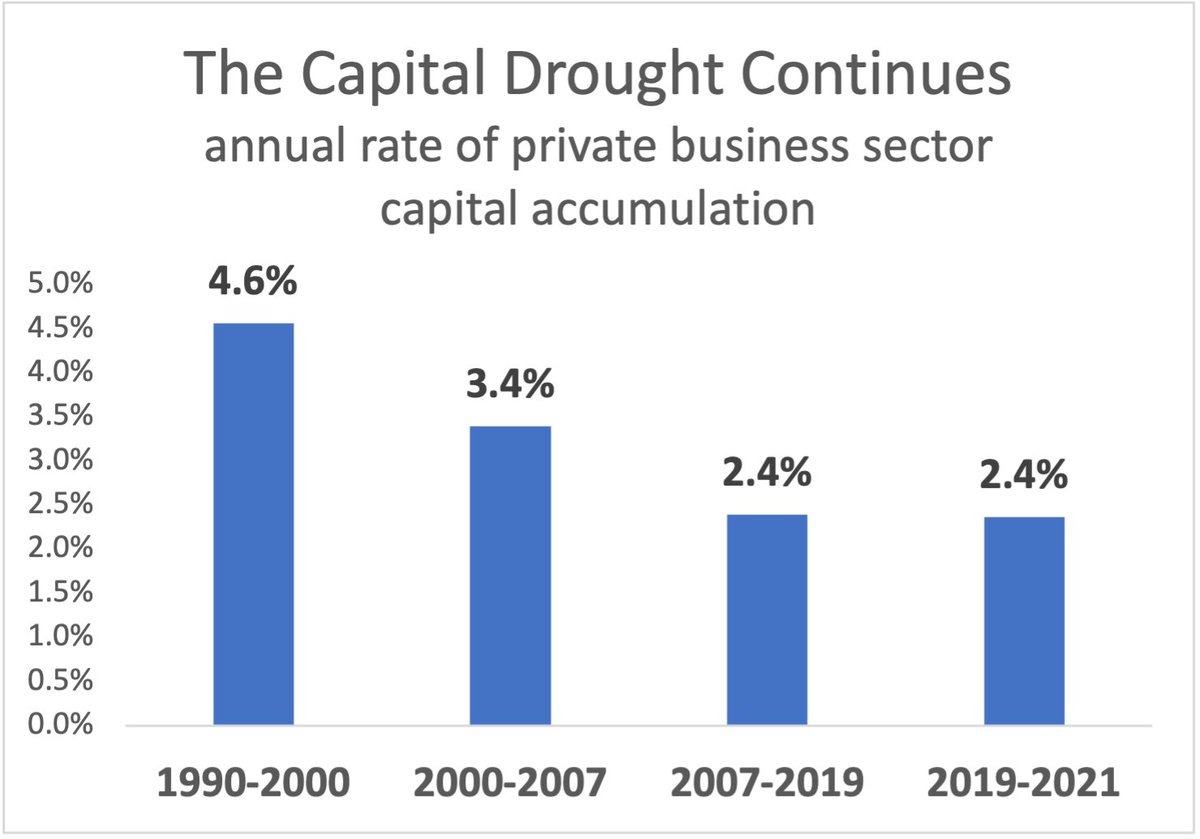
Inflation is a symptom of “capital drought.” The rate of private business capital accumulation dropped in half, from 4.6% in the 90s to 2.4% in recent years
With less domestic capacity relative to demand, the US is more vulnerable to global shocks.
#capitalinvestmentmatters
Ecommerce wage hikes!
Latest BLS data shows 11.5% increase in hourly earnings for production and nonsupervisory workers in ecommerce industries over past year.
Now at $21.57 per hour, just below nondurable manufacturing ($22.85/hr).
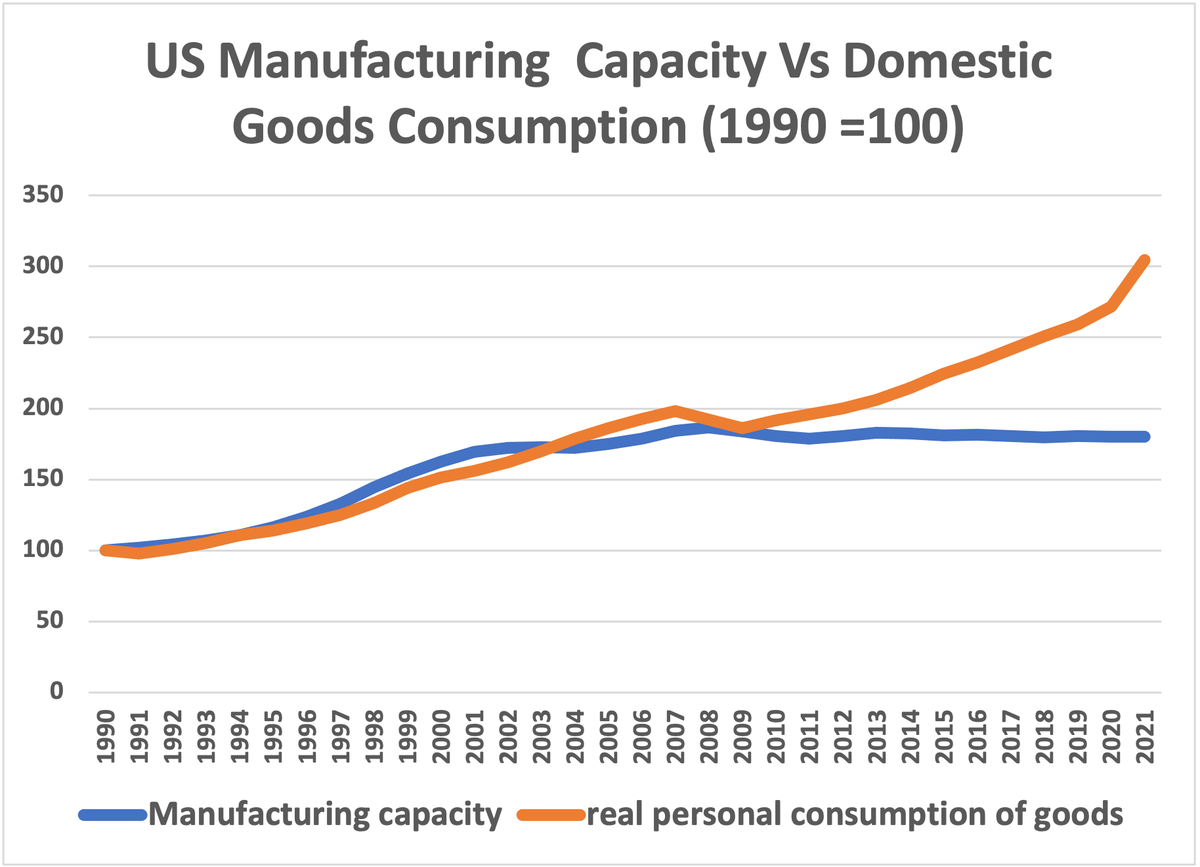
As Russia-Ukraine crisis hits hard, this chart explains why the US is vulnerable to more supply chain disruptions.
Manufacturing capacity (blue line) is flat since 2007. Personal goods consumption (orange line) is up 50%. Manufacturers just haven’t been investing in America.
Moreover, our measures of industrial capacity are “supply-chain-blind.” We don’t collect the data needed to assess supply chain resiliency. We don’t even know the ultimate origin of imported raw materials and parts used by different industries. /2
The key takeaway: Policymakers should care about investment. Tech and telecom companies have been investing in new capacity, so surging demand has not been accompanied by rising prices.
To deal with inflation, look for industries which have not been adding enough capacity./5
Why inflation? Domestic capacity in non-tech manufacturing is now 10% below where it was in 2007, before the financial crisis. By comparison, real consumer spending on goods is about 50% higher today than it was in 2007. /1
Wage gains for production and nonsupervisory workers are accelerating. Average hourly earnings for prod/nonsup workers rose 7.6% over past year.
#JobsDay#Jobsreport
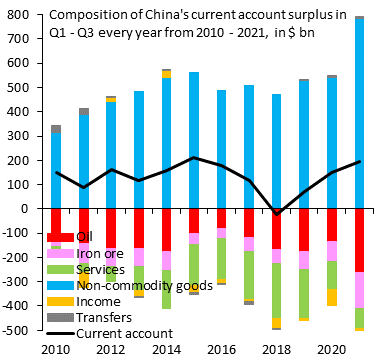
To see just how strongly China's trade surplus rose in 2021, borrow intuition from "core CPI" and strip out commodity prices. Oil (red) and iron ore (pink) prices went up sharply in 2021. Strip out that "noise" effect & the non-commodity goods surplus (blue) is off the charts...
Over the past five years, the tech-ecommerce sector has created 1.8 million jobs.
The whole private sector generated 4.3 million jobs over the same period.
That means the tech-ecommerce sector accounted for 42% of private sector job gains over past five years
#jobs#economy
Trouble finding high performing consultants? It's a talent scarce market and identifying top talent to fuel your organizations growth can be tricky.
Reach out to us, we would love to help, particularly those hard to fill ones!