Beginning today, your congressman can sign a discharge petition to force a vote on Epstein Files Transparency Act II.
EFTA II gives state AGs access to Epstein files required to prosecute perpetrators under state law, and makes it easier for survivors to sue to get their files.
No plane hit the Pentagon Sept 11, 2001! Cruise missile! Explosion and damage to building would have been immense! No bodies? No seats, fuselage! No landing gear? FAA states Flight 77 Never Existed! There was no plane! You've been lied to! 911 Truth? 👇 https://t.co/6QtlGDGAAz
@skillz17q UNFORTUNATELY, YOUR BOUGHT AND PAID FOR CONGRESS'S HAVE, OVER THE YEARS UNLAWFULLY CREATED A 4TH BRANCH OF GOVERNMENT CALLED ADMINISTRATIVE. WITH IT THEIR EXTORTIVE STATUTORY SCHEME HAS REPLACED THE BILL OF RIGHTS AND IN THE PROCESS, CONVERTED YOUR RIGHTS TO MERE PRIVILEGES!
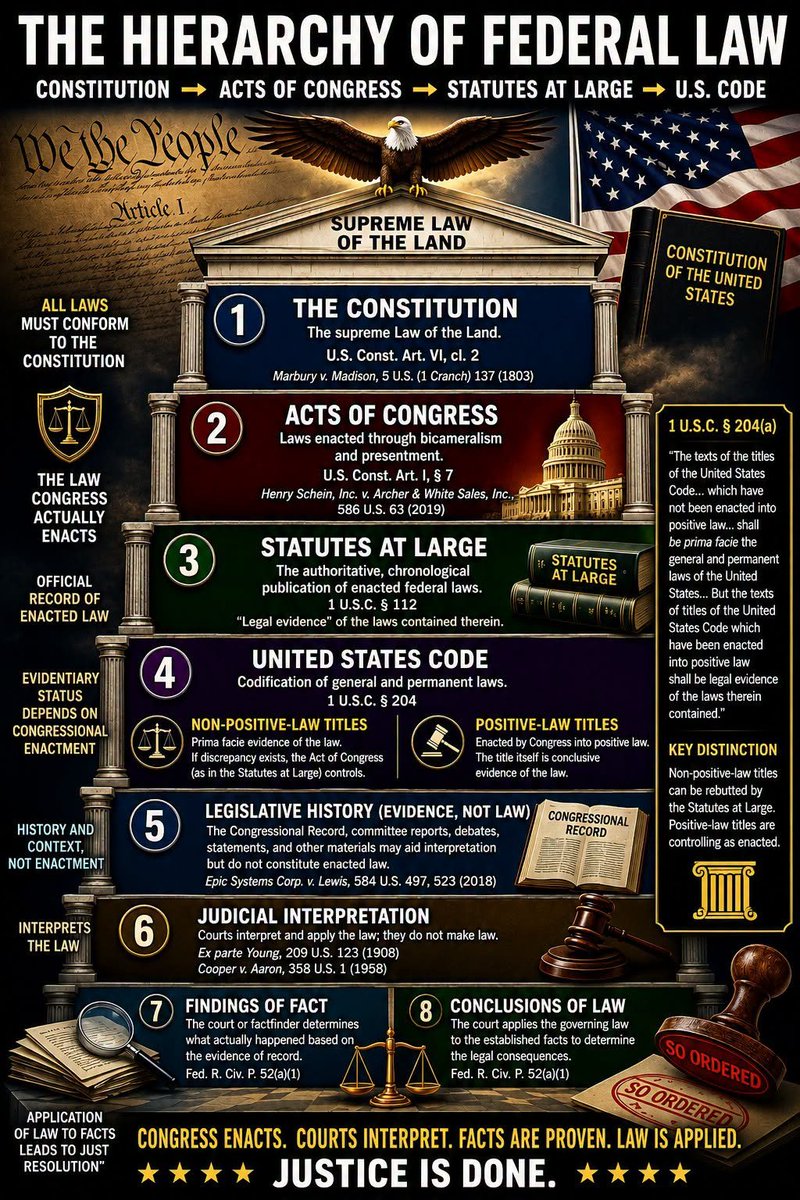
1. The Constitution: Supreme Governing Authority
The Constitution of the United States is the foundation of all legal authority. Article VI, Clause 2 declares that the Constitution, federal laws made pursuant to it, and treaties constitute the "supreme Law of the Land."
In Marbury v. Madison, 5 U.S. (1 Cranch) 137, 177–78 (1803), the Supreme Court established that legislative acts contravening the Constitution are void. Thus, the Constitution is not merely a statute within the hierarchy but the ultimate framework of authority, governing the enactment and application of all federal laws.
Key Rule:
The Constitution governs the validity and scope of all lower-level legal authorities.
2. Acts of Congress: The Enacted Statutory Law
Congress derives its authority from Article I of the Constitution and legislates through a bicameral process requiring presentment to the President (Article I, § 7). The laws Congress enacts—referred to as Acts—are binding federal statutory law.
Enforcement begins by asking the question:
What did Congress actually enact?
Thus, interpretations or judicial preferences cannot override the text explicitly enacted. In Henry Schein, Inc. v. Archer & White Sales, Inc., 586 U.S. 63, 68 (2019), the Supreme Court held that courts could not insert unwritten exceptions into statutory text, affirming that statutory interpretation respects legislative supremacy.
Key Rule:
Only provisions explicitly passed by Congress carry statutory force.
3. United States Statutes at Large: Chronological Evidence of Enactments
The United States Statutes at Large is the authoritative publication of federal session laws. Pursuant to 1 U.S.C. § 112, these statutes "shall be legal evidence" in both federal and state courts.
When determining what Congress enacted, the Statutes at Large provide the definitive source for tracing legislative language, original Acts, and amendments. For example, Pub. L. 95-598, codified in 92 Stat. 2549, represents the Bankruptcy Reform Act of 1978 and its enacted language.
Key Rule:
The Statutes at Large are critical for confirming the original text Congress passed.
4. United States Code: Codification With Distinctions
The United States Code organizes and codifies federal statutes into subject-matter titles. However, the Code's evidentiary value depends on whether a title is classified as positive-law or non-positive-law:
Positive-law titles: Specifically enacted by Congress as self-contained federal statutes, treated as authoritative legal evidence.
Non-positive-law titles: Editorial compilations based on enacted laws, serving as prima facie (on their face) evidence of federal law. If the non-positive-law Code conflicts with the Statutes at Large, the enacted text in the Statutes prevails (1 U.S.C. § 204).
Practical Difference:
Positive-law titles hold statutory authority. Non-positive-law titles are rebuttable when discrepancies arise.
5. Legislative History: Context, Not Enacted Law
The Congressional Record and other historical documents provide evidence of legislative deliberations, debates, and intent but are not themselves the law.
The Supreme Court reiterated this in Epic Systems Corp. v. Lewis, 584 U.S. 497, 523 (2018), where it stated:
“Legislative history is not the law.”
While legislative history may help clarify ambiguities, statutory interpretation ultimately depends on the enacted text, not the statements or motivations of individual legislators. Thus:
Acts of Congress (supported by the Statutes at Large) → Enacted Law
Congressional Record → Evidence of context; non-binding.
Key Rule:
Courts interpret legislative text, not intent, as controlling law.
6. Judicial Precedent: Interpretation and Application of Law
Federal courts determine how enacted statutes apply to specific cases. Supreme Court holdings on federal statutory or constitutional law are binding on lower courts under vertical stare decisis.