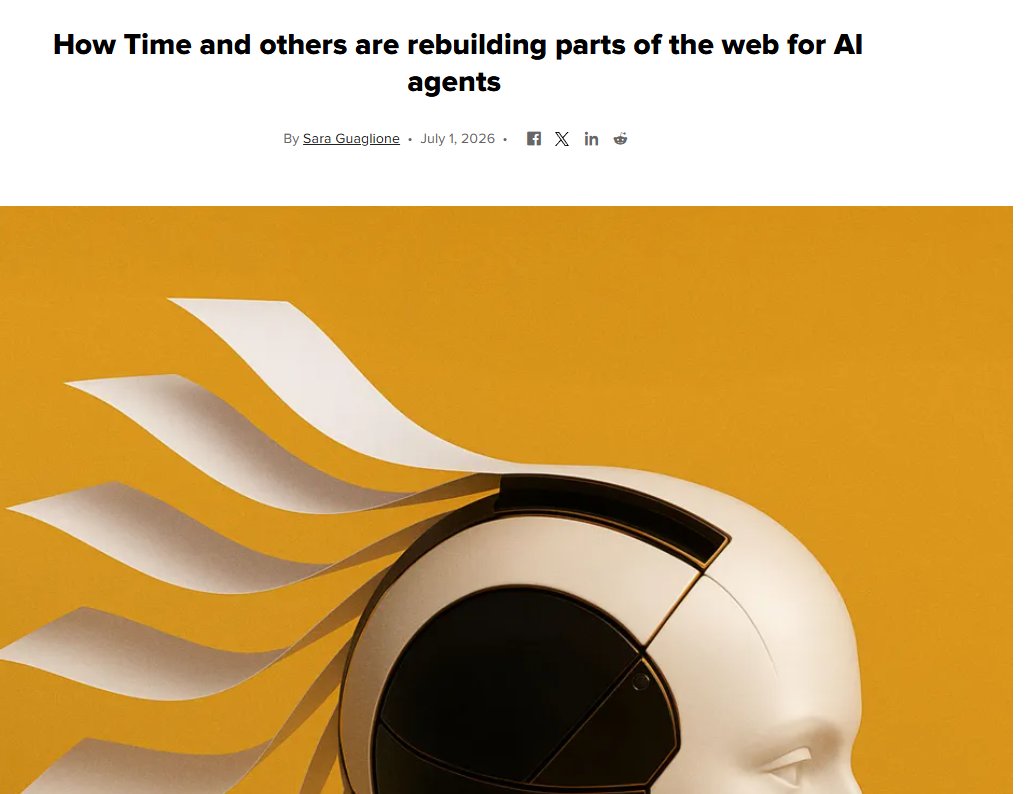
Muy interesante sobre como algunos medios de comunicación se están preparando para que sean agentes los que vengan a su web a consumir contenidos.
Lo primero que se pensaría: bloqueándolos porque los agentes IA se llevan el contenido, no ven / no se dejan influir por la publi y pueden agregar los artículos a datasets para entrenar futuros modelos de inteligencia artificial. O permitir al chatbot contestar sin que el creador del contenido capture valor.
Y, obviamente, eso forma parte de la estrategia. En la pieza hablan mucho de Time y The Economist, que están en lo siguiente:
> creando versiones “amigables para agentes de IA” de sus contenidos: páginas paralelas en formato markdown en lugar de HTML.
> Utilizan un sistema de "lista blanca": bloquean todos los bots por defecto, pero los aprobados (ej pagan) son redirigidos a estas versiones en Markdown, mientras que los humanos siguen viendo la página tradicional.
> Un gran editor (este no dicen cuál es) está experimentando con WebMCP: mucha más capacidades para que la gente mande sus agentes a utilizar el contenido y servicios del medio.
> Le Monde está experimentando con la detección de si los agentes actúan en nombre de suscriptores pagados para decidir cómo surfaced su contenido.
El internet actual está repensándose: cómo es el mundo al que vamos en el que el agente de a inteligencia artificial va a intermediar entre los usuarios y los servicios y contenidos digitales.
https://t.co/1aUFEUX2SD
Mi experiencia en reuniones académicas internacionales es que nadie te cree que puedan suceder estas cosas, que no puedas estudiar en un centro público en tu lengua materna, que es la oficial y de uso común en todo el país. Pero ningún gobierno, ni PP ni PSOE, va a cambiar esto.
La verdadera razón de la abrupta marcha de la directora de la Agencia Tributaria no son las joyas de Zapatero sino la cesión de competencias a Cataluña.
Por @jgjorrin en @elconfidencial
https://t.co/XpGvcmWVi5
Anticorrupción apunta a la directora de la Guardia Civil por "utilizar expedientes disciplinarios" para "presionar" a los mandos de la UCO que dirigían investigaciones de corrupción https://t.co/bhlvT60dgn
Últimamente me da pereza analizar titulares porque es un no parar pero este "la tránsfoba" bien merece una parada porque no hay por dónde cogerlo.
¿Debe un periódico utilizar insultos o etiquetas morales como hechos objetivos en sus titulares? 🧵
"Giving the government an ownership stake could help secure good relations with the administration and would mark an attempt to address political blowback..."
Not a sign of a healthy form of capitalism where large firms feel the need to hand over equity to the state to preserve good relations with the government of the day.
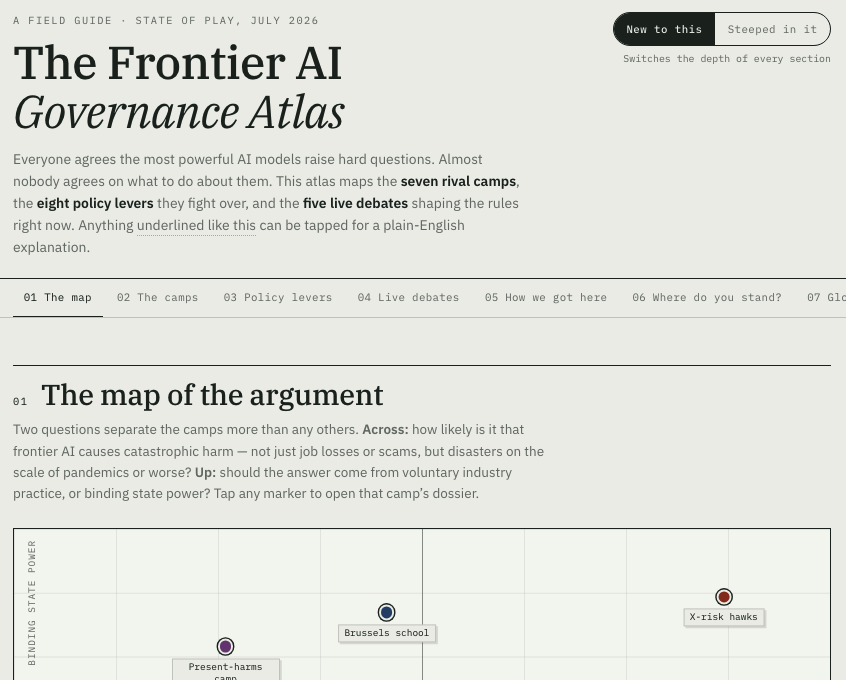
To welcome Fable back, I asked it to put together an interactive tool mapping to explain current debates over how to regulate frontier models, map the relevant camps and provide sources. You can toggle beginner & expert mode at the top.
The new business model that pays for the Internet in a world of AI agents instead of humans browsing.
Will take a while as most humans are still using AI as a siloed browser experience, but as soon as they start using AI like everyone in tech, the model will flip and quickly.
Parisian urbanism is fascinating from the social perspective, and wholly unlike anything in the Anglo world.
While the city is massive, the scale still feels very human as the density is (literally) upper-bounded given height restrictions on building.
The net result is that life unfolds inside your 'quartier' as if you lived in a village: you go to the same shops with the same people, everyone looks you in the eye and every interaction feels very personal (almost too personal). The sort of dissociative anomie you feel living inside Anglo or more Northern European cities doesn't exist really, as the human still bursts through (whether you like it or not).
The barista girl flirts outrageously with a regular client (slowing down your coffee order); the waiter engages in an entire debate with a seated party about their reservation, fluctuating between emotional appeals and whatever the 'règlement' says; go to the same bar twice and the guy will remember your order and start pouring it when you walk in; eyeball someone across the street while people-watching and the stranger will meet your gaze as if you were standing face to face.
In NYC, SF, or other cities, the crowd greets you with indifference (or if you push, hostility).
In Paris, you have to negotiate a hundred human interactions every day--often warm, occasionally hostile, but never indifferent-- everywhere. This is why Americans often think of the French as 'rude' when really there's just an interpersonal dance whose steps they don't know.
It's not very WEIRD in the Henrich sense of total strangers being offered rule-bound (but cold) dignity by default; you kind of have to earn it. But it imbues what would normally feel like being another ant in the pile with a human drama that most urban life lacks.
"El imperio disfuncional", sobre los 250 años de EE. UU. y la crisis de su democracia, en el número de julio de Letras Libres España.
Sheri Berman habla con @LeonKrauze. Jill Lepore sobre los aniversarios de la independencia. @DiegoFonsecaDF sobre el evangelismo político.