This is solid advice, but there is no harm in giving a cash poor advisor 25-50 bips over two years for a very specific set of deliverables — framing them as “consultants” in your mind makes this helpful (ie you would have paid for their work otherwise, and you prefer them having skin in the game)
Uber had some high profile advisors in fact, which were helpful on the margins I understand
Giving 1-5 points is crazy, as is having 10 advisors just lending their name — and we’ve seen both and helped clean these up.
Important: always on a 24 month vesting schedule
@tobi Shopify used to be known for outstanding customer support. That all of a sudden changed recently. Support is absolutely atrocious now. Can't ever talk to an actual human by email.
We started Simple Modern with $200k.
In 8 years, we've sold half a billion dollars of insulated drinkware through Target, Amazon & DTC.
We're licensed with Disney, NFL & more.
Our best threads about how we did it:
My take on the Amazon aggregators, and why 95% of them are doomed to fail. ⬇️
From the day I met the first aggregator, back in 2019 meeting with some Thrasio representatives, I had strong doubts about the viability of the endeavor.
But I was also trying to consider that maybe they understood something I didn’t, that surely if they got so much money from investors there must be a good reason that I was missing.
It turns out that my doubts were well-founded, the entire thing didn’t make sense, on multiple levels.
The valuations
At some point Thrasio reached a valuation of $10 000 000 000. Yes 10 billions. Let’s break down the maths. Unilever has a price to earning ratio of 14, so if we assume that Thrasio could fetch a similar PE in the future (they wouldn’t, we’ll see why later), that means they would need to bring is roughly $800M in annual EBIDTA.
I already feel like this is really an insanely optimistic outcome.
The acquisitions
A lot of acquisitions were done in the first half of 2021. By then competition had ramped up and the average multiple was x4. Not too bad? Very bad. Because most sellers had a standout year because of COVID with crazy margins, usually 3x their usual EBIDTA. So in reality these aggregators bought at x12 multiples.
The erosion
It gets worse. A lot of aggregators compared themselves to companies like Unilever or P&G. The difference is that these companies operate on limited shelf space, not everyone can dislodge you from your spot at Walmart. This is not the case with Amazon, it is very rare that a product sales doesn’t decline throughout the years.
What most Amazon sellers do to compensate for that is launch new products, but this was never part of the aggregators plans or expertise.
The operations
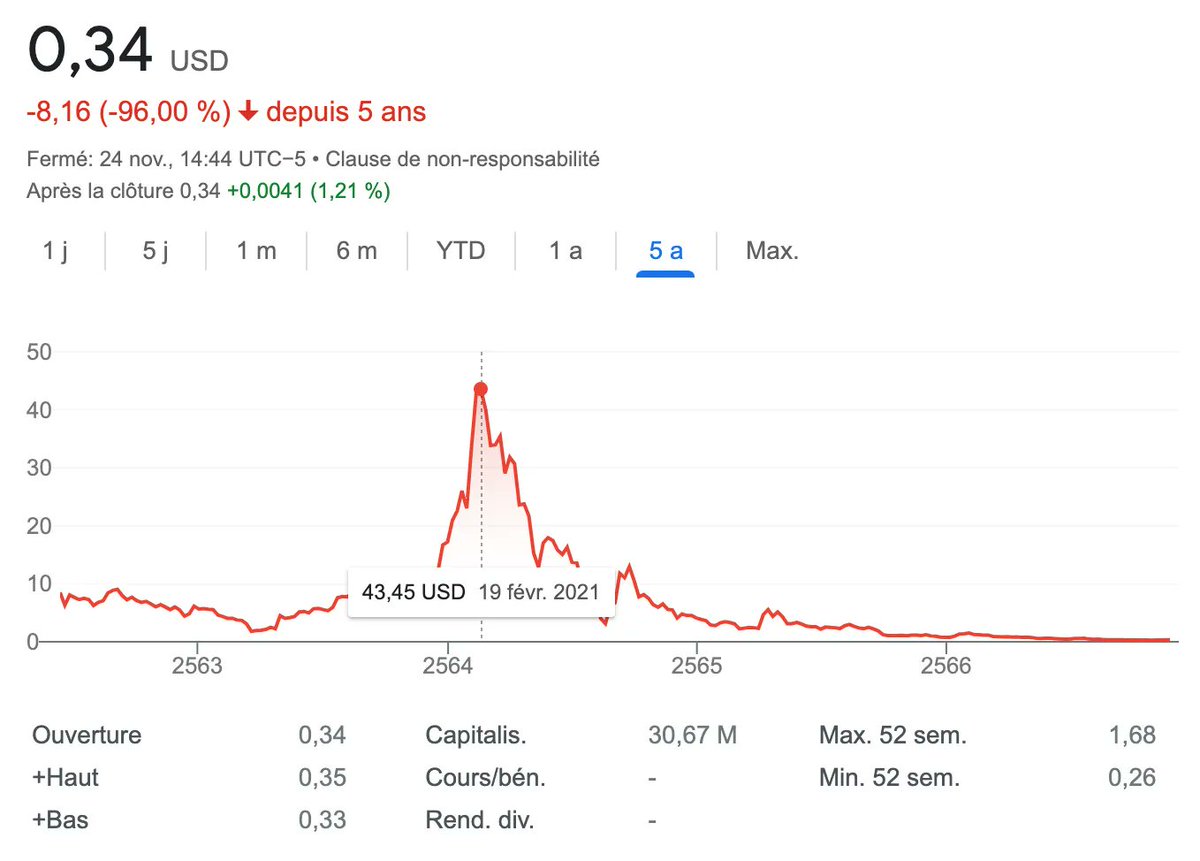
Back in feb 2021 I had a call with the CFO of a company called Atherian (their stock price is the image in the thread)
It was at the time valued $800M, now it’s valued $30M.
On the call their CFO insisted that they had developed a proprietary algorithms that guaranteed them success on Amazon, with a 98% success rate on new products release. This pitch would work on investors, not on sellers. We know how hard it would be to achieve, with some parts like sourcing that simply cannot be truly automated.
Overall it seems to have been the case that aggregators talked a good game to investors, and severely underestimated the value of an owner who will work on Sunday and spend 5 hours on calls with seller support to fix a suspended listing.
I know a lot of sellers who sold, and they all have the exact same story : some random person took over the brand, and sales crashed.
The debt
Aggregators raised debt, usually in the ballpark of 15% interest rates. That’s a heavy burden to carry. And I’ve been told that a lot of them, and this is what happened with Thrasio, will have to repay the principal in early 2024. Some of them might be able to negotiate something with their creditors, but a lot will simply be unable to pay back the principal and be effectively insolvent.
Honestly, if I was a supplier/vendor of any aggregator right now, I would categorically refuse to offer any credit.
It adds up
Let’s take an hypothetical example.
Rollupbois(tm) raised $4M in debt at 15%. It’s march 2021, they buy Garlic Press & Co for the $4M, with an EBIDTA of $1M (multiple of x4)
What happens?
First, Garlic Press & Co covid boost dies down, and the next 12 months would brings it to $250k EBIDTA.
Next, you add in erosion, that’s another 20% of sales, and profits down. You’re at $200k.
Then you had mismanagement, Rollupsbois went full retard on PPC, can divide these profits by 2 down to $100k. So now, we’re already at a 40x yearly multiple.
Oh, and there’s the debt. 15% on 4 Millions is… $600 000.
So now the brand is at -$500 000 a year.
They almost got away with it (and some probably did)
The crazy thing, is that I strongly believe that if Thrasio had been able to IPO a few months earlier (they scrapped it because the wind was turning), they would have been able to get rid of the bag, and gotten away with it.
In the end, it was a basic arbitrage play, aggregators saw that they could buy at x2 multiple and be valued at x20 multiple. As far as I know they didn’t lie to investors, so it’s the investors’ fault that they failed to realise that no aggregator was worth a PE of 20.
Hopefully only investors’ money will be lost, and all the vendors, employees, suppliers can be made whole.
Are there lessons to gather from this & what opportunities lie ahead?
a. Companies will focus on what they value, aggregators were M&A machines, not Amazon operations machine. There was a total lack of respect for the difficulty of operations. => in our case I think it makes sense to put operations as the cornerstone of what our company is. I honestly believe this will be the only way to do well in an Amazon environment where margins will be tight.
b. Real synergies are rare. => for any acquisition start from the assumption that there will be no synergy.
c. Skin-in-the-game owners are difficult to replace. They might not be the most skilled, and they make plenty of mistakes, but giving a fuck goes a long way. And finding employees who even gives 50% of the fucks is not easy. It also ties to a., the big shots in aggregators were the M&A guys, from what I could gather operators were not especially valued and fairly big businesses were left to be managed by inexperienced, not-so-motivated employees. => all businesses being sold write something like “owners barely works 5 hours a week in the business, everything is automated”. Don’t trust it, consider the cost of hiring a competent person to run the newly acquired business.
d. Sales erosion. => for any acquisition assume that sales will organically decrease by 20% a year.
e. Valuations matter. If aggregators such as Thrasio had stuck to the discipline of buying at x2 multiples, and wait out the unusual covid profits, I think they could have been fine. => buy at a price that allows for a margin of error.
—
Obviously I’ve been quite negative about aggregators, but I think most of them were doomed from the start, the spreadsheet maths didn’t match reality. Some aggregators might survive though, and I think those will be the ones who a. very quickly transition to a lean and mean, operation focused business b. manage to negotiate longer payment terms for their debt.
I know some people who work for aggregators read this newsletter, I am actually open to doing some consultation, spend maybe half a day looking under the hood. I believe there are probably some low hanging fruits in there.
All-in-all, this might purify the Amazon ecosystem a little, a lot of the investor’s money and debt went into running extremely unprofitable PPC, pushing prices down and so on. I prefer an environment where all sellers are forced to be profitable, and may the best one win.
@Jason @linakhanFTC @amazon Ecom founder here.
1. This is totally not true. Would love to see evidence of that. AMZ algorithm complex but lower price elsewhere is not part of it.
2. Yes. Totally up to seller. Not AMZ. The entire AMZ business model would not be sustainable if AMZ were to dictate price.
Ecommerce founders - this is an intervention.
🛑 STOP taking "fixed fee" merchant cash advance loans from Wayflier, 8Fig, Shopify Capital, and more.
💰 The entire biz model of these lenders is exploiting the fact that you can't do interest rate math.
That ends now - read on...
You know the pitch:
"Click here to borrow $100,000 for a fixed fee of JUST 9%. You pay back 15% of revenue until you've paid back $109,000"
These loans are framed as inexpensive, founder-friendly, and easy - just click a button and get a wire!
Here's what they don't tell you, and some alternative options.
What's the true interest rate on that $100,000 loan with a 9% upfront fee and daily payback, if it takes 6 months to pay off?
Is it 9%? Nope 🙅♂️
Is it 18%? Nope ❌
It's much higher. Let me teach you some math to calculate the true APR - math that they hope you won't understand.
Since you pay back a % of sales each day, your first repayment is made one day after borrowing the money. You had that principal for just ONE DAY, but paid a 9% fee on that money.
To get the *annual* percentage rate you paid on this one payment, do 9% * 365.
That's 3,285% APR! 🫢
So in fact, we can see that embedded in a 6-month "fixed fee" loan are actually 180 "mini-loans" of different lengths, one for each day you make a repayment.
As each day goes by, your effective APR gets a little "better". Let's keep going...
Tomorrow you'll make another repayment. You'll have had that money for TWO DAYS, but paid a 9% fee.
Your effective APR on that mini-loan is 1,642%!
This same pattern repeats for 180 days - each of which is a "mini-loan" embedded in your 6 month loan. Let's skip to the end.
The "best" mini-loan is the longest one, the last daily repayment you make. You've had that money for a full 180 days and paid the 9% fee - an effective APR of 18%.
To figure out the true APR we must AVERAGE the APRs of all 180 embedded mini-loans...
Turns out, the true blended APR on this seemingly cheap 9% fixed fee loan is in fact a whopping 104%!
That's about 4X more expensive than carrying a balance on a typical credit card.
Why does it work this way?
With a "normal" loan, you pay interest only for days money is outstanding.
So if you borrow $100,000 at "true interest" of 9% and pay it back in full tomorrow, you'll pay back ~$100,024.
To pay $109,000 you'd need to keep ALL the $$ for a whole year.
This is why these loans are so sneaky - they charge a full year of interest right upfront, no matter how quickly you pay back the money.
Borrowing ANYWHERE with true interest (yes, including a credit card) is much cheaper, bc they only charge interest until they get paid back.
So what are your alternatives? Glad you asked.
I've talked to probably 20 ecommerce-focused lenders. Nearly ALL of them have some version of the above predatory dynamic.
There are THREE who offer "true interest" - meaning you only pay interest on money you actually use. They are:
@getampla
@HighbeamApp
@Sellers_Fi
I am intentionally NOT including affiliate links so you know I'm not selling you anything. If you send me a DM, I can introduce you to folks at any of the above. In that case yes, they'll kick me back.
But you don't have to go through me - just get in touch directly if you want.
I'm also sharing a google sheets calculator that you can use to calculate the true APR of a merchant cash advance loan. Scroll down to the next tweet.
And if this helped you - please repost it so other founders who follow you can benefit!