public fills are enough to reverse-engineer an entire trading strategy.
public orderflow accelerates alpha decay.
trade HL privately on @hyperlink_xyz. keep your edge.
ms or bps. figure out which one your strategy is actually short of before you spend money on either.
01/ edge decay
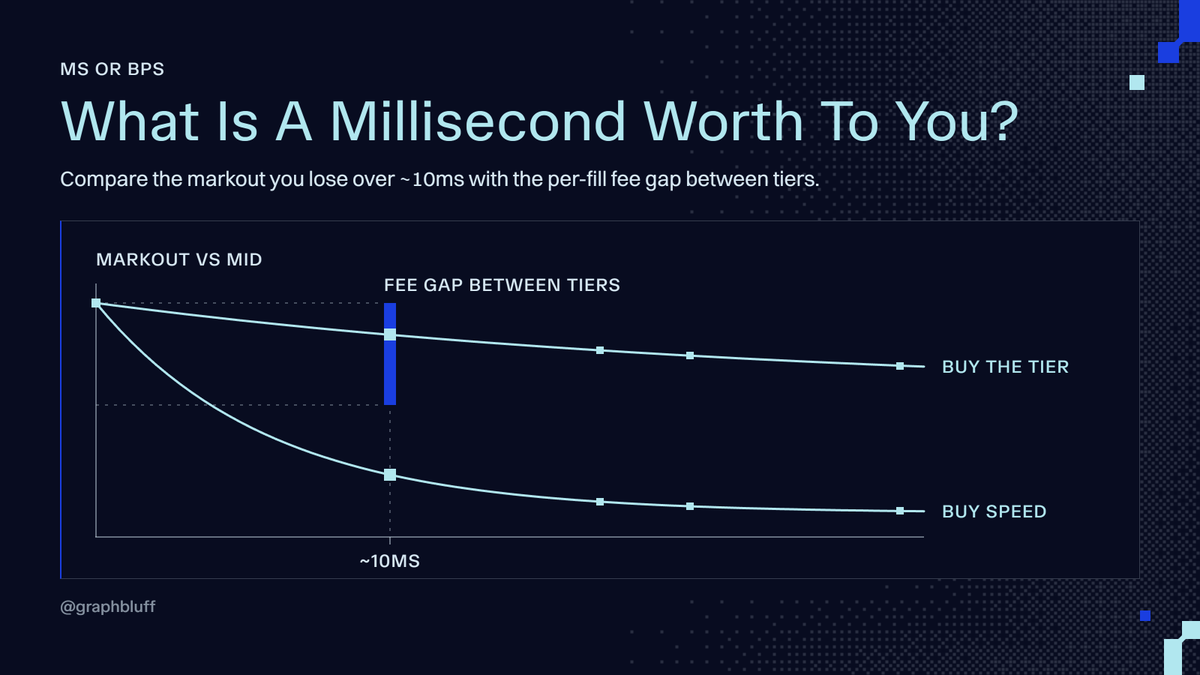
for every signal i log the markout of the fill against mid at roughly 10, 50, 100 and 500ms after the signal fired. plotted, that curve tells you what a millisecond is worth to your strategy. a latency benchmark from someone else can't give you that, because their edge decays on a different clock than yours.
02/ fee side
then take your cost per fill at your current Hyperliquid tier and at the next tier up, and write the gap as a share of your average edge per fill. tiers run on rolling 14 day weighted volume and get assessed at the end of each UTC day. sub-accounts share the master account's tier, and spot volume counts double toward it. the schedule is here: https://t.co/ZZYMg4O6R8
03/ the rule
if the markout you lose over ~10ms is smaller than the per-fill fee gap between tiers, the tier is the better spend. if the decay is bigger, put the money into speed. queue racers and liquidation snipers usually sit on that second side of the line, where a few ms decide whether you get the fill at all.
04/ one Hyperliquid caveat
cancels and ALO orders sent at the same time as your IOC almost always execute first, and that prioritization spans several blocks. so a taker strategy can't fully buy its way past makers pulling quotes, however fast it gets. end-to-end write latency also includes time to commit, usually 2 blocks, so i take timestamps from my own sends when i measure.
run the markout test first. it's mostly logging you should have anyway, because that curve is very important.
U.S. stocks and ETFs tokenized by @eqxlabs now trade on HyperLink: 11 spot markets on Hyperliquid, open 24/7.
Deposits and withdrawals are live, and every token is backed 1:1 by custodied shares.
Trade them privately, below base fees, on Hyperliquid's order book.
→ https://t.co/dq5tAzQyyy
I'm going to start posting educational threads and content regarding algo trading, feel like it's missing in the HL ecosystem and lots of users / traders can benefit from it.
HyperLink coded.
$240 per $1M sounds small until you run it at systematic volume.
At $10M a day of taker flow, that's $2,400 a day back versus Hyperliquid base tier, roughly $876k a year.
The only change on your side is the base URL.
Fee drag compounds for systematic flow.
Hyperliquid base: 4.5 bps taker, 1.5 bps maker.
HyperLink: 2.1 bps taker, 0.28 bps maker, with built-in privacy.
That's $240 back per $1M of taker flow, so thinner edges turn profitable.
Same API, new base URL: https://t.co/WrwPUZepYv
Fee drag compounds for systematic flow.
Hyperliquid base: 4.5 bps taker, 1.5 bps maker.
HyperLink: 2.1 bps taker, 0.28 bps maker, with built-in privacy.
That's $240 back per $1M of taker flow, so thinner edges turn profitable.
Same API, new base URL: https://t.co/WrwPUZepYv
@drwconvexity great breakdown Don. on #2, this is exactly what we built @hyperlink_xyz for: trader activity is obfuscated through an omnibus account, live today with $900M+ in volume.
https://t.co/gD82tJ9I4T
Recent events remind us that security is never finished.
HyperLink is operating normally. We continuously harden our contracts, TEE, and infrastructure through independent audits and red-team testing with frontier models.
We'll keep raising the bar to protect users.
ICE bringing US perps to Hyperliquid is a huge milestone. Congrats @tradexyz & @HyperliquidX.
Don's #2 is fair: anyone can track your positions live.
HyperLink fixes this today. Positions and orders stay private, settlement stays public. Same Hyperliquid liquidity, lower fees.
Intercontinental Exchange (ICE) and trade[XYZ] have announced their plan to use Hyperliquid as the infrastructure layer to deploy perpetual futures markets for US traders across crypto, equities, commodities, foreign exchange, and other real-world assets, subject to regulatory approvals. ICE operates NYSE and some of the largest exchanges and clearing houses globally.
In this structure:
+ Hyperliquid serves as the underlying technology infrastructure via HIP-3*
+ trade[XYZ] designs and implements the markets
+ ICE operates the regulated market and clearing structure
Existing trade[XYZ] HIP-3 markets will remain unchanged.
Hyperliquid is a neutral infrastructure layer with the goal of supporting large parts of the financial system. As with HIP-3, HIP-3* deployers are independent operators who use Hyperliquid as the onchain infrastructure layer for their own markets, while retaining control and responsibility over their deployment.