@Yash912 Would you mind sharing the cost and token stats for these calls. AI at scale is not cheap and we need to understand these costs before real decisions are made.
Clawd disaster incoming
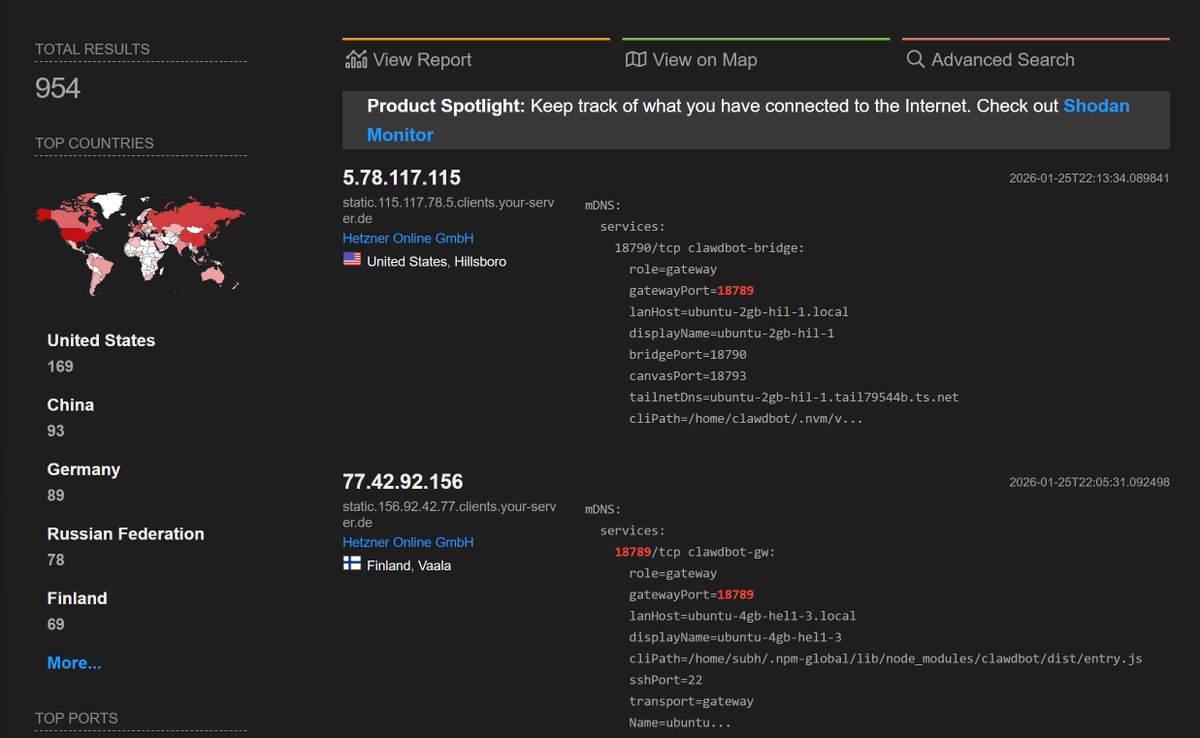
if this trend of hosting ClawdBot on VPS instances keeps up, along with people not reading the docs and opening ports with zero auth...
I'm scared we're gonna have a massive credentials breach soon and it can be huge
This is just a basic scan of instances hosting clawdbot with open gateway ports and a lot of them have 0 auth
I am committing INR 1 Cr to find Bangalore Choke-Points via Google Maps & AL.
11 km → 2.15 hours in Bangalore Traffic on Saturday late night!
I was stuck at one choke-point at ORR, where I spent 100 mins struggling to understand why there is no traffic-light or cop here!
But I don’t want one more “Bengaluru Traffic Memes or Rant”. I WANT TO FIX IT.
Very recently, in April 2025, Google Maps started sharing "Road Management Insight". It's a city-level data in Big Query format.
Using Google Data and Satellite Imagery, we can list down all the choke-points & their exact timings in a month. For the traffic department to work on those areas specifically.
I am willing to spend INR 1 Crore on this project by funding: 1-2 senior ML/AI engineers. And providing budget for using Google Maps API calls, Satellite Imagery & GPUs
I will start this project, when BTP/BBMP: Open their raw feeds or API access AND names a team, committed to acting on the insights we generate.
🙌 How can you help right now?
1. TAG anyone you know in the Bangalore Traffic Office, BBMP or the Traffic Commissioner’s office, let this hit the right inbox.
2. ML/AI folks: comment "IN", if you can work along part-time to end this menace
3. Every commuter who’s sick of bleeding time: comment or share. More noise -> faster response.
Bengalore is India’s tech future; and people making it happen deserve MUCH better.
#BangaloreTraffic #AIforGood #OpenData #CSR #peakbengaluru
IT'S OVER!
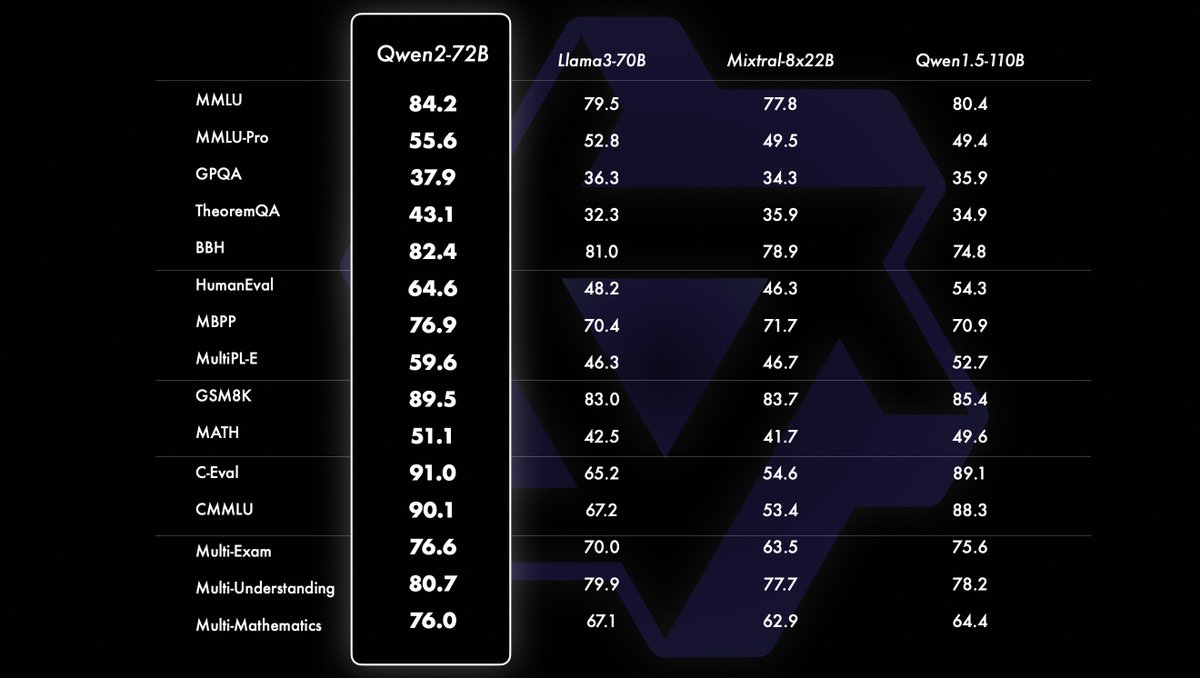
OSS has a new king in town - With an MMLU of 84.32, Qwen-2 is legitimately a GPT-4o /Turbo class model!!
Plus, we are JUST getting started. I am expecting several new OSS drops that could potentially beat GPT-4o in the coming months🤷
As a senior executive, you care a lot about your teams moving fast.
So when a team misses its committed launch date, you show great displeasure.
You demand more accountability.
You make an example out of this team.
Other teams see this.
They are not stupid.
So they learn.
And from now on, every single team hits their committed launch dates.
You are very happy.
I can see it.
But my friend, I am so sorry to tell you:
You are no longer moving as fast as you were before.
Plus, what you ship will no longer be as high quality as before.
And over time you start to see this too.
You are not stupid.
Even though everyone is hitting their launch dates, something has changed.
Things seem to be moving slower than before.
And you have no idea why.
So you call meetings.
You set up check-ins.
You set up processes.
But despite all your efforts, nothing changes.
That gnawing feeling that you are no longer moving fast persists.
That embarrassment of seeing your teams ship a shoddy experience is all too common now.
And you have no idea why.
The answer is right there.
You are no longer moving fast because of YOUR communication.
Instead of creating a culture where teams have intrinsic motivation to move fast — because they are energetic and they care — you started punishing the odd case where a team misses its aggressive target date.
And so, by doing that you sent a message to everyone: Don't be very ambitious, because the reward for ambition is punishment.
I know that isn't the message you wanted to send.
But by doing what you did, it is the only message you will send. 100 times out of 100.
What could you have done instead?
When that team missed its launch date, you could have sent a positive message instead of punishing the team's leaders.
You could have used this opportunity to build & maintain a culture of aggression and ambition.
You could have said:
"I understand why you missed the launch date.
I'd rather that you stay aggressive and sometimes miss the date than being conservative and always hitting the date.
I don't want you to stop being aggressive by default.
And we want more teams to be like you."
At this point, you are either seeing the value of this approach or you are trying to find reasons to reject it.
And your reasons are quite flimsy, such as: "But what about launches that have an external commitment?"
You are smart. You can figure that one out.
But okay, let me spell it out for you:
1. Most launch dates should not be committed externally. So don't commit dates for most launches.
2. A few launches need external commitments (to customers, or regulators, or partners...)
3. For the launches in # 2, sure, commit a conservative launch date that you are almost certain to hit.
4. But even for those, ask the team to devise an aggressive internal target date. It's okay if they slip this date. But it's important to have that aggressive internal target.
Why? Because remember Parkinson's Law:
Work expands to fill the time allotted for its completion.
Have you ever noticed how teams always struggle to hit their launch date, no matter how conservatively they've set them?
Yes, that's because of Parkinson's Law.
Look, I know it's easy to have dogma around "always hitting dates".
Dates are an easy, but incorrect proxy for your teams' velocity, ambition, and energy.
Though if you still want to maintain your fascination with hitting all dates, I am not sure I can (or even want to at this point) convince you otherwise.
But then I also guarantee that you will spend your entire career managing teams that move slower than they really can and/or ship lower quality products than they really can, and you will spend your entire career setting up check-ins, processes, spreadsheets, and carrots/sticks trying & failing to solve a problem that you created in the first place.
Best of luck to you!
Hi all,
We are up for it"s first meetup event of 2024 on 13 January (14:30 hrs IST).
Agenda:
Transformers 101 by @AnkushChander
Long document summarization using LLMs by Saurabh Pradhan
Registration link: https://t.co/hOptZwqM9O
Meetup link: https://t.co/dTxfQz1zhy
#nlp
“Hallucinations” was the most significant addition to the mainstream vocabulary this year!
What used to be a reference to a good acid trip has become a salient attribute of AI models!
In the long run, this property of LLMs will turn out to be more useful than not!
Dreams, ours’ or the LLM’s, are generally a good thing!
AGI is near. I can see for sure in our lifetime we will be able to witness maid (house help) discussions evolve how to robot maid discussions. Exciting times ahead!
Full text of new Economist article:
"Why bitcoin is up by almost 150% this year"
Chopping off their heads does not work: cockroaches can live without one for as long as a week. Whacking them is no guarantee either: their flexible exoskeletons can bend to accommodate as much as 900 times their body weight. Nor is flushing them down the toilet a solution: some breeds can hold their breath for more than half an hour. To most, roaches are an unwelcome pest. Their presence is made all the worse because they are indestructible.
An unwelcome pest is how many financiers and regulators would describe the crypto industry. Criminals use cryptocurrencies to launder money. Terrorists use them to make payments. Hackers demand ransoms in bitcoin. Many crypto coins are created simply so their makers can make off with the money.
The industry also appears to be indestructible. Crypto prices were crushed by higher interest rates in 2022. The industry’s head has been chopped off: Changpeng Zhao and Sam Bankman-Fried, the founders of the world’s biggest and second-biggest crypto exchanges, now both await sentencing for financial crimes (breaking anti-money-laundering laws and fraud, respectively). Regulators are cracking down. Yet not only has crypto survived, it is once again soaring: bitcoin climbed to a two-year high of almost $45,000 on December 11th, up from just $16,600 at the start of the year.
What is going on? For one thing, indestructibility is built into the technology. Bitcoin, ether and other coins are not companies—they cannot go bankrupt and be shut down. They employ blockchains, which maintain a database of transactions. Their lists are verified by a decentralised network of computers that are incentivised to keep maintaining them by the promise of new tokens. Only if the tokens fall to zero does the whole architecture collapse. And there continue to be lots of reasons to believe some crypto tokens are worth more than nothing.
The first is that holding crypto is a bet on a future in which use of the technology is widespread. People in despotic countries already use bitcoin and stablecoins (tokens pegged to a hard currency, like the dollar) to store savings and sometimes to make payments. These could be used more widely. Artists and museums are still creating or collecting non-fungible tokens (nfts). As are those looking to flog an image. Donald Trump is selling his mugshot for $99 a piece. He plans to have the suit he was booked in cut into pieces, made into cards and given to punters who buy at least 47 nfts in a single transaction.
During the boom times, the crypto industry raised a lot of money and hired plenty of smart developers. Those that remain are working on new uses, like social-media applications or play-to-earn games. Perhaps these will never be widely adopted. But even the small chance that they work out is worth something.
The second reason is that, with each boom-and-bust cycle, it becomes clearer crypto is not a bubble like tulip mania in the 1630s or the craze for Beanie Babies in the 1990s. Although bitcoin is a volatile asset, its price history looks more like a mountain range than a single peak, and appears closely correlated with tech stocks. Yet it is only moderately correlated with the broader market. An asset that swings up and down, and not in parallel with other things people might have in a portfolio, can be a useful diversifier.
That bitcoin has established itself as a serious asset seems to be the source of the latest surge. In August an American court ruled that the Securities and Exchange Commission, America’s main markets regulator, had been “arbitrary and capricious” when rejecting an effort by Grayscale, an investment firm, to convert a $17bn trust invested entirely in bitcoin into an exchange-traded fund (etf). Doing so would make investing in bitcoin easier for the average punter.
In October the court upheld its ruling—in effect ordering the sec to give way. The biggest fund managers, including BlackRock and Fidelity, have also applied to launch etfs. Given the returns bitcoin has offered in the past, and its correlations with other assets, the result could be a rush of cash into bitcoin, as even sensible investors consider putting small slices of their pension pots or portfolios into crypto for diversification.
Many feel instinctive revulsion when they spy a roach. But in spite of their flaws, the bugs have uses—they turn decaying matter into nutrients and eat other pests, such as mosquitoes. Crypto has its uses, too, such as portfolio diversification and keeping money safe under despotic regimes. And, as has been shown, it is just about impossible to kill.